

Quick Brief
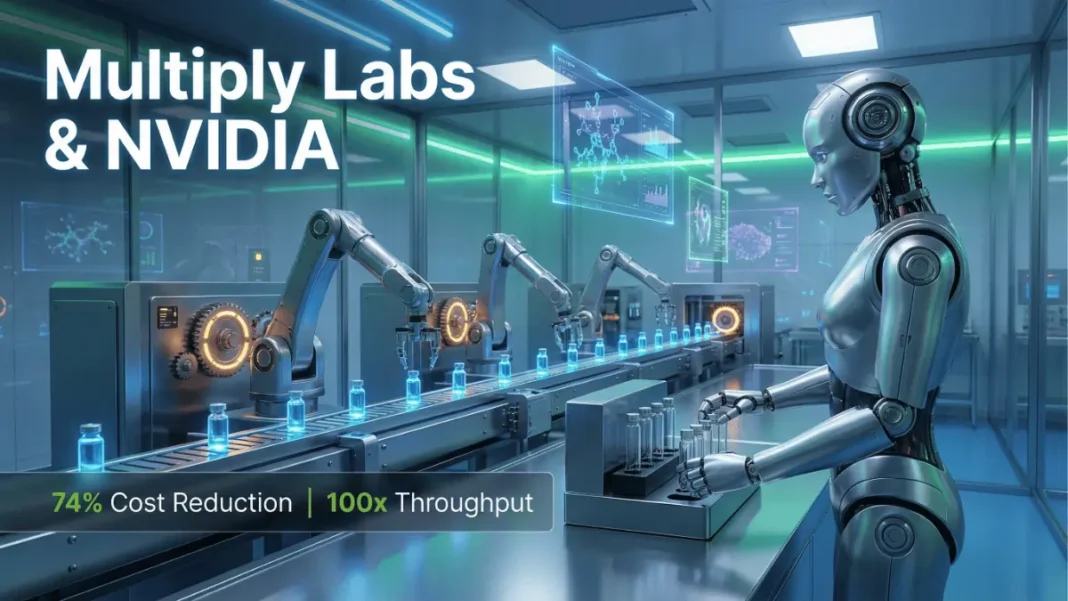
- The Deployment: San Francisco’s Multiply Labs integrates NVIDIA Omniverse digital twins and Isaac Sim to automate cell therapy production for Kyverna Therapeutics and Legend Biotech
- The Impact: Manufacturing costs drop from $100,000 to $25,000-$35,000 per dose (74% reduction); throughput increases 100x per square foot
- The Tech: Imitation learning via Isaac Sim trains robots on scientist video demonstrations; Isaac GR00T N1.5 humanoids handle contamination-prone loading tasks
- The Context: $41M-funded startup addresses $100K+ production costs limiting patient access to life-saving therapies
Multiply Labs announced it has deployed NVIDIA’s Isaac Sim robotics simulation and Omniverse digital twin libraries to automate cell therapy manufacturing, achieving a 74% cost reduction and 100-fold throughput gains. The YCombinator-backed startup, founded in 2016 by MIT robotics PhD Fred Parietti, now provides end-to-end robotic systems to biopharmaceutical leaders including Kyverna Therapeutics and Legend Biotech.
What’s New in Robotic Biomanufacturing
Multiply Labs operates cloud-controlled robotic clusters that replicate expert laboratory workflows through imitation learning. The system leverages NVIDIA FoundationPose for pose estimation and FoundationStereo for stereo matching to extract precise trajectories from video demonstrations of top scientists. These trajectories train robots in Isaac Sim to execute thousands of sterile, precision steps, liquid transfers, temperature control, bubble-free syringe handling with statistical equivalence to human experts.
The company simulates entire robotic arm processes using Omniverse digital twins, running thousands of virtual iterations to identify mechanical bugs before physical deployment. This workflow preserves institutional knowledge amid staff turnover, addressing a critical pharma vulnerability where implicit expert techniques can be lost when scientists leave.
Multiply Labs is developing humanoid robots using NVIDIA Isaac GR00T N1.5, an open foundation model for generalized humanoid reasoning released in May 2025. These humanoids handle the “wild west” outside sterile clusters loading cartridges, moving materials, and preventing contamination from manual handling errors. Parietti states the GR00T model provides humanoids “the muscle memory of a thousand lifetimes,” enabling scalable training from messy human demonstrations.
Why It Matters: Economic Barriers to Life-Saving Treatments
Cell and gene therapies modify patient or donor cells to treat cancers, genetic disorders, autoimmune diseases, and neurological conditions, but manufacturing complexity has restricted access. A single dose currently costs upward of $100,000 to produce. Kyverna Therapeutics, a Multiply Labs client, reports 60% of lupus nephritis patients fail to respond to standard treatments, positioning CD19 CAR T-cell therapy as a potential immune system reset requiring just one application.
Multiply Labs’ automation brings per-dose costs down to $25,000-$35,000, targeting what Parietti calls “the shift from niche to scale 100 times more therapies at 70% less cost so life-saving treatments aren’t just for the few, but for the millions“. The startup has raised $41.3 million over seven funding rounds from 24 institutional investors, including Y Combinator, Lux Capital, and Casdin Capital.
Technical Architecture vs. Manual Processes
| Parameter | Manual Manufacturing | Multiply Labs Automation |
|---|---|---|
| Cost per dose | $100,000+ | $25,000-$35,000 |
| Throughput density | Baseline | 100x per sq ft |
| Contamination risk | High (human breathing, handling) | Minimized (robotic sterility) |
| Knowledge retention | Lost with staff turnover | Preserved via imitation learning |
| Training method | Manual apprenticeship | Video-based Isaac Sim policies |
| Humanoid model | N/A | Isaac GR00T N1.5 |
| Footprint per system | Large cleanroom space | 15 sq ft per robot |
The NVIDIA Isaac GR00T N1.5 model demonstrates 93.3% language command following accuracy versus 46.6% in the prior N1 version, with improved novel object generalization for material handling and sorting tasks.
What’s Next for Pharma Automation
Multiply Labs positions its systems as replicating the semiconductor industry’s evolution from manual cleanroom technicians to fully automated chip fabrication. The company targets expansion alongside growing demand for individualized therapies, with each robotic system occupying just 15 square feet of manufacturing space. Imitation learning addresses tech transfer challenges the critical handoff from R&D labs to production environments by capturing undocumented scientist expertise that Parietti describes as “almost like an art”.
The deployment of humanoids powered by Isaac GR00T aims to create fully automated manufacturing floors where “humans watch from behind the glass, and humanoids keep the process flowing, clean and contamination-free,” according to Multiply Labs. NVIDIA continues expanding its Blackwell systems portfolio and Isaac GR00T-Dreams synthetic motion data generation blueprint to accelerate robotics research and deployment.
Frequently Asked Questions (FAQs)
How much does cell therapy manufacturing cost?
Manual cell therapy production costs exceed $100,000 per dose. Multiply Labs’ robotic automation reduces costs to $25,000-$35,000 per dose, a 74% reduction.
What is NVIDIA Isaac Omniverse used for in pharma?
Isaac Sim trains robots via video demonstrations. Omniverse creates digital twins to simulate robotic processes, resolving bugs before deployment.
How do robots reduce cell therapy contamination?
Robots eliminate human breathing, handling errors, and manual mistakes in sterile environments. Humanoids manage loading tasks prone to contamination.
What is NVIDIA Isaac GR00T N1.5?
An open foundation model for humanoid robot reasoning released in May 2025, achieving 93.3% language command accuracy for material handling tasks.
Which companies use Multiply Labs robotics?
Kyverna Therapeutics and Legend Biotech deploy Multiply Labs systems for automated cell and gene therapy manufacturing.

