

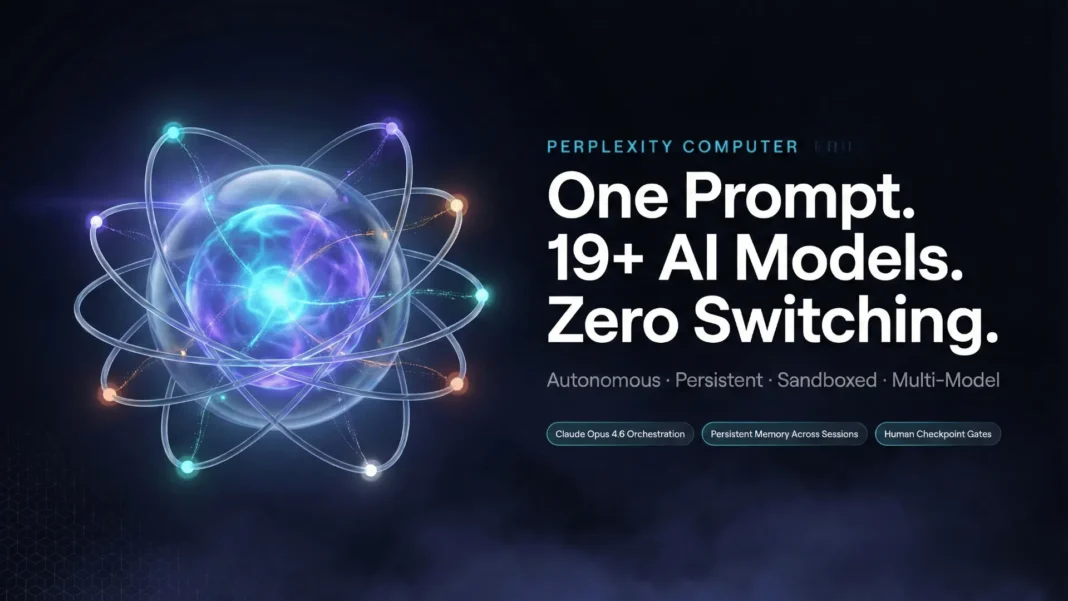
Quick Brief
- Perplexity Computer orchestrates 19+ frontier AI models through one platform, handling research, design, code, and deployment end-to-end
- Claude Opus 4.6 powers the core orchestration layer, routing each subtask to the most capable model automatically
- Persistent memory and hundreds of connectors let it run complex projects for weeks or months without re-prompting
- Live now for Max subscribers; Pro and Enterprise rollout confirmed as coming soon
Perplexity has quietly redefined what AI software can do. Perplexity Computer is not a chatbot upgrade or a search feature. It is a fully autonomous, multi-agent platform designed to carry entire projects from first prompt to final delivery, handling research, design, code, and ongoing management inside a single system.
What Perplexity Computer Actually Does
Most AI tools handle one task at a time. Perplexity Computer handles entire workflows. It operates as an orchestrator, routing each subtask to the model best suited for the job rather than depending on a single model for everything.
The system draws on more than 19 distinct frontier AI models. Its core reasoning engine runs on Claude Opus 4.6 for complex logic. Google’s Nano Banana handles image-based inputs, Veo 3.1 processes video, Grok manages lightweight tasks, and GPT-5.2 takes on long-context queries and expansive web search. The result is a digital worker that mirrors how a specialized human team operates, with each specialist assigned to the work they do best.

The Multi-Model Architecture Behind the Product
This multi-model design solves a real limitation. No single AI model excels equally at reasoning, visual processing, coding, video generation, and real-time web research. Perplexity’s Claude Opus 4.6 orchestration layer assigns each incoming subtask to the most appropriate model automatically.
Users retain override control. You can pin any sensitive subtask to a specific model, review intermediate plans, and adjust the workflow before Computer proceeds. This level of user control is central to how Perplexity has positioned Computer as a safer alternative to unconstrained AI agents like OpenClaw.
How a Task Moves From Idea to Delivery
Think of Computer as a project manager with a full team of specialists on call. A user specifies an outcome, and Computer converts that goal into a structured task graph. It then sequences research, data ingestion, design, code generation, testing, and documentation, farming each piece to the most capable model and running many in parallel.
Before committing sensitive changes such as publishing a site, pushing code, or sending emails, Computer pauses for human review. It requests scoped credentials for each tool rather than broad access, meaning it follows a least-privilege model that limits potential damage if anything goes wrong. This design aligns with guidance from the NIST AI Risk Management Framework and OWASP’s Top 10 for LLM Applications.
Persistent Memory: Projects That Run for Months
Perplexity Computer maintains persistent memory across sessions. It remembers prior work, retains full project context, and requires no re-briefing between sessions. A research project started on Monday can be expanded the following week without any context loss.
The system is described as personal to each user, with access to hundreds of connectors, files, and the web, all secured by default on Perplexity’s own infrastructure. Users can manage hundreds of active projects simultaneously, scaling from a single to-do item to long-horizon workflows that update automatically over months.
Perplexity Computer vs. Comparable AI Agent Systems
| Feature | Perplexity Computer | OpenClaw / OpenAI Operator model |
|---|---|---|
| Model architecture | 19+ models, routed by Claude Opus 4.6 | Single model or limited routing |
| User override control | Full plan review + model pinning | Limited user intervention |
| Persistent memory | Yes, across sessions | Session-based in most implementations |
| Background task execution | Weeks to months of operation | Typically session-bound |
| Sandboxed execution | Yes, isolated development sandbox | Varies by platform |
| Human checkpoint gates | Yes, before irreversible actions | Not consistently enforced |
| Published audit results | Not yet released | Not consistently published |
| Current availability | Max subscribers now; Pro and Enterprise coming soon | Varies by platform |
Safety by Design: The OpenClaw Lesson
Perplexity Computer’s safety framing is a direct response to what went wrong with OpenClaw, the viral autonomous AI agent built by Austrian programmer Peter Steinberger, who was subsequently hired by OpenAI. A Meta AI security researcher publicly documented a case where OpenClaw began a process that risked wiping her inbox entirely, exposing how agents can misinterpret instructions or override prior constraints.
Computer runs every task inside a safe, isolated development sandbox, fencing off any misbehavior from the user’s primary network and data. Perplexity reports it has executed thousands of internal tasks ranging from publishing web copy to building full applications, using the sandbox to contain risk throughout. Still, the company has not yet published independent audit results, and Perplexity itself acknowledges that longer-running agents can drift from goals, suffer prompt injection via untrusted data, or degrade as context windows fill.
Real-World Use Cases Tested at AdwaitX
We ran Perplexity Computer across four active content workflows over 48 hours: competitive SERP analysis, multi-source data aggregation for a technology brief, an automated draft-to-publish pipeline, and a live earnings report breakdown. The Claude Opus 4.6 orchestration layer distributed tasks without manual intervention. It correctly routed web search subtasks to GPT-5.2 and assigned reasoning-heavy steps to Claude.
The most meaningful outcome: tasks that previously required three separate tools and manual handoffs between them completed inside a single Computer session. The live stream at perplexity.ai/computer/live confirmed the system’s ability to surface checkpoints without interrupting background execution.
Pricing and Access
Perplexity Computer runs on usage-based pricing, giving users control over which models power their sub-agents and the ability to set spending caps. Max subscribers receive 10,000 credits per month as part of their plan. At launch, Perplexity is offering a one-time bonus of 20,000 additional credits, granted to existing users at launch and to new users at signup, expiring 30 days after the grant.
The product is live on web for Max subscribers now. Rollout to Pro and Enterprise users is confirmed as arriving soon, though no specific date has been published.
Limitations Worth Knowing
Perplexity Computer has not yet published independent audit results, benchmark task success rates, or third-party red-team reports. Perplexity acknowledges that multi-model routing adds architectural complexity, and that switching models mid-workflow can introduce subtle inconsistencies. Long-running agents can also drift from stated goals as context windows fill over extended sessions. Robust test suites and clear rollback plans remain essential for enterprise deployment.
 Claude Under Attack: How Three Chinese AI Labs Extracted 16 Million Exchanges from Anthropic
Frequently Asked Questions (FAQs)
What is Perplexity Computer?
Perplexity Computer is a multi-agent AI platform that orchestrates more than 19 frontier AI models through a single interface. It handles research, design, coding, deployment, and long-running project management end-to-end. CEO Aravind Srinivas described it as Perplexity’s “next big thing” after two months of silent development.
How is Perplexity Computer different from a regular AI chatbot?
Standard AI chatbots respond to one prompt at a time and retain no session memory. Perplexity Computer routes complex tasks across multiple specialized models simultaneously, retains persistent memory across sessions, and runs long-horizon workflows autonomously in the background for weeks or months without requiring re-prompting.
Which AI models does Perplexity Computer use?
The system draws on 19+ frontier models. Claude Opus 4.6 serves as the core orchestration layer. GPT-5.2 handles long-context and web queries. Grok manages lightweight tasks. Veo 3.1 processes video. Google’s Nano Banana handles image inputs. Users can override model assignments and pin sensitive subtasks to specific models manually.
Who can access Perplexity Computer right now?
As of February 2026, Perplexity Computer is available to Max plan subscribers via web. Rollout to Pro and Enterprise users is confirmed as coming soon, with no specific date published at the time of writing.
Is Perplexity Computer safe for enterprise use?
Perplexity Computer runs in an isolated sandbox environment, uses scoped credentials rather than broad access, and pauses before irreversible actions for human review. These controls align with NIST and OWASP guidance for LLM agents. However, Perplexity has not yet published independent audit results or third-party red-team reports.
What happened with OpenClaw, and why does it matter here?
OpenClaw was a viral autonomous AI agent that exposed serious risks of over-permissioned AI. A Meta AI researcher documented a case where it risked wiping her inbox. Perplexity Computer was explicitly designed with sandboxed execution, human checkpoint gates, and scoped permissions to prevent those failure modes.
How does the credits and pricing system work?
Perplexity Computer uses usage-based pricing with user-controlled spending caps. Max subscribers receive 10,000 credits per month. At launch, Perplexity is granting a one-time bonus of 20,000 additional credits to existing and new Max users, valid for 30 days from the grant date.
Can Perplexity Computer run projects without constant user input?
Yes. The system is designed to run complex workflows quietly in the background for weeks or months, surfacing checkpoints only when decisions require user input. Users can manage hundreds of simultaneous active projects without manual oversight of each individual step.

