

Quick Brief
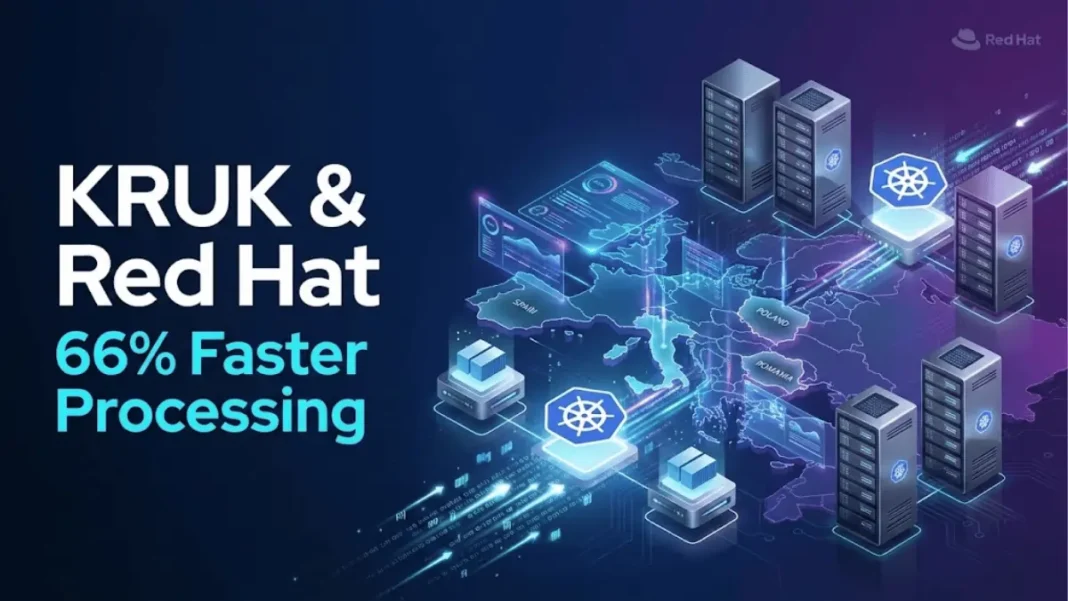
- The Deployment: Polish debt management firm KRUK deployed Red Hat OpenShift, Ansible Automation Platform, and Advanced Cluster Security to unify operations across Poland, Romania, Spain, and Italy cutting batch processing from 6 hours to 2 hours (66% reduction).
- The Impact: Over 20 development teams now deploy services in weeks instead of months, with IT maintenance reduced from days to hours.
- The Context: KRUK’s “New Horizon” program replaced a 20-year-old monolithic system to meet EU regulatory demands and prepare for AI/ML integration.
Red Hat announced that KRUK S.A., Poland’s leading debt management company with pan-European operations, achieved 66% faster batch processing and unified IT operations across four countries using Red Hat’s open hybrid cloud technologies. The modernization, completed through the “New Horizon” program in partnership with systems integrator ESKOM, addresses two decades of technical debt in a highly regulated financial sector.
The Multi-Cluster Architecture: From Monolith to Microservices
KRUK deployed Red Hat OpenShift as its cloud-native application platform, powered by Kubernetes, alongside Red Hat Ansible Automation Platform for infrastructure automation and Red Hat Advanced Cluster Security for software supply chain protection. The architecture standardizes operations across Poland, Romania, Spain, and Italy within a single ecosystem.
The company reduced batch processing time from six hours to two hours a 66% improvement while cutting document pre-processing from over 10 seconds to under 6 seconds per page. IT maintenance and configuration tasks that previously required days now complete in hours. Service deployment cycles compressed from months to weeks, enabling faster response to market and regulatory changes.

AdwaitX Analysis: Financial Services Embrace Cloud-Native Standardization
Operating in heavily regulated markets, KRUK faced mounting pressure to modernize legacy systems while maintaining strict data protection and compliance standards across multiple jurisdictions. The implementation demonstrates how financial institutions can leverage open-source hybrid cloud platforms to achieve operational consistency without sacrificing security or control.
Lubomir Stojek, Red Hat’s Country Manager for Poland, emphasized that “financial institutions face mounting pressure to modernize their systems while meeting strict security and regulatory standards,” noting that KRUK’s approach provides a blueprint for standardizing operations across markets while innovating at scale. The centralized policy management and supply chain security features address EU regulatory requirements for financial data handling.
Platform Engineering and Autonomous Development Teams
The transformation enabled KRUK to adopt DevOps practices and platform engineering principles, granting its 20+ development teams greater autonomy. The multi-cluster architecture with centralized management freed IT teams from repetitive maintenance tasks, allowing them to focus on innovation rather than firefighting legacy system issues.
Adam Łodygowski, KRUK’s Chief Data & Technology Officer, stated the new platform “gives our teams the autonomy to innovate faster” while enhancing security and accelerating delivery. The company fostered a cultural shift toward platform engineering, with development teams now able to deploy services independently within a governed framework.
Roadmap: Hybrid Cloud Expansion and AI Integration
KRUK is developing its hybrid platform to combine on-premises infrastructure reliability with public cloud flexibility, maintaining data control while preparing for geographic expansion. The company is investing in artificial intelligence and machine learning capabilities to deliver data-driven digital services for customers.
Red Hat solutions remain foundational for this evolution, enabling smooth platform expansion to other countries and business units within the KRUK Group. The standardized infrastructure positions KRUK to deploy AI workloads across its European operations with consistent governance and security controls.
| Metric | Before | After | Improvement |
|---|---|---|---|
| Batch Processing | 6 hours | 2 hours | 66% faster |
| Document Pre-Processing | >10 sec/page | <6 sec/page | 40%+ faster |
| IT Maintenance Tasks | Days | Hours | 90%+ faster |
| Service Deployment | Months | Weeks | 75%+ faster |
| Market Coverage | Fragmented | 4 unified markets | Standardized |

Frequently Asked Questions (FAQs)
How did KRUK achieve 66% faster processing with Red Hat?
KRUK deployed Red Hat OpenShift and Ansible Automation Platform to replace a monolithic system, reducing batch processing from 6 to 2 hours through containerization and automation.
What is Red Hat OpenShift used for in financial services?
OpenShift provides a Kubernetes-based platform for building cloud-native applications with centralized security, enabling financial firms to standardize operations across regions while maintaining compliance.
Which European markets does KRUK’s platform cover?
KRUK unified IT operations across Poland, Romania, Spain, and Italy using Red Hat’s hybrid cloud technologies within a single managed ecosystem.
What security features does Red Hat Advanced Cluster Security provide?
Red Hat Advanced Cluster Security strengthens software supply chain integrity and enables centralized policy management across Kubernetes clusters, critical for regulated financial environments.
How long does Red Hat OpenShift reduce deployment time?
KRUK reduced service deployment from months to weeks using OpenShift’s container platform and automated workflows.

