

Quick Brief
- The Launch: Alibaba Cloud open-sourced LoongSuite in September 2025, a data collection development kit delivering 10x higher throughput with 80% reduced resource consumption compared to traditional observability tools
- The Impact: Addresses critical monitoring gaps in AI Agent applications, where autonomous systems generate exponentially more data across distributed architectures
- The Context: AI Agent applications create “Token black holes” and nonlinear workflows that traditional monitoring tools cannot adequately track
- The Technology: Built on eBPF with over a decade of production-scale refinement from Alibaba’s infrastructure, starting in 2013
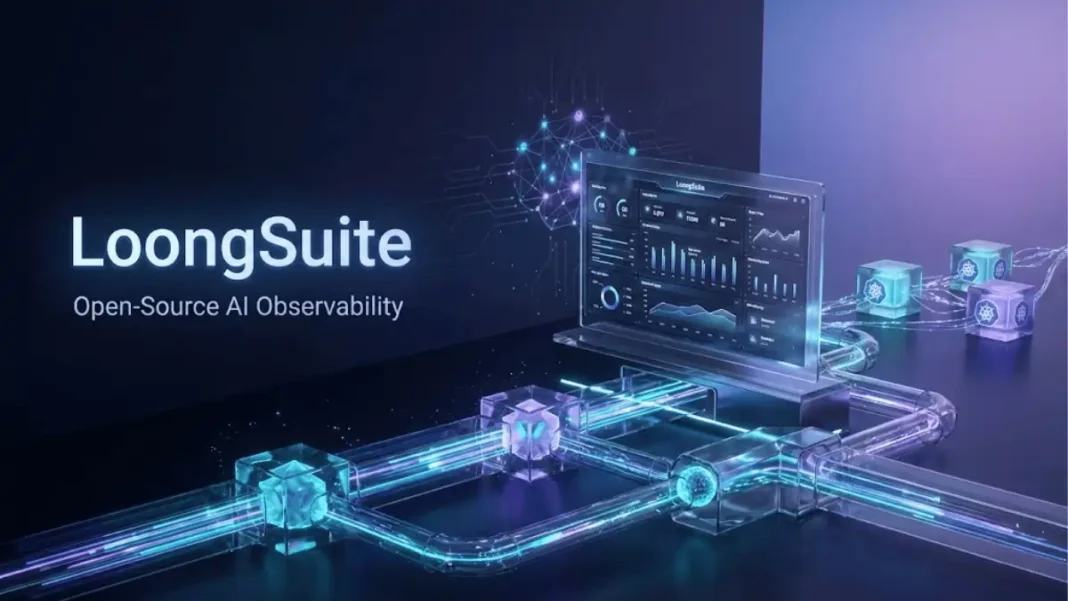
Alibaba Cloud formally released LoongSuite as an open-source project in September 2025, deploying a comprehensive observability data collection framework specifically engineered for AI Agent applications. The kit addresses the escalating complexity of autonomous AI systems, where multi-modal inputs and nonlinear workflows create unprecedented monitoring challenges. LoongSuite consists of three integrated components: LoongCollector host probes, multi-language process-level agents, and unified data collection engines.
Architecture: Three-Layer Observability Stack
LoongSuite implements a modular architecture addressing both host-level and application-level data capture. LoongCollector serves as the core engine, leveraging eBPF (Extended Berkeley Packet Filter) technology to collect logs, Prometheus metrics, and network security data without modifying application code. The system’s process-level agents support Java, Go, and Python environments, automatically capturing function call chains and resource consumption patterns.
Performance benchmarks demonstrate LoongCollector achieves 10x higher throughput than comparable solutions while consuming 80% fewer resources. This efficiency stems from time-slice scheduling, lock-free design, and high-low watermark feedback queues that prevent data loss during traffic spikes. The architecture supports both agent mode and cluster mode deployments, with automatic container context discovery and Kubernetes metadata association.
| Component | Function | Technology |
|---|---|---|
| LoongCollector | Host-level probe & data engine | eBPF, event-driven architecture |
| Multi-language Agents | Process-level instrumentation | Java, Go, Python support |
| Data Processing | Unified signal correlation | SPL query language, modular plugins |
| Deployment Modes | Flexible orchestration | Agent mode, cluster mode, K8s-native |

AdwaitX Analysis: The Agent Observability Problem
Traditional software monitoring operates within deterministic workflows with predictable data volumes. AI Agents fundamentally disrupt this model through autonomous decision-making across multiple interaction layers model inference, tool invocation, context retrieval, and state feedback. A single user request may trigger cascading operations where uncertainty at one node amplifies through subsequent steps, creating what Alibaba Cloud characterizes as “nonlinear workflows”.
Token consumption in Agent systems often grows exponentially, with some scenarios producing inference loops that form “Token black holes” continuous consumption cycles without observable outputs. Without link-level observability, engineering teams cannot isolate consumption sources or validate optimization efforts. LoongSuite addresses this through unified signal correlation, consolidating Logs, Metrics, Traces, Events, and Profiles into a single collection framework.
This All-in-One architecture enables engineers to reconstruct complete execution paths rather than analyzing fragmented data points. The system supports the emerging Agent governance paradigm, where continuous evaluation replaces phase-based assessments. Traditional observability tools were designed for application monitoring, not the multi-hop reasoning chains and dynamic tool selection that characterize Agent workflows.
Technical Specifications: eBPF Integration and OpenTelemetry Compatibility
eBPF technology enables LoongCollector to observe system-level operations without kernel modifications or application restarts. This kernel-space visibility captures encrypted communications over TLS/SSL, tracks database queries, and monitors network flows between services data types traditionally inaccessible to user-space instrumentation. The non-intrusive design proves critical for AI training environments requiring stability and continuity.
LoongSuite maintains compatibility with OpenTelemetry standards, allowing integration into existing observability ecosystems. The system’s SPL query language and multi-language plugin support enable structured data transformation at the collection layer, routing signals to different analysis platforms without architectural reconstruction. This modularity enables flexible downstream processing while maintaining standardized collection protocols.
Production deployment at Alibaba’s Model Studio platform has validated LoongSuite’s scalability. The system currently supports automatic tracking for OpenAI and DashScope model access SDKs, with community contributions expanding protocol coverage. The project originated in 2013 as Alibaba’s internal observability solution before its public release.
Roadmap: Open-Source Strategy and Ecosystem Development
Alibaba Cloud positions LoongSuite as infrastructure rather than proprietary tooling, explicitly stating the intent to become “a universal puzzle piece within the AI observability system”. The open-source release via GitHub enables validation across diverse production environments beyond Alibaba’s internal use cases. This strategy mirrors OpenTelemetry’s success in establishing cross-vendor semantic specifications and data models.
Near-term development priorities include expanding model SDK integrations and releasing optimizations accumulated from large-scale model platform operations. The project welcomes community plugin implementations to address the proliferation of signal types in Agent scenarios, function calls, tool usage, inference chains, and evaluation results. The platform’s architecture unified signal collection with flexible downstream routing supports expanding requirements without core redesign.
Alibaba Cloud has made the complete source code available on GitHub, including documentation for plugin development and deployment configurations. The company continues active development with regular commits and community engagement through the repository.

Frequently Asked Questions (FAQs)
What is Alibaba Cloud LoongSuite?
LoongSuite is an open-source observability data collection kit comprising host probes, process-level agents, and data engines designed for AI Agent applications.
How does LoongCollector compare to traditional monitoring tools?
LoongCollector delivers 10x higher throughput with 80% lower resource consumption through eBPF, time-slice scheduling, and lock-free design.
Why did Alibaba Cloud open source LoongSuite?
Open sourcing establishes industry-wide semantic standards for AI observability, prevents vendor lock-in, and enables community-driven optimization across diverse production environments.
What is eBPF in data collection?
eBPF allows kernel-space data collection without code modifications, capturing encrypted communications, network flows, and system calls that user-space tools cannot access.

