

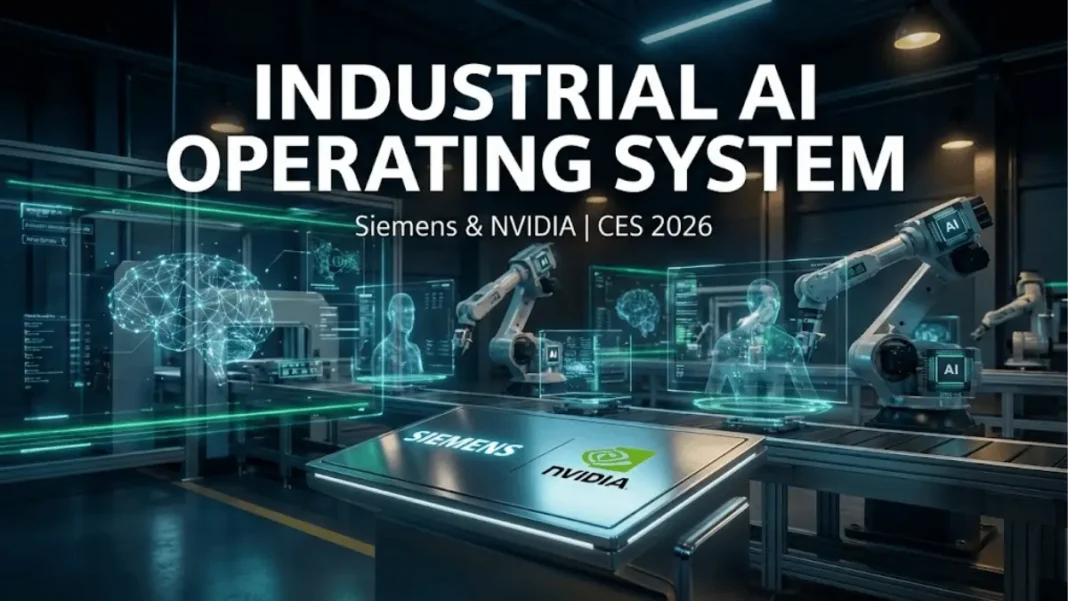
Siemens and NVIDIA announced at CES 2026 a major expansion of their partnership to build what they’re calling the Industrial AI Operating System, a unified platform that transforms digital twins from passive simulations into active intelligence systems for the physical world. The collaboration, unveiled today in Las Vegas, merges Siemens’ industrial software leadership with NVIDIA’s full-stack AI platform to enable end-to-end industrial automation across design, manufacturing, and operations.
What the Industrial AI Operating System Does
The Industrial AI Operating System represents a fundamental shift in how industries design, build, and operate physical systems. Rather than treating digital simulations and physical operations as separate domains, the platform creates a continuous loop where AI-powered digital twins actively control and optimize real-world industrial processes. Companies can now simulate complex systems in software, then seamlessly automate and operate them in physical factories, infrastructure projects, and manufacturing facilities.
The system combines the Siemens Xcelerator software portfolio with NVIDIA Omniverse libraries to enable real-time, physically accurate visualization and collaboration across engineering and manufacturing teams. This integration eliminates data format compatibility issues and allows engineers to focus on industrial tasks rather than technical infrastructure.
Key Technologies Powering the Platform
Siemens unveiled Digital Twin Composer as part of the announcement, a new software solution that builds industrial metaverse experiences by integrating 3D visualization, simulation, and factory data into a single environment. The technology creates holistic, highly realistic digital twins that unify multiple data streams and enable real-time decision-making.
NVIDIA’s accelerated computing platform powers the system’s AI execution capabilities, with Siemens Industrial PCs certified for NVIDIA GPUs delivering 25x acceleration in AI processing compared to traditional systems. These industrial-grade computers withstand heat, dust, vibration, and 24/7 operation demands while running complex AI tasks including robotics control, quality inspection, and predictive maintenance.
Advanced AI agents now work across the Siemens Industrial Copilot portfolio, executing entire AI-powered processes without human intervention. The Industrial Copilot for Operations, optimized to run on NVIDIA RTX PRO 6000 Blackwell Server Edition GPUs, delivers real-time AI assistance to shopfloor operators and saves 30% of reactive maintenance time.

Why This Matters for Industry
Manufacturing and infrastructure sectors face mounting pressure to boost efficiency, enhance quality, and adapt to rapid market changes. The Industrial AI Operating System addresses these challenges by providing manufacturers with comprehensive, AI-powered capabilities spanning every stage from product design to execution.
Real-world deployments demonstrate measurable impact. HD Hyundai uses the platform to visualize next-generation hydrogen and ammonia-powered vessels, managing millions of parts in real time while cutting design iteration time from days to hours. BMW Group and Siemens achieved a 30x speedup for transient aerodynamics simulations of entire vehicle geometries using Simcenter Star-CCM+ software accelerated by NVIDIA Blackwell GPUs, reducing both time and energy costs.
The partnership also pioneers operational technology cybersecurity by integrating NVIDIA BlueField DPUs to provide 360-degree visibility into industrial systems. This AI-driven security approach leverages accelerated computing to protect manufacturing infrastructure against evolving threats.
Building on Three Years of Collaboration
Siemens and NVIDIA first partnered in June 2022 to bring the industrial metaverse to life by connecting Siemens Xcelerator technologies to the NVIDIA Omniverse platform. The collaboration expanded in June 2025 to include generative AI, industrial AI, and robotics applications for next-generation factory automation.
“Together, we are building the Industrial AI operating system redefining how the physical world is designed, built and run to scale AI and accelerate the next wave of industrial innovation,” according to statements from both companies. The partnership combines Siemens’ industrial domain expertise with NVIDIA’s cutting-edge AI and accelerated computing to help organizations optimize performance, boost productivity, and meet sustainability goals.
Industry Applications and Adoption
The Industrial AI Operating System targets multiple sectors beyond manufacturing, including infrastructure development, mobility systems, and healthcare facilities. Companies of all sizes can now access industrial AI capabilities that were previously available only to large enterprises with specialized technical teams.
The Teamcenter Digital Reality Viewer, announced earlier in 2025, represents a significant advancement in product lifecycle management by bringing real-time ray-tracing capabilities directly into the Teamcenter platform. This allows companies to visualize and interact with photorealistic, physics-based digital twins of products for faster, more informed decisions.
Siemens’ full suite of Industrial PCs powered by NVIDIA technologies are now NVIDIA-Certified Systems, meaning they’re ready to deploy applications built with NVIDIA NIM microservices and edge AI frameworks including Isaac ROS, Holoscan, and Metropolis. The systems maintain a small footprint while meeting stringent industrial environment demands.
Evolution of Siemens-NVIDIA Partnership
| Timeline | Focus Area | Key Technology | Impact |
|---|---|---|---|
| June 2022 | Industrial Metaverse | Xcelerator + Omniverse | Digital twin visualization |
| June 2025 | Factory Automation | Industrial PCs + GPUs | 25x AI execution speed |
| Jan 2026 | Industrial AI OS | Digital Twin Composer | End-to-end automation |
What’s Next for Industrial AI
The partnership positions both companies to drive the next wave of innovation in industrial manufacturing and infrastructure. Siemens demonstrated the technology stack at NVIDIA GTC in Washington, D.C., and continues to showcase capabilities at CES 2026 through immersive booth experiences and hands-on demonstrations.
Future development will focus on expanding AI agent capabilities across more industrial processes and deepening the integration between Siemens Xcelerator and NVIDIA Omniverse technologies. The companies aim to make industrial AI accessible and impactful for customers across diverse industries while closing the gap between digital design and physical operation.
Additional collaborations include work with Accenture to bring the Industrial Metaverse blueprint to enterprise customers, creating an integrated software and hardware environment that delivers AI capabilities at scale. This multi-partner ecosystem approach enables performance and computing power required to drive comprehensive Industrial Metaverse experiences.
Featured Snippet Boxes
What is the Industrial AI Operating System from Siemens and NVIDIA?
The Industrial AI Operating System is a unified platform announced at CES 2026 that transforms digital twins from passive simulations into active AI systems controlling real-world industrial operations. It combines Siemens Xcelerator software with NVIDIA’s AI computing platform to enable seamless automation from design through manufacturing and operations.
How does Digital Twin Composer work?
Digital Twin Composer is Siemens’ new software solution that builds industrial metaverse experiences by integrating 3D visualization, simulation, and live factory data into a single environment. It creates holistic, photorealistic digital twins that enable real-time collaboration and decision-making across engineering and manufacturing teams.
What performance improvements does the partnership deliver?
Siemens Industrial PCs with NVIDIA GPUs provide 25x acceleration in AI execution for tasks like robotics, quality inspection, and predictive maintenance. BMW Group achieved 30x speedup for vehicle aerodynamics simulations, while Siemens Industrial Copilot saves 30% of reactive maintenance time.
When did Siemens and NVIDIA first partner together?
Siemens and NVIDIA announced their initial partnership in June 2022 to connect Siemens Xcelerator to NVIDIA Omniverse for the industrial metaverse. They expanded collaboration in June 2025 to include generative AI and robotics, and further expanded at CES 2026 to build the Industrial AI Operating System.

