

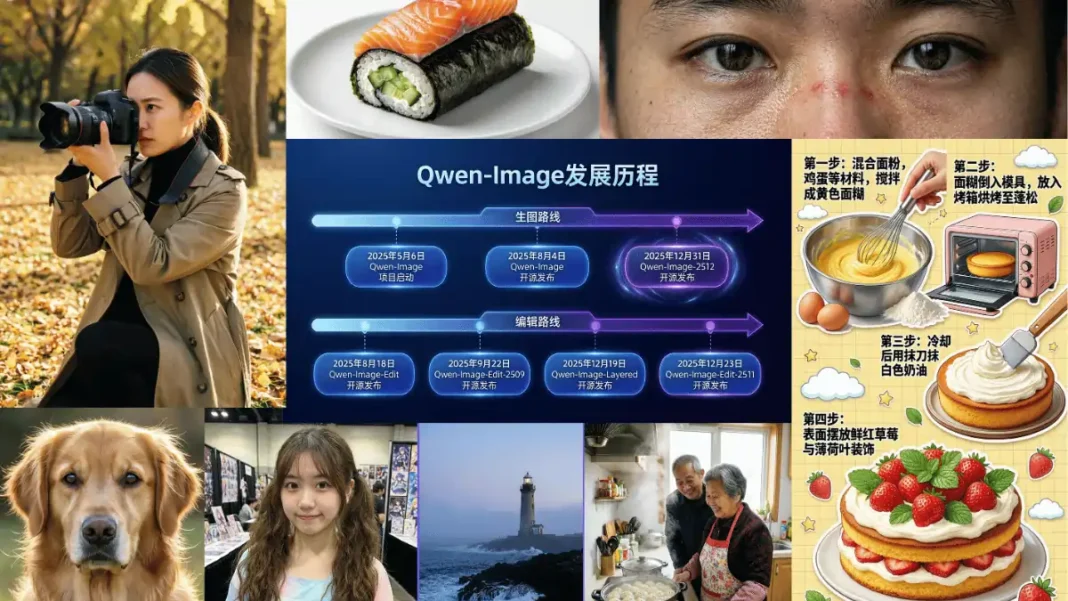
Alibaba’s Qwen team has released Qwen-Image-2512, an open-source text-to-image AI model that ranks as the strongest performer among free alternatives to proprietary systems like Google’s Imagen and OpenAI’s GPT-4o. The December 2024 update addresses long-standing weaknesses in AI-generated imagery particularly the “AI look” that undermines realism in faces, textures, and embedded text.
What’s New in Qwen-Image-2512
The model introduces three core improvements over its August 2024 predecessor. Human depictions now show significantly finer facial details, accurate age rendering, and better adherence to posture instructions in prompts. Natural textures from landscape water flows to animal fur display enhanced gradation and depth. Text rendering has been upgraded to handle complex multilingual layouts, including full presentation slides, infographics, and mixed text-image documents.
Alibaba conducted over 10,000 blind evaluations on its AI Arena platform, where Qwen-Image-2512 outperformed all open-source competitors and remained competitive with closed-source models. The model is built on a 20-billion-parameter multimodal diffusion transformer architecture and is licensed under Apache 2.0 for unrestricted commercial use.
Why It Matters for Developers and Enterprises
Qwen-Image-2512 offers deployment sovereignty unavailable with proprietary APIs. Enterprises can self-host the model, fine-tune it for industry-specific workflows, and avoid vendor lock-in while maintaining data governance. The model supports both English and Chinese prompts, making it viable for localized content generation in e-commerce, education, and visual documentation.
For developers, the complete model weights are available on Hugging Face and ModelScope, with hosted demos for zero-install testing. Alibaba Cloud also provides managed API access via Model Studio at $0.075 per image under the qwen-image-max endpoint.

How It Compares to Closed Alternatives
| Feature | Qwen-Image-2512 | Google Imagen 3 | FLUX 1.1 Pro |
|---|---|---|---|
| License | Apache 2.0 (open) | Proprietary | Open-source |
| Human realism | Enhanced, reduced AI look | Best-in-class | Strong |
| Text rendering | Complex multilingual | Standard | Limited |
| API cost | $0.075/image | $0.035/image | $0.025/image |
| Self-hosting | Yes | No | Yes |
The model excels in structured visual generation use cases like presentation decks, technical diagrams, and posters where text accuracy is critical. However, artistic stylization remains stronger in Midjourney, and photorealism peaks with Imagen 3.
What’s Next
Alibaba has not announced a roadmap beyond this release, but the December update follows a consistent quarterly improvement cycle. The Qwen team previously released Qwen-Image in August 2024 and complementary editing models (Qwen-Image-Edit-2511, Qwen-Image-Layered) in late 2024. Developers can access the model immediately via Qwen Chat or integrate it through GitHub repositories.
Open-source adoption will likely determine whether Qwen-Image-2512 gains traction in production environments, as enterprises weigh cost predictability against the polish of closed alternatives.
Featured Snippet Boxes
What is Qwen-Image-2512?
Qwen-Image-2512 is an open-source text-to-image AI model released by Alibaba Cloud in December 2024. It generates photorealistic images from text prompts and is licensed under Apache 2.0 for free commercial use.
How does Qwen-Image-2512 rank against other AI image generators?
In blind testing across 10,000+ evaluations, Qwen-Image-2512 ranked first among open-source models and remained competitive with closed-source systems like GPT-4o and Imagen 3. It leads in text rendering and multilingual support.
Is Qwen-Image-2512 free to use?
Yes, the model is fully open-source under Apache 2.0. You can self-host it at no cost or use Alibaba Cloud’s managed API at $0.075 per image. Free access is available via Qwen Chat.
What improvements does Qwen-Image-2512 offer over the August release?
The December update enhances human facial detail and age accuracy, improves natural texture rendering in landscapes and materials, and upgrades text rendering for complex layouts like infographics and slides.

