

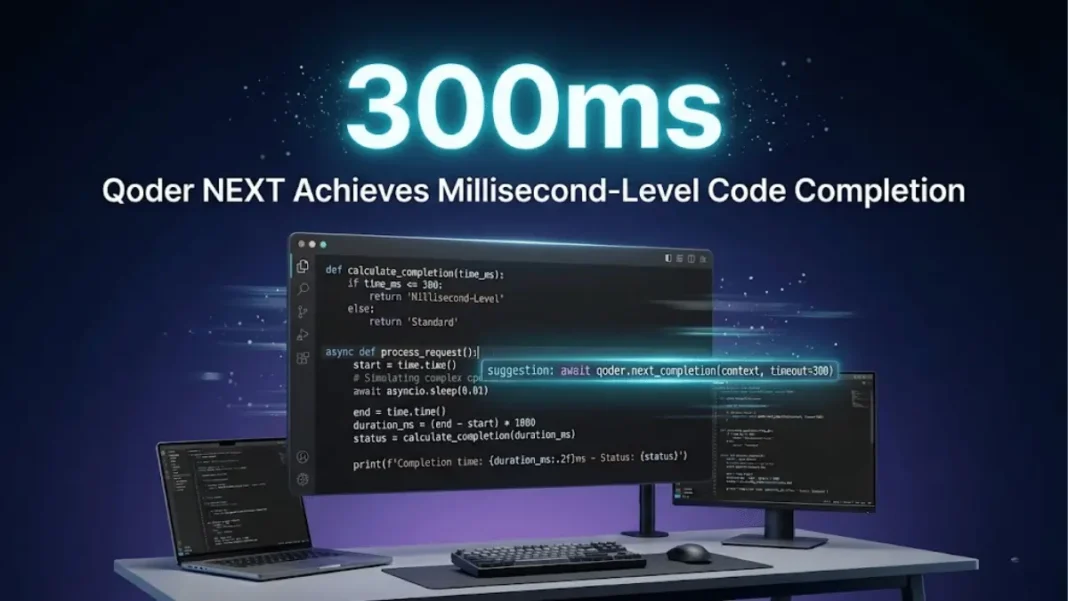
Alibaba Cloud has optimized its Qoder NEXT AI coding assistant to deliver code completions in 300 milliseconds, down from 800ms a 62% reduction in latency. The update, announced in January 2026, targets the critical 300ms threshold where developers experience “instant response” without breaking flow state. This positions Qoder NEXT among the fastest AI code completion tools as latency becomes a key differentiator in developer productivity software.
What’s New in Qoder NEXT
Alibaba Cloud’s Qoder team achieved the performance milestone by optimizing every stage of the completion pipeline. The system now delivers “First Action” completions semantically complete, adoptable code snippets within 300ms for 50% of requests (P50 latency). Previously, most users waited 800ms, with tail latencies exceeding 1.3 seconds.
The optimization effort targeted two major bottlenecks: model inference (50% of delay) and network transfer (25% of delay). Alibaba deployed FP8 quantization, speculative decoding, and custom-trained draft models to accelerate inference. Network latency dropped from 200ms to 50ms through proximity-based deployments and dedicated cloud lines.
Qoder NEXT is available as a free upgrade to version 0.2.28 for all users with zero credit requirements. The platform supports Windows, macOS, and Linux, integrating with popular IDEs.
Why 300ms Matters for Developers
Human-computer interaction research identifies 100ms as the boundary for “instant response,” while 400ms marks where productivity begins declining. Code completion uniquely demands low latency because developers trigger it dozens of times per minute, competing directly with manual typing speed.
Alibaba categorizes the experience into four levels: excellent (under 300ms), good (300-500ms), average (500-700ms), and poor (over 700ms). The 300ms target ensures suggestions appear before a developer’s next keystroke, since typical typing intervals range from 200-400ms. A 2023 study found developers expect token-level completions within 200 milliseconds for optimal efficiency.
The performance gains directly impact developer output. Industry data from 2025 shows AI coding tools helped increase median lines of code per developer from 4,450 to 7,839 across the year.

How Alibaba Optimized the Stack
Qoder NEXT’s speed improvements stem from five technical strategies implemented across the completion lifecycle.
Model Inference Acceleration
The team applied FP8 quantization to balance precision and performance, while fusing mainstream operators to reduce Time Per Output Token (TPOT). Speculative decoding uses a lightweight draft model to generate candidate sequences that the main model verifies in batches, increasing throughput without quality loss.
Context Collection Optimization
A three-tier cache system (L1 memory, L2 project, L3 semantic) achieves a combined 75% hit rate, avoiding costly file system reads. The system dynamically adjusts context depth based on real-time keystroke patterns, collecting lightweight data during fast typing and deep context during natural pauses.
Network Path Streamlining
Global proximity deployments reduced round-trip time by 150ms, while dedicated cloud lines bypass public internet congestion for an additional 30ms gain. HTTP/2 streaming pushes tokens as generated rather than waiting for complete responses.
Intelligent Result Caching
The system caches completion results for 30 seconds, recognizing that 23% of requests involve similar contexts during undo, deletion, or cursor movement operations. Cache hits return results in under 10ms versus the standard 300ms.
Adaptive User Profiling
Qoder NEXT learns individual typing habits, raising lightweight mode thresholds for fast typists and switching to deep context mode more frequently for think-while-typing users.
Performance Compared to Industry Tools
While Qoder NEXT’s 300ms P50 latency represents a significant achievement, direct comparisons to competitors like GitHub Copilot or Cursor are limited by proprietary benchmarks. A 2025 analysis of major AI coding models focused on Time To First Token (TTFT) for chat-based coding, showing ranges from 1.8s (Anthropic Sonnet 4.5) to 13.1s (Gemini 3 Pro) at P50. However, these metrics measure different workflows than inline completion.
Research suggests code completion performance targets have evolved rapidly. A 2021 discussion among developers suggested 16ms as the ideal threshold comparable to typing latency though 300ms was considered acceptable. Qoder NEXT’s roadmap includes a “Next Action Prediction” feature aiming for sub-100ms latency by computing results before users trigger suggestions.
| Feature | Qoder NEXT | Industry Standard |
|---|---|---|
| P50 First Action Latency | 300ms | 500-800ms |
| Token-level expectation | Under 300ms | Under 200ms preferred |
| Cache hit benefit | 23% requests < 10ms | Not disclosed |
| Free tier | Yes, zero credits | Varies by provider |
What’s Next for Qoder NEXT
Alibaba Cloud is exploring knowledge distillation to create lighter, specialized models that dynamically select based on task complexity. The team is also testing INT4 quantization for further hardware-level acceleration.
The upcoming “Next Action Prediction” (NAP) feature aims to achieve zero-wait experiences by analyzing editing trajectories and computing results in the background before users trigger completions. This could reduce First Action latency below 100ms.
The Qoder team continues optimizing for P99 latency the slowest 1% of requests to ensure consistent performance across all users. Current focus areas include improving KV Cache hit rates and refining prompt templates.

Featured Snippet Boxes
What is Qoder NEXT’s current code completion speed?
Qoder NEXT delivers code completions in 300 milliseconds for 50% of requests (P50 latency), down from 800ms before optimization. The system targets the critical 300ms threshold where developers experience instant response without breaking flow state during coding.
How does 300ms latency compare to other AI coding tools?
While proprietary benchmarks limit direct comparisons, Qoder NEXT’s 300ms P50 latency is competitive with industry standards where developers typically experience 500-800ms delays. Research shows developers prefer token-level completions within 200ms, though 300ms maintains flow state.
Is Qoder NEXT free to use?
Yes, Qoder NEXT is free for all users with zero credit requirements. The latest performance optimizations are available in version 0.2.28, supporting Windows, macOS, and Linux platforms.
What technical methods did Alibaba use to reduce latency?
Alibaba implemented five strategies: FP8 quantization and speculative decoding for model inference, three-tier caching for context collection, global proximity deployments for network optimization, HTTP/2 streaming for faster token delivery, and intelligent result caching that serves 23% of requests in under 10ms.

