

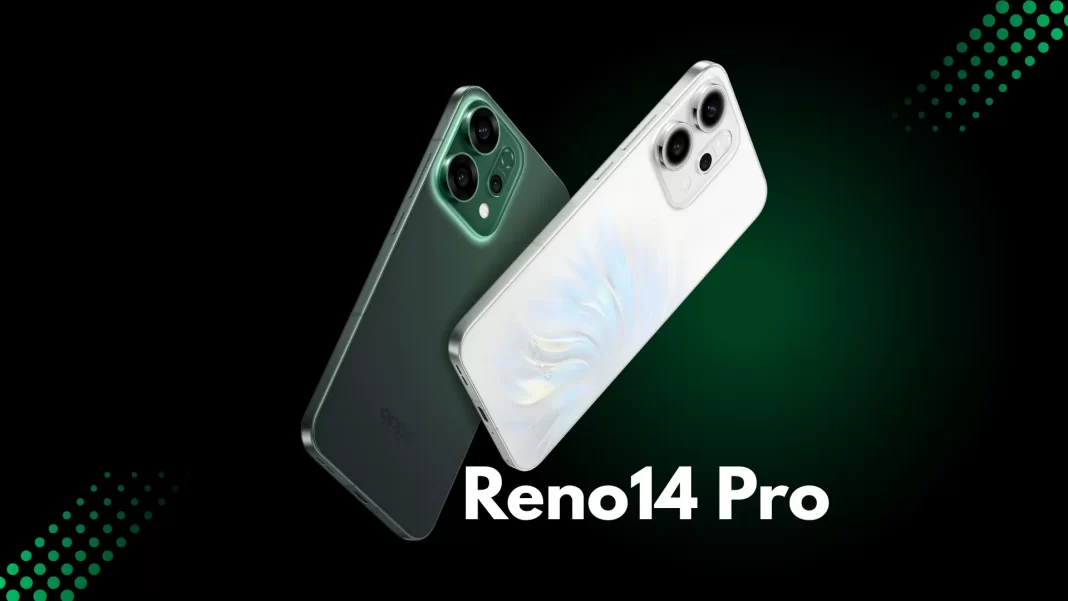
Oppo’s Reno line is known for camera-first features in a slim, stylish body. With the Reno14 Pro, Oppo didn’t just tweak last year’s formula—it added a tougher build (triple IP ratings), a bigger 6,200 mAh battery, and wireless charging, while keeping the price squarely under ₹55k. If you shoot a lot of portraits or travel reels and want something lighter than an Ultra-class flagship but stronger than mid-rangers, this targets you.
Table of Contents
Oppo Reno14 Pro in India starts at ₹49,999 (12GB/256GB) and ₹54,999 (12GB/512GB). Sales began July 8, 2025 across Amazon, Flipkart, Oppo E-store, and retail. Highlights include triple IP66/IP68/IP69 durability, a 6,200 mAh battery with 80W wired and 50W wireless charging, and a 3.5x telephoto camera.
Price and variants
- 12GB + 256GB: ₹49,999
- 12GB + 512GB: ₹54,999
- Colors: Pearl White, Titanium Grey
- First sale: July 8, 2025 (Amazon, Flipkart, Oppo Online Store, mainline retail)

Key specification at a glance
- Chipset: MediaTek Dimensity 8450 (4 nm), ARM G720 MC7 GPU
- RAM/Storage: 12GB LPDDR5X; 256/512GB UFS 3.1
- Display: 6.83-inch AMOLED (1272×2800), up to 120 Hz, 600 nits typical, 1200 nits HBM
- Cameras: 50 MP main (OIS) + 50 MP ultrawide + 50 MP 3.5x telephoto (OIS); 50 MP AF selfie
- Video: 4K60 rear and 4K60 on the selfie
- Battery/Charging: 6,200 mAh; 80W wired; 50W AIRVOOC wireless; charger in box
- Build: Aluminum frame, Gorilla Glass 7i, IP66/IP68/IP69
- Software: ColorOS 15 (Android 15)
- Connectivity: Dual-SIM + eSIM, Wi-Fi 6 (160 MHz), BT 5.4 (LDAC/LHDC 5.0), NFC
- 5G bands (India model CPH2739): n1/n2/n3/n5/n7/n8/n12/n20/n26/n28/n38/n40/n41/n48/n66/n77/n78
- SAR (India): Head 1.164 W/kg, Body 1.140 W/kg
Design and build
Reno14 Pro sticks to a clean, flat aesthetic with a metal (aerospace-grade aluminum) frame and Corning Gorilla Glass 7i. The numbers: 201 g and ~7.48–7.58 mm depending on color. It’s grippy without feeling chunky, which matters if you shoot one-handed. The standout here is durability: IP66/IP68/IP69—that means dustproof, submersion-resistant, and protected against high-pressure, high-temperature water jets (the IP69 piece). As always, don’t charge it wet, and treat water resistance as a safety net, not a license to swim with it.
Reality check: Oppo’s India specs page doesn’t print the IP line as prominently, but the global page and India press release confirm IP66/IP68/IP69 for the series.
Display and audio
You get a 6.83-inch flexible AMOLED at 1272×2800 with 120 Hz refresh and 240 Hz touch sampling by default (peaking at 240 Hz). Brightness figures are 600 nits typical and 1200 nits HBM—bright enough for most Indian afternoons, though not a “3,000+ nits” panel you see on some flagships. Stereo speakers are onboard.
If you care about flicker/PWM: Oppo doesn’t list PWM numbers here. If you’re sensitive, test the phone in-store at your typical brightness before buying.
Performance and thermals
Dimensity 8450 (4 nm) powers the Reno14 Pro with a 7-core Mali-G720 GPU. It’s paired with LPDDR5X RAM and UFS 3.1 storage—fast enough for 4K editing and heavy app juggling. Oppo’s marketing claims improved thermals with a large vapor chamber and “Nano Dual-Drive Cooling,” which should help during long BGMI sessions. Expect reliable 60 fps gaming at high settings and consistent 4K60 recording without immediate throttling, though we’ll refrain from hard fps/°C numbers until broad third-party testing is in.
Cameras with notes
Rear: 50 MP main (OIS), 50 MP ultrawide, 50 MP 3.5x telephoto with OIS.
Front: 50 MP with autofocus.
Video is a strength here: 4K60 on both rear and front (rare at this price). You can also do 960 fps slo-mo at 720p for effects, and there’s an Underwater Mode for basic shots in wet scenarios. For creators: smooth lens-switching at 4K, Dual-view video, and AI Editor 2.0 tools to recompose or fix expressions in group shots. We’ll watch for how Oppo tunes skin tones and HDR this year; past Reno phones leaned toward bright, social-ready results.
If portraits are your thing, that 3.5x (≈80 mm) tele gives you flattering perspective and subject-background separation without walking closer-handy at events or touristy spots.
Battery and charging
Big battery, simple story. 6,200 mAh plus 80W SUPERVOOC wired and 50W AIRVOOC wireless. The charger is in the box, along with a case. Oppo quotes sub-50-minute full wired charges; the press note says ~47 minutes. Real-world wireless at 50W usually lands around an hour on Oppo’s pads; expect longer on standard Qi. Either way, the “charge at lunch, shoot till night” workflow is very doable.
Software and updates
Out of the box: ColorOS 15.0.x based on Android 15. Now, the update policy is where reports differ:
- Official Oppo India press release lists: 3 years of OS updates + 4 years of security updates for the Reno14 series.
- Some media outlets and community posts claimed 5 OS + 6 years; take that with caution unless Oppo updates its official stance. If long-term updates are your top priority, note this gap.
ColorOS 15 adds AI utilities (translation, summarisation, Circle to Search with Google), and Oppo’s Editor 2.0 bits tie neatly into the camera workflow.
Network and 5G bands
Dual nano-SIM + eSIM, Wi-Fi 6 with 160 MHz, 2×2 MIMO, Bluetooth 5.4 (SBC/AAC/aptX/aptX HD/LDAC/LHDC 5.0), NFC—solid stack. The India model’s 5G NR bands cover n1/n2/n3/n5/n7/n8/n12/n20/n26/n28/n38/n40/n41/n48/n66/n77/n78, so you’re fine on Airtel, Jio, and Vi 5G deployments and roaming. SAR sits at Head 1.164 W/kg, Body 1.140 W/kg (India method).
Voice over 5G (VoNR) isn’t explicitly listed; expect VoLTE and 5G data by default, with VoNR dependent on carrier rollouts.
Rivals and comparisons
OnePlus 13R (from ~₹42,999 street)
- Pros vs Reno14 Pro: Snapdragon 8 Gen 3 grunt, often cheaper; LTPO display on many units; OxygenOS preference for some; long battery life.
- Cons: No wireless charging, IP65 only (still fine for rain, not submersion), wired charging varies by region (official spec: 55W). If you want high-pressure IP ratings or front 4K60 video, Reno14 Pro feels more creator-friendly.
vivo V40 Pro (≈₹38k–₹49k depending on config)
- Pros: Often lower price than Reno14 Pro; 80W charging; capable cameras in good light.
- Cons: No wireless charging; software preference varies; check exact Indian variant specs. If you don’t need IP69 or front 4K60, V40 Pro gets you strong basics for less.
Samsung Galaxy S25 FE (₹? India, ~$649 global)
- Pros: IP68, wireless charging (15W), 7-year update promise on current FE/S lines; One UI familiarity.
- Cons: Exynos performance trails Snapdragon 8 Gen 3 class; wired 45W is decent but not Oppo-fast. Camera consistency and updates are the draw here.
Quick take:
- Creators / vloggers: Reno14 Pro (front 4K60, tele OIS, wireless charging).
- Gamers on a budget: OnePlus 13R for raw Snapdragon power, if you can live without wireless and submersion-grade IP.
- Update-length first: Galaxy S25 FE for long OS support and wireless; Reno14 Pro if you value the camera stack and higher IP.
Should you buy it?
If your priorities are telephoto portraits, front 4K60 video, wireless charging, and serious water ingress protection, the Reno14 Pro makes sense at ₹49,999–₹54,999. If you want the absolute longest software support or Snapdragon-first gaming optimization, check Samsung FE or OnePlus 13R. We’d recommend Reno14 Pro to travel shooters, festival-goers, and anyone who edits posts/videos on the go and wants that 3.5x reach plus quick top-ups.
Full Specification
| Category | Details |
|---|---|
| Model | Oppo Reno14 Pro 5G (CPH2739) |
| SoC | MediaTek Dimensity 8450 (4 nm); GPU ARM G720 MC7 |
| RAM/Storage | 12GB LPDDR5X; 256/512GB UFS 3.1 |
| Display | 6.83″ AMOLED, 1272×2800, 120 Hz, 240 Hz touch; 600 nits typical, 1200 nits HBM; Gorilla Glass 7i |
| Rear Cameras | 50 MP main (OIS), 50 MP ultrawide, 50 MP 3.5x tele (OIS) |
| Front Camera | 50 MP with AF, up to 4K60 |
| Video | Rear 4K60, front 4K60; slo-mo 960 fps (720p), 480 fps (1080p) |
| Battery | 6,200 mAh |
| Charging | 80W SUPERVOOC wired; 50W AIRVOOC wireless; charger included |
| Build | Aluminum frame; IP66/IP68/IP69 |
| Software | ColorOS 15.0.x (Android 15) |
| Connectivity | Dual nano-SIM + eSIM, Wi-Fi 6 (160 MHz, 2×2 MIMO), BT 5.4 (SBC/AAC/aptX/aptX HD/LDAC/LHDC 5.0), NFC, USB-C |
| 5G NR bands | n1/n2/n3/n5/n7/n8/n12/n20/n26/n28/n38/n40/n41/n48/n66/n77/n78 |
| SAR (India) | Head 1.164 W/kg, Body 1.140 W/kg |
| Dimensions/Weight | ~7.48–7.58 mm; 201 g |
Comparison Table
| Phone | Launch price (approx) | SoC | Battery | Wired / Wireless | IP rating | Notables |
|---|---|---|---|---|---|---|
| Oppo Reno14 Pro | ₹49,999 (12/256) | Dimensity 8450 | 6,200 mAh | 80W / 50W | IP66/IP68/IP69 | 3.5x tele OIS; front 4K60 |
| OnePlus 13R | ₹42,999 (typical street) | Snapdragon 8 Gen 3 | 6,000 mAh | 55W / No | IP65 | LTPO display on many units |
| vivo V40 Pro | ~₹38k–₹49k | Dimensity 9200+ | ~5,500 mAh (varies) | 80W / No | (Check variant) | Good daylight camera |
| Samsung Galaxy S25 FE | (~₹?) $649 global | Exynos 2400 (var.) | 4,900 mAh | 45W / 15W | IP68 | Long updates (FE line) |
Pros and Cons
Pros
- Tough IP66/IP68/IP69 rating uncommon in this segment.
- Front 4K60 video and 3.5x tele OIS—creator-friendly.
- 6,200 mAh battery + 80W wired / 50W wireless with charger in box.
- Extensive 5G bands, Wi-Fi 6 (160 MHz), BT 5.4 LHDC/LDAC.
Cons
- Brightness spec tops at 1200 nits HBM, not a peak-brightness champ.
- Update policy officially 3+4 (OS+security), which lags Samsung’s FE line; some outlets claimed higher, but Oppo’s page/press says 3+4.
- No LTPO mention; adaptive steps are 60/90/120 Hz—not 1–120 Hz.
Frequently Asked Questions
What is the price of Oppo Reno14 Pro in India?
₹49,999 for 12GB/256GB and ₹54,999 for 12GB/512GB. First sale began on July 8, 2025 via Amazon, Flipkart, Oppo E-store, and offline retail. Color options include Pearl White and Titanium Grey.
Does Oppo Reno14 Pro have OIS and 4K video?
Yes. The rear setup includes a 50 MP main with OIS and a 50 MP 3.5x telephoto with OIS. Video supports 4K at 60 fps on both rear and front cameras, plus slo-mo up to 960 fps at 720p.
How many 5G bands does Reno14 Pro support?
The India model (CPH2739) lists 17 NR bands: n1/n2/n3/n5/n7/n8/n12/n20/n26/n28/n38/n40/n41/n48/n66/n77/n78—covering Indian carriers and common roaming bands.
How long does the battery last and how fast does it charge?
With 6,200 mAh, day-and-a-half use is realistic for mixed data, social, and camera work. Oppo quotes ~47 minutes for a full wired charge at 80W and supports 50W wireless on compatible pads. Charger is included. Actual runtime varies by use.
How many Android updates will Reno14 Pro get?
Oppo India’s press release states 3 OS upgrades and 4 years of security updates for the Reno14 series. Some media reported higher numbers (5+6), but treat those as unconfirmed unless Oppo revises its policy.
Is a charger included in the box?
Yes. The box includes the phone, USB-C cable, charger, SIM tool, quick guide, and a protective case.
 Oppo Reno 14 5G: ₹37,999 in India with 120Hz AMOLED, 50MP 3.5x telephoto, 6,000mAh and 80W charging.
Buying checklist
If you want a creator-leaning phone under ₹55k with front 4K60, 3.5x tele OIS, wireless charging, and IP69 toughness, Reno14 Pro is easy to recommend. If you care more about Snapdragon gaming or long OS support, check the OnePlus 13R or Galaxy S25 FE.
Checklist before you buy
- Confirm you’re getting the 12/512 if you shoot 4K a lot.
- Wireless pad at home? Great-50W AIRVOOC is fastest with Oppo’s own pads.
- If updates matter, compare Oppo’s 3+4 vs Samsung FE’s longer policy.
- If you need LTPO or ultra-high peak brightness, consider alternatives.
Source: OPPO

