

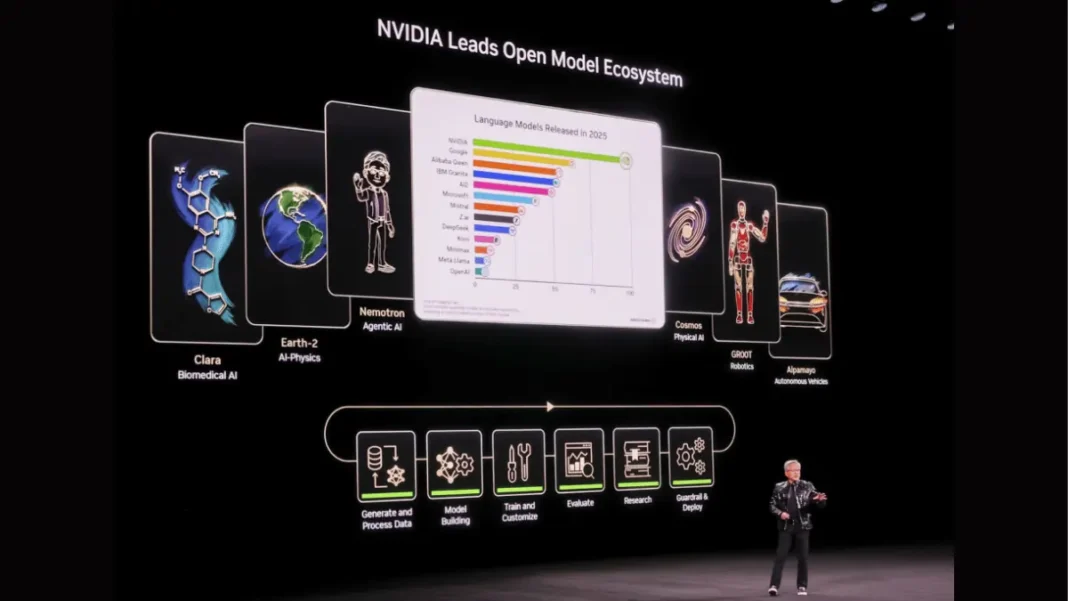
NVIDIA CEO Jensen Huang opened CES 2026 in Las Vegas by unveiling the Rubin Platform, the company’s first six-chip AI system now in full production, alongside Alpamayo, an open reasoning model for autonomous vehicles. Huang declared that $10 trillion of computing infrastructure is being modernized for AI, with Rubin promising to deliver AI tokens at one-tenth the cost of its predecessor. The announcements position NVIDIA as both a frontier AI model builder and infrastructure provider across healthcare, climate science, robotics, and autonomous driving.
NVIDIA Rubin Platform
The Rubin Platform succeeds the Blackwell architecture and marks NVIDIA’s shift to extreme codesign integrating six components built together from the ground up. The system includes Rubin GPUs with 50 petaflops of NVFP4 inference, Vera CPUs with 88 ARM cores engineered for data movement and agentic processing, NVLink 6 scale-up networking, Spectrum-X Ethernet Photonics, ConnectX-9 SuperNICs, and BlueField-4 DPUs.
Rubin GPUs feature 288 GB of HBM4 memory with 22 TB/s bandwidth, nearly triple that of Blackwell’s HBM3. A full NVL144 rack integrates 144 Rubin GPUs delivering up to 3.6 exaflops for inference, while the CPX variant reaches 8 exaflops using GDDR7-based accelerators. Huang emphasized the platform’s speed advantage: “The faster you train AI models, the faster you can get the next frontier out to the world”.
NVIDIA also introduced AI-native Inference Context Memory Storage, a KV-cache tier boosting long-context inference with 5x higher tokens per second, 5x better cost efficiency, and 5x improved power efficiency.
Alpamayo for Autonomous Driving
Alpamayo is an open portfolio of reasoning vision-language-action models enabling Level 4 autonomy. Unlike reactive systems, Alpamayo uses chain-of-thought reasoning to break down complex driving situations before determining the safest action. The centerpiece is Alpamayo R1, a 10-billion parameter model that explains its reasoning at each decision point.
The Alpamayo ecosystem includes AlpaSim, a fully open simulation blueprint for high-fidelity autonomous vehicle testing, and Physical AI Open Datasets with over 1,700 hours of driving data covering rare and complex real-world scenarios. Huang showcased a demo where an Alpamayo-powered vehicle smoothly navigated San Francisco traffic and detected a ball rolling into the road, recognizing a child might follow, demonstrating predictive reasoning capability.
Mercedes-Benz will deploy the first Alpamayo-powered vehicle in the all-new CLA, with AI-defined driving launching in the U.S. in Q1 2026. The CLA recently received EuroNCAP’s five-star safety rating, signaling readiness for production deployment.

Six Open Model Domains
NVIDIA positioned itself as a frontier AI builder releasing open models trained on its own supercomputers, available globally. The portfolio spans six domains:
- Clara – Healthcare AI models
- Earth-2 – Climate science and weather simulation
- Nemotron – Reasoning and multimodal AI
- Cosmos – Robotics and physical simulation, generating realistic videos from images and synthesizing multi-camera driving scenarios
- GR00T – Embodied intelligence for humanoid robots
- Alpamayo – Autonomous vehicle development
“These models are open to the world,” Huang stated, underlining NVIDIA’s strategy to enable every company, industry, and country to participate in AI development. Downloads of NVIDIA open models have “exploded” as new, smarter models emerge every six months.
Physical AI and Robotics
Huang demonstrated a personalized AI agent running locally on the DGX Spark desktop supercomputer, embodied through a Reachy Mini robot using Hugging Face models. “The amazing thing is that is utterly trivial now, but yet, just a couple of years ago, that would have been impossible,” he said.
DGX Spark now delivers up to 2.6x performance for large models with new support for Lightricks LTX-2 and FLUX image models, plus upcoming NVIDIA AI Enterprise availability. Leading enterprises including Palantir, ServiceNow, Snowflake, CodeRabbit, CrowdStrike, NetApp, and Semantec are integrating NVIDIA AI into their products.
NVIDIA expanded its partnership with Siemens, showing how the full stack integrates with Siemens’ industrial software to enable physical AI from design through production. “These manufacturing plants are going to be essentially giant robots,” Huang declared.
Rubin vs. Blackwell
Rubin represents a 3.3x to 5x performance increase over Blackwell primarily through TSMC’s 3nm process node and multi-chiplet design. While Blackwell uses 192 GB of HBM3 memory at 8 TB/s bandwidth, Rubin offers 288 GB of HBM4 with 22 TB/s 50% more capacity and nearly 2.8x the bandwidth.
The Vera CPU in Rubin delivers twice the performance of the Grace CPU used in Blackwell systems, with 88 custom ARM cores supporting 176 threads simultaneously. Power densities exceed 150 kW per rack, requiring mandatory liquid cooling deployment. A follow-on Rubin Ultra platform targeted for 2027 will double performance to 100 petaflops per GPU package with 1 TB of HBM4E memory.
Gaming and RTX Updates
NVIDIA announced DLSS 4.5 with Dynamic Multi Frame Generation, introducing a 6X Multi Frame Generation mode and second-generation transformer model for DLSS Super Resolution. Over 250 games and apps now support DLSS 4, with 2026 titles including 007 First Light, Phantom Blade Zero, PRAGMATA, and Resident Evil Requiem adding support at launch.
RTX Remix Logic debuted, expanding the modding platform to trigger dynamic graphics effects based on real-time game events. G-SYNC Pulsar monitors launched this week, delivering perceived 1,000Hz+ effective motion clarity and G-SYNC Ambient Adaptive Technology. NVIDIA is also bringing GeForce RTX gaming to new devices with GeForce NOW apps for Linux PC and Amazon Fire TV.

Featured Snippet Boxes
What is NVIDIA Rubin Platform?
Rubin is NVIDIA’s first extreme-codesigned, six-chip AI platform integrating Rubin GPUs, Vera CPUs, NVLink 6 networking, and storage components. It delivers AI tokens at one-tenth the cost of Blackwell using 288 GB HBM4 memory with 22 TB/s bandwidth and 50 petaflops of NVFP4 inference per GPU.
How does Alpamayo enable self-driving cars?
Alpamayo uses chain-of-thought reasoning to analyze sensor inputs, break down driving situations into steps, and predict hazards before acting. The 10-billion parameter R1 model explains its reasoning at each decision point, handling unexpected events like malfunctioning traffic lights or children near roads.
When will Mercedes-Benz CLA with Alpamayo launch?
The all-new Mercedes-Benz CLA featuring Alpamayo on NVIDIA DRIVE will roll out in the U.S. in Q1 2026, followed by Europe in Q2 and Asia in Q3-Q4. The vehicle received EuroNCAP’s five-star safety rating and represents the first passenger car with NVIDIA’s reasoning-based autonomous driving technology.
What are NVIDIA’s six open model domains?
NVIDIA released open models across Clara (healthcare), Earth-2 (climate), Nemotron (reasoning AI), Cosmos (robotics simulation), GR00T (embodied intelligence), and Alpamayo (autonomous driving). All models are trained on NVIDIA supercomputers and available globally for developers to customize and deploy.

