

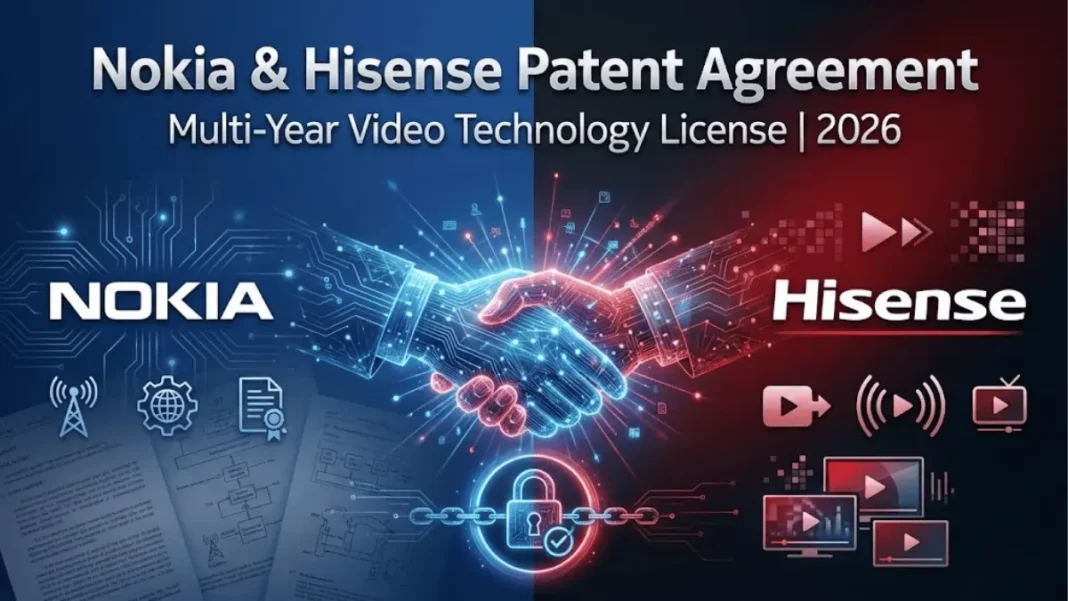
Nokia and Hisense have ended their worldwide patent dispute by signing a multi-year licensing agreement covering video technologies used in Hisense televisions. Announced on January 7, 2026, the deal requires Hisense to pay royalties to Nokia and resolves all patent-related litigation between the companies across all jurisdictions. This marks the first patent license agreement between the Finnish technology leader and the Chinese consumer electronics manufacturer.
What’s in the Agreement
The license grants Hisense access to Nokia’s video technology patents for use in its television products. Nokia will receive ongoing royalty payments from Hisense, though both parties agreed to keep the financial terms confidential. The agreement immediately terminates pending lawsuits in multiple jurisdictions, including cases at the Regional Court Munich and the Unified Patent Court’s Munich local division.
Nokia withdrew its German lawsuits against Hisense (case IDs: 7 O 4104/25 and 7 O 4105/25) shortly after the announcement, according to the Regional Court Munich. Documents filed on January 5 at the UPC suggest the withdrawal process had already begun before the public announcement.
The deal covers Nokia’s extensive portfolio of video and multimedia patents, including technologies related to video compression, content delivery, content recommendation, and hardware aspects. Nokia has developed over 5,000 inventions enabling multimedia products and services over the past 25 years.
Why the Settlement Matters
This agreement adds Hisense to Nokia’s growing list of consumer electronics licensees and demonstrates the ongoing value of Nokia’s video technology portfolio. Nokia’s president of technology standards, Patrik Hammarén, highlighted in November 2025 that the company primarily licenses video and WiFi technologies for tablets, laptops, and connected TVs.
The settlement comes after a UK High Court ruling in December 2025 that granted Acer, Asus, and Hisense an interim license at $0.365 per device. This rate fell between the $0.03 per unit proposed by the implementers and Nokia’s requested $0.69 per device. The final negotiated terms between Nokia and Hisense likely reflect this judicial guidance, though the exact royalty structure remains undisclosed.
For Hisense, the agreement removes legal uncertainty and allows the TV manufacturer to continue selling products globally without infringement concerns. For Nokia, it expands revenue from its patent licensing business, which includes similar deals with Samsung, HP, Amazon, Casio, and GoPro.
Nokia’s Video Patent Portfolio
Nokia’s multimedia technology leadership stems from continuous research and standardization work spanning 25 years. The company’s inventions cover fundamental aspects of video technology that enable modern consumer electronics:
- Video compression algorithms used in industry standards
- Content delivery systems for streaming media
- Content recommendation technologies
- Hardware-related innovations for multimedia devices
These patents are essential for manufacturers producing smart TVs, streaming devices, and other video-capable products. Nokia licenses these technologies separately from its 5G and telecommunications patent portfolio, creating distinct revenue streams.
The company maintains market-leading coverage in consumer electronics patent licensing, according to its Capital Markets Day presentation in November 2025. This business model allows Nokia to monetize decades of research investment even after exiting the consumer device market.
Litigation Background and Resolution
The patent dispute between Nokia and Hisense involved parallel proceedings across multiple jurisdictions. Nokia had filed infringement cases in Germany and at the European Unified Patent Court targeting Hisense’s television products. Simultaneously, Hisense joined Acer and Asus in asking the UK High Court to determine fair and reasonable licensing terms for Nokia’s video streaming portfolio.
The UK court’s December 2025 decision to grant an interim license at $0.365 per device created a framework for settlement. Judge James Mellor ruled that a reasonable licensor like Nokia would consent to temporary licensing terms while litigation proceeded. This approach, increasingly common in English courts, provides implementers with legal certainty while disputes are resolved.
Hisense’s decision to settle rather than continue litigation suggests the company preferred negotiated terms over prolonged court battles. The global resolution across all jurisdictions eliminates the complexity of managing separate lawsuits in different countries.
What’s Next for Patent Licensing
Nokia continues expanding its consumer electronics licensing program as more manufacturers recognize the need to license video technology patents. The company’s Capital Markets Day presentation emphasized consumer electronics as an “important pillar” for expansion areas alongside telecommunications.
Similar patent holders, including Ericsson and Qualcomm, maintain active licensing programs for multimedia and connectivity technologies. The Nokia-Hisense settlement may influence ongoing negotiations between other patent holders and TV manufacturers as it establishes a recent precedent for video technology licensing.
For implementers, the deal demonstrates that UK court interim license mechanisms can facilitate settlements by providing concrete rate guidance. This may encourage more companies to pursue parallel litigation and negotiation strategies when facing patent licensing demands.
Nokia has not announced additional enforcement actions against other TV manufacturers, but its comprehensive portfolio and recent licensing momentum suggest continued expansion of its consumer electronics program. The confidential terms prevent competitors from knowing the exact financial commitment Hisense made, though the UK court’s $0.365 interim rate provides market observers with a rough benchmark.
Featured Snippet Boxes
What patents does Nokia own for TVs?
Nokia owns over 5,000 multimedia and video technology patents covering video compression, content delivery, content recommendation systems, and hardware-related innovations developed over 25 years. These patents are essential for modern smart TV functionality and streaming capabilities.
How much will Hisense pay Nokia?
The financial terms remain confidential, but a UK court ruling in December 2025 set an interim rate of $0.365 per device before the settlement. The actual negotiated royalty between Nokia and Hisense was not disclosed per their agreement.
Why did Nokia sue Hisense?
Nokia filed patent infringement lawsuits because Hisense used Nokia’s video technologies in its televisions without a licensing agreement. This is Nokia’s first patent license with Hisense, indicating no prior licensing relationship existed.
Does this affect other TV manufacturers?
The Nokia-Hisense agreement is specific to Hisense products and does not directly impact other manufacturers. However, Nokia has separate licensing agreements with Samsung, and continues licensing its video technology portfolio to consumer electronics makers globally.

