

Quick Brief
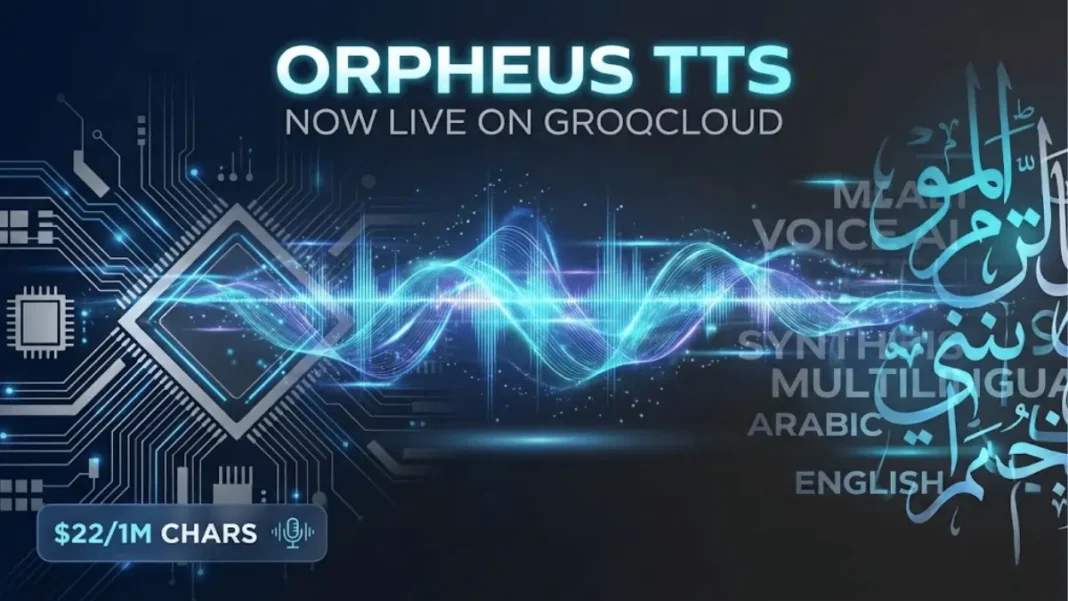
- The Launch: Groq activates Canopy Labs’ Orpheus text-to-speech models on GroqCloud with English ($22/1M characters) and Saudi Arabic ($40/1M characters) variants on January 13, 2026
- The Performance: Both models deliver 100 characters/second with 10 voice personas (6 English, 4 Saudi Arabic) via OpenAI-compatible API endpoints
- The Context: Replaces PlayAI-TTS infrastructure as global TTS market expands from $4.0B (2024) to projected $7.6B by 2029 at 13.7% CAGR
Groq announced on January 13, 2026, the deployment of Canopy Labs’ Orpheus text-to-speech models on GroqCloud infrastructure, introducing two specialized variants for real-time voice synthesis. The launch positions Groq’s inference platform against established TTS providers while the global text-to-speech market expands from $4.0 billion in 2024 toward projected $7.6 billion by 2029.
Orpheus Architecture and Training Foundation
Orpheus V1 English operates on a Llama 3B backbone trained across 100,000+ hours of English speech data and billions of text tokens. The model architecture enables bracket-based vocal direction control, allowing developers to inject tags such as [cheerful] or [whisper] directly into text prompts for emotional modulation.
The Saudi Arabic variant delivers authentic dialect synthesis with regional pronunciation accuracy, though vocal direction functionality remains unsupported in the initial release. Both models achieve streaming latency of approximately 200 milliseconds, reducible to 100ms with input streaming optimization.
Pricing Structure Against Market Benchmarks
| Provider | Model | Price per 1M Characters | Voice Options | Key Feature |
|---|---|---|---|---|
| Groq | Orpheus English | $22.00 | 6 voices | Vocal directions |
| Groq | Orpheus Arabic Saudi | $40.00 | 4 voices | Dialect authenticity |
| OpenAI | TTS Standard | $15.00 | Multiple | API simplicity |
| OpenAI | TTS HD | $30.00 | Multiple | Audio quality |
| ElevenLabs | Tier-based | $5-$1,320/month | Custom cloning | Voice quality |
Groq’s character-based pricing model eliminates idle infrastructure costs while maintaining predictable scaling economics. The deployment replaces previous PlayAI-TTS integrations on GroqCloud, consolidating voice synthesis under Canopy Labs’ technology stack.
Enterprise Integration Pathways
GroqCloud exposes Orpheus through OpenAI-compatible speech endpoints at https://api.groq.com/openai/v1/audio/speech, enabling direct substitution for existing OpenAI TTS implementations. AdwaitX analysis indicates this architectural decision reduces migration friction for enterprises already standardized on OpenAI SDK patterns.
The platform targets three vertical applications: conversational voice agents requiring sub-200ms latency, customer support systems demanding bilingual capability, and content localization workflows needing emotional speech control. Groq positions the 100 characters/second throughput as sufficient for real-time dialogue systems, though performance benchmarks against ElevenLabs’ ultra-low latency offerings remain undisclosed.
Competitive Positioning in Voice AI Infrastructure
Groq’s TTS deployment follows the company’s broader strategy of offering tokenized AI services with linear pricing structures. The platform already processes text inference at rates exceeding 800 tokens/second for models like Llama 3.1 8B, positioning voice synthesis as a complementary capability within unified inference infrastructure.
ElevenLabs maintains partnerships with GroqCloud for LLM inference while competing in the TTS layer, creating a hybrid competitive-collaborative market dynamic. The text-to-speech sector demonstrates 13.7% CAGR growth as voice-driven interfaces penetrate enterprise communication stacks and accessibility mandates expand regulatory pressure.
Roadmap and Model Evolution
Canopy Labs released Orpheus as open-source technology on Hugging Face prior to the GroqCloud integration, establishing a foundation for community-driven model refinement. The current deployment lacks vocal direction support for Arabic models and omits voice cloning capabilities present in the base Orpheus architecture.
Groq operates developer access through GroqCloud Console with immediate API availability and playground testing environments. The company positions batch processing capabilities and prompt caching features as cost optimization levers for high-volume TTS workloads, though specific batch pricing for voice synthesis remains undefined.
Frequently Asked Questions (FAQs)
What pricing does Groq charge for Orpheus TTS?
Groq charges $22 per million characters for English and $40 per million characters for Saudi Arabic synthesis.
How fast does Orpheus TTS generate speech on GroqCloud?
Both Orpheus models deliver approximately 100 characters per second with streaming latency around 200 milliseconds, reducible to 100ms with input streaming.
Does Orpheus support OpenAI API compatibility?
Yes, Groq exposes Orpheus through OpenAI-compatible endpoints at api.groq.com/openai/v1/audio/speech for seamless integration.
What languages does Orpheus TTS currently support?
Orpheus supports English with vocal direction controls and Saudi Arabic dialect with authentic regional pronunciation.

