

Quick Brief
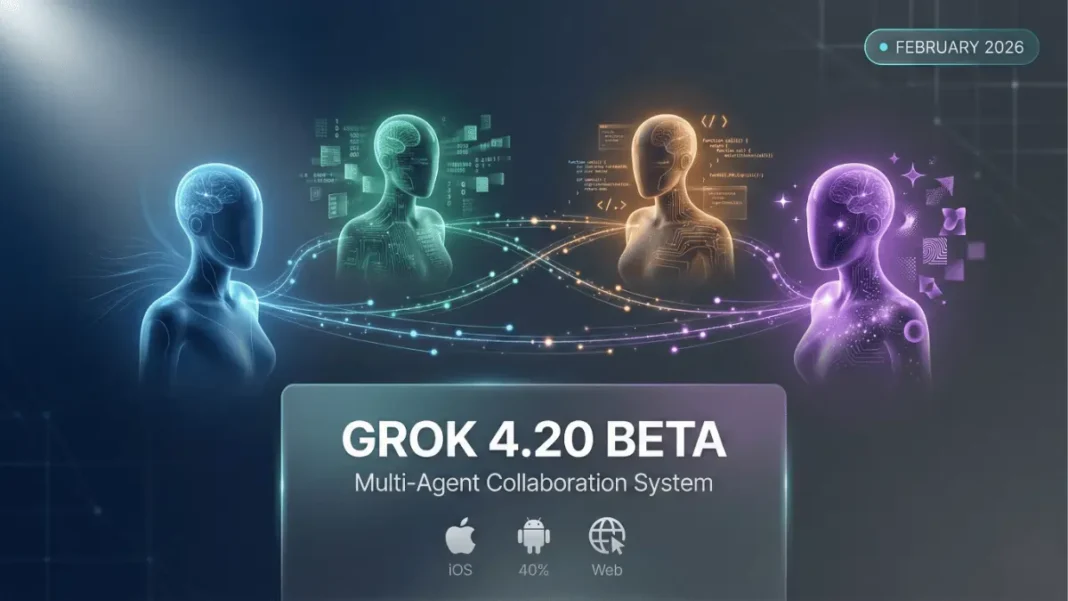
- Grok 4.20 Beta launched mid-February 2026 across iOS, Android, and Web with 4-agent collaboration architecture
- Four specialized agents (Grok, Harper, Benjamin, Lucas) process queries simultaneously with distinct expertise areas
- Available through SuperGrok subscription ($30/month) and X Premium+ plans with 2-million token context window
- Multi-agent system enables peer verification and multi-perspective problem-solving across research, coding, and creative tasks
xAI restructured its AI architecture in mid-February 2026. Grok 4.20 Beta introduced a 4-agent collaboration system where specialized AI agents work simultaneously on single queries. The update represents xAI’s shift from single-model responses to multi-agent problem-solving across iOS, Android, and Web platforms.
The release follows Grok 4.1’s November 2025 launch by three months, marking xAI’s fastest iteration cycle. Grok 4.20 Beta deploys four distinct agents each with specialized capabilities that collaborate internally before presenting unified responses. This architecture enables parallel processing with built-in verification mechanisms.
The 4-Agent Architecture
Grok 4.20 Beta operates through four specialized agents working in parallel. Each agent contributes unique expertise to every query:
Grok serves as the coordination agent, synthesizing inputs from other agents and managing conversation flow. This agent maintains context across multi-turn dialogues and determines when to engage specialist agents.
Harper handles research and fact verification. This agent accesses real-time information, cross-references data sources, and validates claims before incorporation into responses.
Benjamin specializes in mathematics, coding, and logical reasoning. Complex calculations, algorithm development, and technical problem-solving route through this agent.
Lucas focuses on creative content and balanced perspectives. This agent generates original ideas, explores alternative viewpoints, and ensures response completeness.
The system processes queries by distributing work across all four agents simultaneously. Internal discussions occur between agents before presenting final output, creating a peer-review mechanism within single responses.
How many agents work in Grok 4.20 Beta?
Grok 4.20 Beta uses four specialized agents: Grok (coordinator), Harper (research expert), Benjamin (math and coding specialist), and Lucas (creative content). All four agents process queries simultaneously with internal collaboration before generating responses.
Platform Availability and Access
Grok 4.20 Beta launched across grok.com, iOS app, and Android app in mid-February 2026. xAI deployed the model simultaneously across all platforms without staged rollouts. The system integrates with X platform for premium subscribers.
Access requires SuperGrok subscription at approximately $30 per month or X Premium+ membership. xAI positioned the 4-agent system as a premium feature targeting users requiring advanced multi-perspective analysis. The model appears in Auto mode and model selection menus for eligible subscribers.
Grok 4.20 Beta maintains Grok 4.1’s 2-million token context window, allowing extensive conversation history and document processing. The multi-agent architecture operates within this context limit, distributing token usage across all four agents.
Performance Capabilities
Grok 4.20 Beta demonstrated practical applications across multiple domains before public release. xAI tested the system in real-world scenarios including financial analysis and creative content generation.
The model achieved measurable results in Alpha Arena, a stock trading simulation platform. Performance metrics showed profitable trading decisions through multi-agent collaboration. This validated the architecture’s ability to synthesize complex information across research, mathematical analysis, and strategic reasoning.
Creative tasks benefit from Lucas’s specialized focus combined with peer review from other agents. The system generates original content while Harper verifies factual claims and Benjamin ensures logical consistency. This collaborative approach reduces hallucinations through internal fact-checking.
Coding capabilities leverage Benjamin’s technical expertise with support from other agents. Grok manages context and requirements, Harper researches documentation and best practices, and Lucas explores alternative implementation approaches. The multi-agent structure enables comprehensive code review within single responses.
Is Grok 4.20 Beta free to use?
No. Grok 4.20 Beta requires SuperGrok subscription (approximately $30/month) or X Premium+ membership. The 4-agent collaboration system is positioned as a premium feature. No free tier access is confirmed through official xAI channels.
Technical Architecture Details
The 4-agent system processes queries through parallel execution with internal communication. When users submit prompts, all four agents receive the input simultaneously. Each agent analyzes the query from its specialized perspective.
Agents engage in internal discussion before presenting responses. This collaboration layer operates invisibly to users the interface displays unified output rather than separate agent responses. The architecture creates a peer-verification mechanism where agents challenge and refine each other’s contributions.
Context management is distributed across the agent network. Grok maintains conversational flow and long-term memory. Harper tracks factual claims requiring verification. Benjamin monitors technical accuracy in code and calculations. Lucas ensures creative diversity and perspective balance.
The system inherits capabilities from Grok 4.1, including Agent Tools API with real-time web search, X search integration, file retrieval, and code execution. These tools become available to all four agents, expanding research and analysis capabilities.
Comparison: Grok 4.20 Beta vs. Grok 4.1
| Feature | Grok 4.1 (Nov 2025) | Grok 4.20 Beta (Feb 2026) |
|---|---|---|
| Agent System | Single model | 4 specialized agents (Grok, Harper, Benjamin, Lucas) |
| Collaboration | Sequential processing | Parallel multi-agent with internal discussion |
| Context Window | 2 million tokens | 2 million tokens maintained |
| Access Tier | Premium + limited free periods | SuperGrok ($30/month) or X Premium+ |
| Agent Tools API | Yes | Yes (inherited capabilities) |
| Verification | Single-model validation | Multi-agent peer review |
| Platform Access | iOS, Android, Web | iOS, Android, Web (simultaneous launch) |
Specialized Agent Functions
Grok (Coordinator): Manages multi-turn conversations, maintains context across sessions, determines agent engagement priorities, and synthesizes final responses. This agent handles conversation flow and ensures coherent output structure.
Harper (Research Expert): Accesses real-time information sources, cross-references claims across multiple databases, verifies statistical accuracy, and identifies outdated information. This agent serves as the fact-checking layer.
Benjamin (Technical Specialist): Processes mathematical computations, generates and debugs code, applies logical frameworks to arguments, and evaluates technical feasibility. This agent handles quantitative analysis.
Lucas (Creative Expert): Develops original content angles, explores alternative perspectives, balances response tone and style, and ensures comprehensive topic coverage. This agent adds creative diversity.
The specialization enables depth in each domain while collaboration prevents single-perspective limitations. A coding query triggers Benjamin’s primary engagement with Harper verifying documentation accuracy and Lucas suggesting alternative implementation patterns.
Which platforms support Grok 4.20 Beta?
Grok 4.20 Beta operates on iOS devices through the Grok app, Android devices via the Android app, and web browsers at grok.com. X platform integration is available for premium subscribers. All platforms received simultaneous access in mid-February 2026.
Grok Build Integration
Grok 4.20 Beta connects directly to Grok Build, xAI’s browser-based coding environment. The interface received updates alongside the 4.20 launch, including enhanced navigation for code editing, file management, and project planning.
The 4-agent system transforms coding workflows through specialized collaboration. Benjamin generates code while Harper verifies syntax against documentation. Lucas explores alternative approaches and Grok maintains project context. This multi-perspective analysis happens within single query responses.
Grok Build added features supporting team collaboration including share functionality and comment threads. Combined with multi-agent responses, these tools enable developers to evaluate multiple implementation strategies simultaneously. The architecture supports A/B testing through internal agent discussions visible in response structure.
Timeline: Development to Launch
Elon Musk announced Grok 4.20 development in early December 2025, projecting release within “3 or 4 weeks”. Infrastructure preparation at xAI’s Memphis data center extended the timeline into mid-February 2026.
The model underwent testing in controlled environments before public release. Alpha Arena trading simulations validated the multi-agent architecture’s decision-making capabilities. This represented xAI’s strategy of real-world validation before broad deployment.
The timeline from Grok 4 (July 2025) to 4.1 (November 2025) spanned four months. The 4.1 to 4.20 iteration compressed to three months, demonstrating xAI’s accelerating development pace. The version number jump from 4.1 to 4.20 signals architectural changes beyond incremental improvements.
Real-World Applications
The 4-agent architecture addresses use cases requiring multi-perspective analysis. Financial research benefits from Harper’s data verification combined with Benjamin’s quantitative analysis and Lucas’s alternative scenario exploration. Single queries generate comprehensive assessments with built-in fact-checking.
Content creation leverages Lucas’s creative expertise while maintaining factual accuracy through Harper’s verification. Technical content receives additional review from Benjamin for logical consistency. This reduces the need for external fact-checking tools.
Software development queries activate Benjamin’s coding specialization with support from other agents. Grok maintains project requirements, Harper researches best practices and library documentation, and Lucas suggests alternative implementation patterns. The collaborative output resembles code review from multiple developers.
Complex problem-solving benefits from distributed cognitive load. Each agent approaches problems from distinct angles, with internal discussion surfacing considerations that single-model systems might miss. The architecture creates redundancy that improves response reliability.
Limitations and Considerations
Grok 4.20 Beta’s multi-agent processing introduces computational overhead. Four agents analyzing simultaneously increases resource consumption compared to single-model execution. This may affect response latency, though xAI has not published specific performance metrics.
The premium-only access tier limits widespread adoption. At approximately $30 per month for SuperGrok or X Premium+ requirements, the 4-agent system targets professional users rather than casual consumers. This positions Grok 4.20 Beta as a specialized tool rather than general-purpose AI.
The beta designation indicates ongoing refinement. xAI has not announced a timeline for graduating to stable release. Users should expect iterative improvements and potential feature changes during the beta period.
Context window limitations affect all four agents collectively. The 2-million token capacity distributes across agent operations, potentially constraining extremely long conversations or document processing tasks. Users working with extensive context may encounter limitations absent in single-model architectures with equivalent token budgets.
Frequently Asked Questions (FAQs)
What is Grok 4.20 Beta?
Grok 4.20 Beta is xAI’s AI model launched mid-February 2026 featuring four specialized agents (Grok, Harper, Benjamin, Lucas) that collaborate simultaneously. The system operates across iOS, Android, and Web platforms with premium subscription access.
How do the four agents work together?
All four agents receive queries simultaneously and process from their specialized perspectives. They engage in internal discussion before presenting unified responses. Grok coordinates, Harper verifies facts, Benjamin handles technical analysis, and Lucas provides creative input.
How much does Grok 4.20 Beta cost?
Grok 4.20 Beta requires SuperGrok subscription at approximately $30 per month or X Premium+ membership. The multi-agent system is positioned as a premium feature without confirmed free-tier access.
What’s the difference between Grok 4.1 and 4.20?
Grok 4.20 introduces a 4-agent collaborative architecture (Grok, Harper, Benjamin, Lucas) while Grok 4.1 uses single-model processing. Both maintain 2-million token context windows. The 4.20 system adds multi-agent peer review and specialized expertise distribution.
Can I use Grok 4.20 for coding?
Yes. Benjamin agent specializes in coding with support from Harper (documentation verification), Lucas (alternative approaches), and Grok (context management). The system integrates with Grok Build IDE for enhanced development workflows.
What context window does Grok 4.20 support?
Grok 4.20 Beta maintains a 2-million token context window inherited from Grok 4.1. This capacity distributes across all four agents operating simultaneously.
Which platforms support Grok 4.20 Beta?
iOS app, Android app, grok.com web interface, and X platform integration. All platforms received simultaneous access in mid-February 2026.
How accurate is the multi-agent system?
The 4-agent architecture includes Harper’s fact-verification layer and peer review across agents before response generation. Alpha Arena testing demonstrated profitable decision-making in financial simulations. Specific accuracy benchmarks remain unpublished.

