

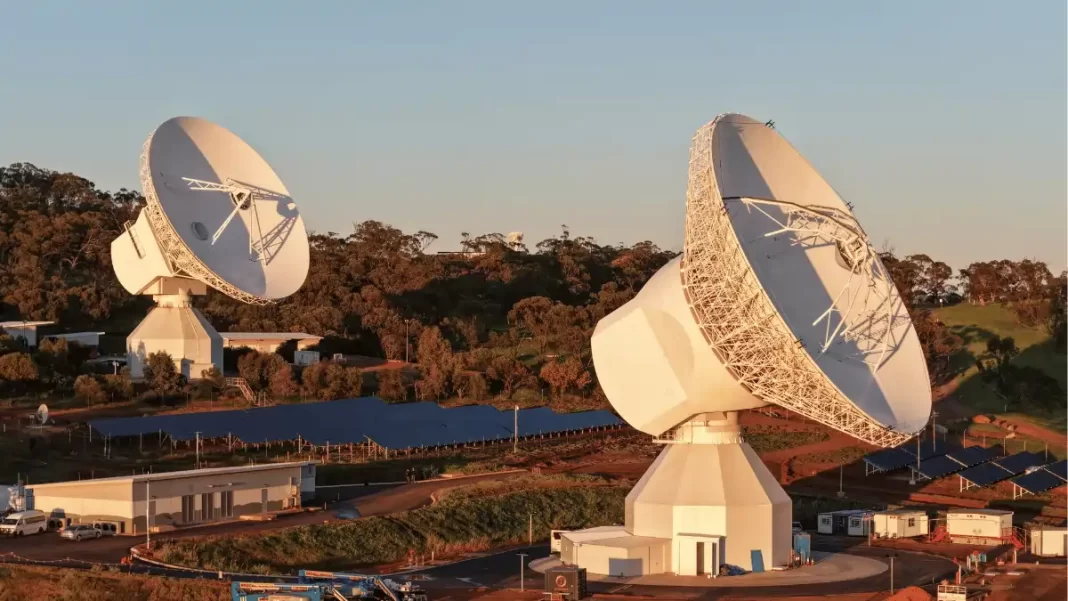
A smarter “ear” for the Solar System
Europe has switched on a new “ear” to the cosmos in the Western Australian outback and this one comes with a brain. The European Space Agency (ESA) has inaugurated a 35-metre deep-space antenna at New Norcia, about 115 kilometers north of Perth, adding crucial capacity to talk to spacecraft scattered across the Solar System. It’s the fourth heavy-duty dish in ESA’s global Estrack network and the second at the New Norcia site. Officials say the station will help keep pace with a surge of scientific missions and, in time, bring artificial intelligence directly into day-to-day operations.
Why New Norcia matters
The new dish known as New Norcia 3, or NNO-3 will formally enter service in 2026, after final testing and calibration. When it does, it’s slated to serve some of ESA’s most demanding flights: the Jupiter Icy Moons Explorer (Juice), Solar Orbiter, the Mercury-bound BepiColombo, the long-running Mars Express, and the asteroid-defense mission Hera. It is also expected to be a critical link for future spacecraft including the exoplanet hunter Plato, the Venus orbiter EnVision, the atmospheric mission Ariel, the proposed Mars sample-return leg Ramses, and the space weather sentinel Vigil. In a shakedown test, the new antenna has already picked up a faint signal from Euclid, the dark-energy mapper launched last year.
If you imagine trying to hear a whisper from hundreds of millions of kilometers away, you get the basic challenge of deep-space communications. To meet it, NNO-3 leans on some serious hardware. Parts of its radio system are chilled to around –263°C just a few degrees above absolute zero to reduce electronic noise and tease out extremely weak signals. On the uplink, a 20-kilowatt amplifier gives flight controllers enough voice to send commands across interplanetary distances. Those features mean more reliable links and, crucially, more data for scientists back on Earth.
The build is also a diplomatic marker. Estrack’s three big dishes at Cebreros in Spain, Malargüe in Argentina and New Norcia in Australia form a near round the clock ring of coverage for spacecraft far from home. By doubling New Norcia’s capacity, Europe gains resilience during flybys and critical maneuvers and cuts scheduling bottlenecks that can force missions to take turns on a limited set of antennas. Under long-standing cross-support arrangements, the station can be pointed not just at European spacecraft but also at those flown by NASA, JAXA and ISRO, as well as commercial probes, a practice that boosts science return for everyone.
What’s new and likely to draw the most attention beyond the engineering community is the promise of on-site AI. ESA Director General Josef Aschbacher told local media the dish will be the first in the agency’s network to incorporate artificial intelligence in its routine operations: helping the system lock onto faint signals amid noise and continuously optimize the dish’s motion as spacecraft drift across the sky. If those tools work as advertised, they could shave minutes off acquisition times, catch anomalies earlier and squeeze extra bits out of every downlink. Even with some hedging the agency’s formal write-ups emphasize the hardware first it’s a notable shift toward “smart” ground stations.
Much of the day-to-day running of New Norcia is Australian. Since 2019, CSIRO, the country’s national science agency, has handled operations and maintenance at the site a practical arrangement that also mirrors Australia’s role at NASA’s Deep Space Network near Canberra. The new antenna continues that partnership model while adding work for local firms: Thales Alenia Space (France) and Spain’s Schwartz Hautmont led the construction, with Australian companies contributing on site. ESA puts total costs for the antenna and associated upgrades at €62.3 million, including a €3 million contribution from the Australian Space Agency.
What will this mean for science, in plain terms? More capacity means more observing time, higher data rates and fewer trade-offs. Juice’s long passes over Jupiter’s ocean-world moons could yield richer maps. Solar Orbiter can keep a closer watch on the Sun’s eruptions, feeding space-weather forecasts that matter to airlines, power grids and satellites. BepiColombo’s tight orbits around Mercury punishing for communications may have steadier coverage. And Hera’s rendezvous with the asteroid Dimorphos, part of an international experiment in planetary defense, should transmit the kind of detailed images that turn a headline into a dataset. Each of those benefits depends, unglamorously, on a clean connection to Earth.
There’s also a local angle. Western Australia bills itself as a natural home for radio-quiet infrastructure far from dense cities and their electrical chatter. The New Norcia station sits among farmland and bushland, not far from mining operations that pioneered autonomous vehicles, a field that space agencies now see as a proving ground for off-world robotics. Community leaders say they’re exploring visitor facilities and education programs tied to the site; that kind of outreach may sound soft, but it’s one of the ways publicly funded science maintains support.
For the technically minded, a few finer points are worth noting. The antenna supports deep-space X- and Ka-band links and is designed to work hand-in-glove with a smaller on-site dish used to track European launchers during early flight. The station recently added a special calibration transponder to help verify measurements from ESA’s new Biomass satellite, which is mapping global forests a reminder that these giant dishes serve both exploration and Earth science. And because Estrack is a network, gains in Australia flow to Europe and South America: a spacecraft over Venus might be talking to Spain at dawn and Australia by nightfall.
The bigger story is strategic. Over the past decade, scientific missions have multiplied and diversified. Planetary probes travel farther, telescopes generate torrents of data, and even small satellites now venture beyond Earth orbit. Ground infrastructure hasn’t always kept up. Adding a fourth deep-space antenna and making it smarter is a concrete way for Europe to protect the investment it has already made in spacecraft and to keep pace with partners who are pursuing similar upgrades. As ever in spaceflight, the heroic moments happen far away, but the success or failure often hinges on the most terrestrial of tools: power, cooling, timing, and a clear line of sight.
For now, New Norcia 3 is still in its commissioning phase. But if all goes to plan, within a year or so the dish will be a routine presence on the schedule: swinging from Mars to Mercury to Jupiter, pulling whispers from the void, and if the AI lives up to expectations doing it a little quicker and a little cleaner than before. That’s not a sci-fi leap. It’s a practical step toward better science.

Frequently Asked Questions (FAQs)
What is New Norcia 3?
New Norcia 3 is a 35-metre deep space antenna in Western Australia that joins ESA’s Estrack network to communicate with spacecraft far from Earth.
How does AI help a ground station?
It assists with locking onto weak signals, optimising dish motion during long tracks, and flagging anomalies that could affect data quality.
Which missions will use the antenna?
Early users include Juice, Solar Orbiter, BepiColombo and Hera, with capacity for future probes such as Plato and EnVision.
Why build it in Australia?
The site offers radio-quiet conditions and fills a coverage gap so spacecraft can stay in contact as the Earth turns.

