

Quick Brief
- The Release: Chrome 145 ships WGSL
subgroup_uniformityextension and experimentalmapSync()method for GPUBuffer in workers, published January 28, 2026 - The Impact: Developers gain improved shader compilation quality-of-life and friction reduction for the 65% of new web applications already leveraging WebGPU
- The Context: This release arrives as WebGPU reaches 70% browser support with Firefox 147, Safari iOS 26, and Chrome/Edge, marking full cross-browser availability
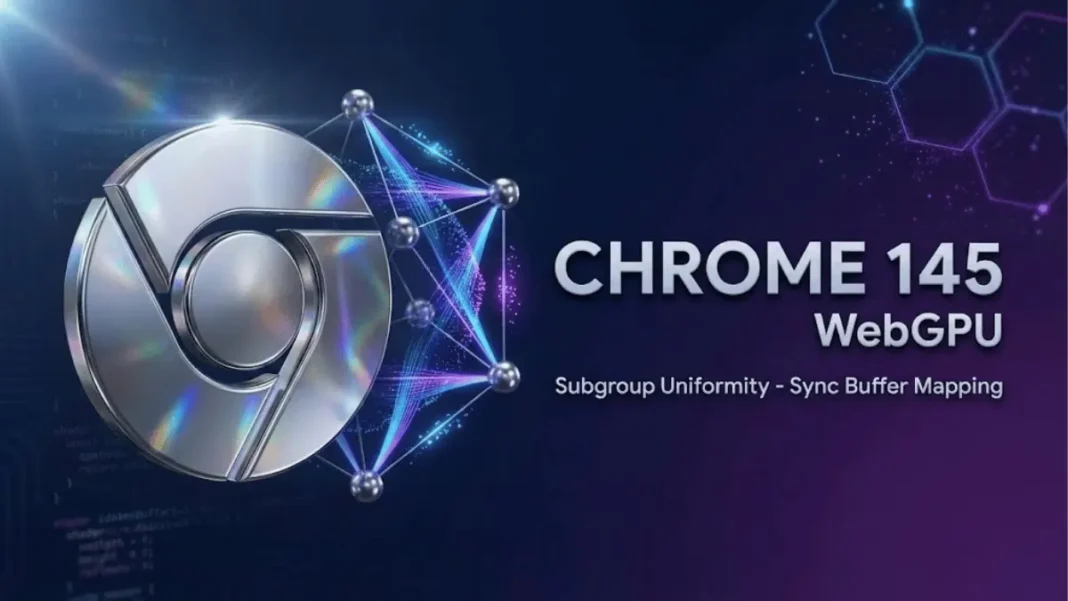
Chrome released version 145 with two significant WebGPU updates on January 28, 2026: the WGSL subgroup_uniformity language extension and experimental synchronous buffer mapping in workers. The release targets developers building GPU-accelerated web applications, coinciding with WebGPU’s maturation across all major browsers with approximately 70% global browser coverage.
WGSL Subgroup Uniformity Extension Reduces Shader Compilation Friction
The subgroup_uniformity extension changes uniformity analysis scope from workgroup level to subgroup level for built-in functions. This modification allows more values to be considered subgroup-uniform, including the recently added subgroup_id built-in value. The practical impact reduces the likelihood developers disable uniformity checks altogether, representing a quality-of-life improvement for shader development.
Developers can feature-detect the extension using navigator.gpu.wgslLanguageFeatures. Chrome’s implementation addresses previous limitations where subgroupElect() functions triggered WGSL errors in non-uniform control flow, even when the code executed within subgroup-uniform contexts.
Experimental Synchronous Buffer Mapping Targets Worker Performance
Chrome 145 introduces an experimental mapSync() method for GPUBuffer, restricted to Web Workers, as part of Google’s investigation into reducing friction between WebGPU and application code. The synchronous method eliminates the await requirement of mapAsync(), which allows other code to run during the mapping operation and can cause application logic issues.
The feature requires launching Chrome with the --enable-features=WebGPUMapSyncOnWorkers flag and remains experimental pending developer feedback. Google seeks input on the feature’s utility and impact before proposing it for standardization. This aligns with broader industry efforts to optimize WebGPU performance recent benchmarks show 15-30x performance improvements over WebGL for compute workloads and browser-based AI inference reaching 80% of native performance.
| Feature | Status | Target Use Case | Developer Action |
|---|---|---|---|
| subgroup_uniformity | Production | Shader compilation quality-of-life | Feature-detect via navigator.gpu.wgslLanguageFeatures |
| mapSync() | Experimental | Worker buffer operations | Enable via –enable-features flag; provide feedback |
| Dawn R8UnormStorage | Deprecated | Replaced by TextureFormatTier1 | Migrate to new feature name |
Dawn Native Implementation Updates Signal API Consolidation
Chrome 145’s Dawn updates include the removal of wgpu::FeatureName::R8UnormStorage, replaced by wgpu::FeatureName::TextureFormatTier1. The Snorm16TextureFormats feature was removed entirely, with capabilities now encompassed by TextureFormatsTier1 except for Resolve functionality.
Dawn nightly binaries now build on GitHub and are available through google/dawn releases, though Google provides them as a best-effort service without signatures or guarantees. Emdawnwebgpu gained wgpu::ExternalTexture support, importable only from JavaScript code via methods like EM_ASM, as C/C++ construction remains impossible due to requirements for JavaScript objects like HTMLVideoElement or VideoFrame.
Production WebGPU Deployments Validate Cross-Browser Maturity
WebGPU achieved full cross-browser availability with Firefox 147 shipping support on January 13, 2026, and Safari enabling it by default in iOS 26 and macOS Tahoe 26. Chrome and Edge have supported WebGPU since version 113. The Chrome 145 release supports a growing ecosystem of production WebGPU applications serving real users at scale, with 65% of new web applications already leveraging the technology.
Nexara Labs deployed AR e-commerce experiences processing 4K frames at 58FPS on iPhone 15, serving 3 million users with a 40% conversion rate increase. ChartGPU demonstrates practical data visualization capabilities by rendering 1 million data points at 60fps workloads that would overwhelm Canvas2D or WebGL implementations.
Browser-based AI inference through WebLLM reaches 80% of native performance without server infrastructure, while Babylon.js reports approximately 10x faster scene rendering using WebGPU’s render bundles. Power consumption improvements show the same workload running for 3 hours on WebGPU versus 2 hours on WebGL on mobile devices.
Frequently Asked Questions (FAQs)
What is the subgroup_uniformity extension in Chrome 145?
A WGSL language extension that shifts uniformity analysis from workgroup to subgroup level, allowing more values to be considered uniform and reducing shader compilation errors.
Can I use mapSync() in production applications?
No. mapSync() is experimental and requires the –enable-features=WebGPUMapSyncOnWorkers flag. Google seeks developer feedback before standardization.
What replaced R8UnormStorage in Dawn?
TextureFormatTier1 now supersedes R8UnormStorage in Chrome 145’s Dawn implementation, requiring developers to migrate feature names.
How does Chrome 145 improve WebGPU developer experience?
It reduces uniformity check workarounds through subgroup_uniformity and explores synchronous buffer operations in workers to eliminate async-related application logic issues.
Is WebGPU ready for production use in 2026?
Yes. WebGPU reached 70% browser support with Firefox 147, Safari iOS 26, and Chrome/Edge all shipping full support, with 65% of new web applications already adopting the technology.

