

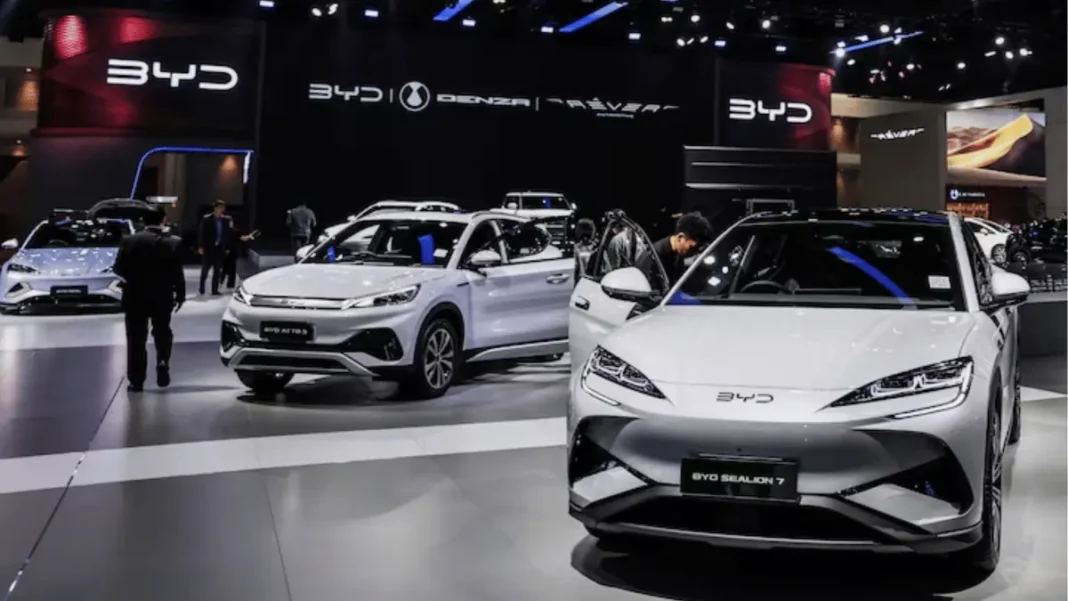
Chinese automaker BYD sold 4.6 million vehicles in 2025, likely surpassing Tesla to become the world’s largest electric vehicle maker for the first time, according to data released Thursday. Tesla is expected to report approximately 1.64 million deliveries for 2025, representing an 8% decline from the prior year and marking the company’s second consecutive year of falling sales. The milestone, however, came with a sobering reality: BYD’s 7.73% growth rate marked its weakest expansion in five years as intensifying domestic competition and a brutal price war weighed on China’s EV leader.
Record Sales Meet Reality Check
BYD delivered 4.6 million units in 2025, up 7.7% from 2024, meeting its revised full-year target. The Chinese EV giant manufactures both pure electric and hybrid vehicles, giving it broader market appeal compared to Tesla’s all-electric lineup.
The company’s achievement lost significant shine after slashing its 2025 sales target by 16% from an initial 5.5 million units. BYD’s December sales tumbled 18.3% year-over-year, extending declines for a fourth consecutive month and marking the largest monthly drop in nearly two years. Domestic sales weakened noticeably from July onward, forcing the company to lower expectations mid-year.
Tesla’s struggles proved even more severe. The American automaker’s projected 1.64 million deliveries would represent its second straight year of declining sales, with analysts pointing to the expiration of U.S. federal tax credits and increasing competition as key factors. Fourth-quarter deliveries are expected to reach just 422,850 units, a 15% drop from the same period in 2024.
Domestic Competition Intensifies
BYD faced mounting pressure from rivals including Geely and Leapmotor in China’s crucial budget segment priced under 150,000 yuan ($20,700). In this key market, BYD sales fell nearly 10% year-over-year in July, while Geely’s comparable models surged 90%.
The company’s second-quarter earnings reflected the toll of increased competition, showing a 30% year-on-year decline in net profit, its first drop in over three years. Other major Chinese EV makers, including Li Auto and Nio, also reported delivery declines during the summer months as the price war intensified.
Leapmotor and Geely positioned aggressive models in the 100,000-150,000 RMB range, with monthly sales approaching 10,000 units each. Leapmotor offered particularly aggressive terminal discounts and lifetime warranties to attract buyers, forcing BYD to respond with its own price cuts.
Price War Triggers Government Response
China’s EV market has been gripped by what industry insiders call “disorderly competition,” prompting the government to launch an “anti-involution” campaign to curb excessive price cuts. EV prices in China have dropped roughly 19% over the past two years, according to industry data.
The China Association of Automobile Manufacturers subtly criticized BYD in a June statement, noting that “one automaker has taken the initiative to implement substantial price reductions, with numerous other companies quickly following”. In May 2025, BYD slashed prices on some high-end battery and hybrid models by around 30%, triggering similar moves from competitors.
Chinese authorities introduced a draft amendment to the country’s pricing law, the first update since 1998 specifically targeting price wars. The amendment aims to enhance regulations concerning price ceilings, recognize “unfair pricing practices,” and restrict “involution-style” competition.
Industry Implications
The leadership shift represents a turning point in the global EV industry as Chinese manufacturers increasingly challenge established Western players. Market research firm Counterpoint Research projects BYD will finish 2025 as the global electric vehicle sales leader with a 15.7% market share.
BYD maintained its sales leadership for four consecutive quarters after overtaking Tesla in Q4 2024. The company’s success stems partly from its diverse product lineup spanning pure electric and plug-in hybrid vehicles, allowing it to capture a broader customer base than competitors focused solely on battery-electric models.
For Tesla, the decline accelerated in Q4 2025 following the expiration of the $7,500 U.S. federal tax credit at the end of Q3. U.S. sales are projected to have dropped to 125,900 units during the fourth quarter, marking a 22.4% decrease.
What’s Next
BYD and other Chinese EV makers face continued pressure in 2026 as domestic competition shows no signs of easing. The challenging outlook for China’s auto market threatens to undermine BYD’s achievement of becoming the world’s largest EV maker.
Tesla’s official fourth-quarter results are expected soon, which will confirm whether BYD has definitively claimed the global EV sales crown. Analysts anticipate both companies will need to navigate a more complex landscape of slowing domestic growth, international expansion challenges, and sustained pricing pressure.
Chinese authorities’ anti-involution measures may bring some pricing stability in 2026, though market watchers remain skeptical given the intensity of competition. XPeng Motors CEO He Xiaopeng warned staff in January 2025 that the market would see fiercer competition and cautioned that some automotive firms might not survive the impending price conflict.
Featured Snippet Boxes
Did BYD surpass Tesla as the world’s largest EV maker in 2025?
Yes, BYD sold 4.6 million vehicles in 2025 compared to Tesla’s expected 1.64 million deliveries. This marks the first time a Chinese automaker has overtaken Tesla in annual EV sales, representing a significant shift in global automotive leadership.
Why did BYD’s sales growth slow in 2025?
BYD’s 7.7% growth was its weakest in five years due to intensifying competition from Geely and Leapmotor in China’s budget segment and a brutal price war. The company cut prices by up to 30% on some models, triggering net profit to fall 30% in Q2.
What is China’s anti-involution campaign?
China’s anti-involution campaign aims to curb excessive price cuts in the EV market where prices have dropped 19% over two years. Authorities introduced draft amendments to pricing laws to restrict “involution-style” competition and unfair pricing practices that threaten industry stability.
How many EVs did Tesla sell in 2025?
Tesla is expected to report approximately 1.64 million deliveries for 2025, down 8% from 2024. This marks Tesla’s second consecutive year of declining sales, with Q4 deliveries projected at 422,850 units, a 15% year-over-year drop.

