

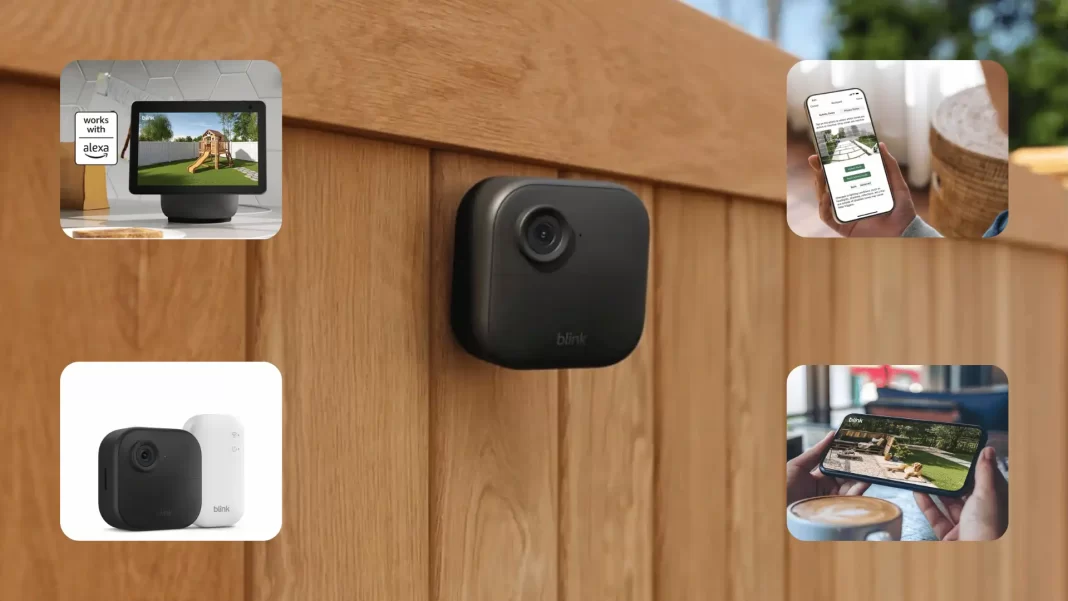
Blink Outdoor 4 is an affordable, battery-powered outdoor camera with 1080p video, a wide 143° view, and up to two years of life per set of AAs (four years with the Battery Extension Pack). Add Sync Module XR to place cameras 250–400 ft away, with lower max resolution at those distances. Person detection requires a subscription.
Pros
- 2-year batteries (4-year optional pack); easy DIY
- Wide 143° field of view; improved low-light
- Local storage option; very competitive pricing
- XR hub pushes coverage far beyond Wi-Fi
Cons
- 1080p only; XR/XR+ lowers quality further
- Person detection paywalled
- Needs a sync module; app outages do happen (rare)
Table of Contents
What is Blink Outdoor 4? Key specs at a glance
Blink Outdoor 4 is Amazon’s budget outdoor cam: 1080p video, 143° diagonal field of view, two-way talk, and weather-resistant housing. It runs on two AA lithium batteries for up to two years under default settings. It adds better motion detection, improved low-light, and optional person detection (with a paid plan).
What changed vs Outdoor 3? A wider lens (110° → 143°), enhanced motion detection, and improved low-light performance. Person detection is new for Blink’s outdoor line, but it requires a subscription.
Pricing, bundles, and the 2025 subscription update
Typical street pricing moves with Amazon promos, especially around Prime events. Single-camera kits and multi-packs often dip well below MSRP. Tom’s Guide routinely tracks steep Blink discounts; expect bundles with Sync Module Core or XR.
Subscription plans (U.S.): Starting Oct 8, 2025, Blink increases plan prices to $3.99/mo (Basic) or $11.99/mo (Plus); annuals are $39.99 and $119.99 respectively. Plans unlock cloud storage, person detection, and other perks.
Without a plan you still get live view and can save clips locally if you add the right Sync Module (details below). Outdoor 4 requires a Sync Module regardless of plan.
Storage: cloud vs local (USB vs microSD)
You’ve got two solid local paths:
- Sync Module 2 → plug in a USB flash drive to store clips locally. Good for typical Wi-Fi setups near the house.
- Sync Module XR → uses a microSD card (1–256GB, ExFAT) for local storage and enables Extended Range. Think barns, gates, detached garages.
XR’s local storage is built around microSD, not USB; Sync Module 2 is the opposite. Choose based on range need and where your Wi-Fi reaches.
Range & reliability: do you need Sync Module XR?
If your camera sits within normal Wi-Fi range, the standard Sync Module 2 is fine. If you need to reach the back acres, Sync Module XR adds a proprietary long-range link:
- XR mode: up to ~250 ft from the hub; 720p/360p quality options.
- XR+ mode: up to ~400 ft, but capped at 360p and no two-way talk.
- Limit: Extended Range applies to up to two Outdoor 4 cameras per XR hub.
Independent tests have shown usable visibility at long distances, but expect softer detail due to the lower transmitted resolution. If plate-reading is your goal, keep critical cams on standard Wi-Fi.
Setup that actually works (and saves battery)
Placement: Mount 7-9 ft high, angle 15-30° downward, and avoid pointing at roads to reduce motion noise.
Motion tuning: Start with medium sensitivity; draw smaller activity zones focusing on paths to your door.
Clip settings: 15–20 s clips, 20–30 s re-trigger delay balance detail with battery life.
When to add the Battery Extension Pack: If you expect frequent motion (busy sidewalk, shared driveway) or will use long clips/live view often, the extension pack bumps you to up to 4 years under default usage. It physically attaches to Outdoor 4 and holds four AAs.
Image quality & night vision
Daytime footage is crisp enough for faces at typical porch distances. At night, IR illumination is decent for short-to-mid range; expect less detail at the edges of that 143° view. If you need license plates at the curb, a 2K rival (or a narrower-FOV placement closer to the action) may suit you better. Specs: 1080p up to 30 fps.
Smart features & integrations
- Person detection (camera-side computer vision) trims false alerts but requires a plan.
- Alexa support is strong “show me the driveway” on Echo Show, motion announcements, routines. (Listed on Amazon product pages.)
Blink Outdoor 4 vs rivals (quick picks)
| Camera | Resolution | Battery/Power | Local Storage | Notables | Best for |
|---|---|---|---|---|---|
| Blink Outdoor 4 | 1080p | 2×AA (2 yrs; 4 yrs with pack) | USB (SM2) or microSD (XR) | 143° FoV; XR long-range | Budget, long battery, Alexa homes |
| Ring Outdoor Cam Plus (2025) | 2K | Battery/solar/USB-C | Cloud-centric | Dual-band Wi-Fi, richer app | Feature seekers, Ring users |
| Arlo Essential (2nd gen) | 2K | Battery | Cloud (limited local via hub) | Clarity, spotlight | Image detail over battery life |
| Wyze Cam Outdoor v2 | 1080p | Rechargeable packs | microSD (base) | Color night vision, low price | Budget tinkerers |
| eufy SoloCam S220 | 2K | Solar + battery | On-board 8GB | No monthly fee, Alexa/Google | Set-and-forget solar use |
Should you buy Blink Outdoor 4?
Choose Blink Outdoor 4 if you want low cost, low maintenance, and you’re okay with 1080p. Add XR for distant spots (gates, barns), accepting the lower video quality there. If you need forensic detail, grab a 2K camera for the critical angle and keep Blink for general coverage.
Limitations & recent notes
- App outage (Sept 26, 2025) briefly blocked access/log-ins; Amazon says recordings/notifications weren’t affected and service was restored. Not common, but worth noting.
Frequently Asked Question
What’s the field of view and frame rate?
143° diagonal; up to 30 fps.
How long do batteries last?
Up to 2 years (default use); up to 4 years with the Battery Extension Pack.
Does person detection work without a plan?
No, it’s a subscription feature processed on-device.
USB vs microSD what’s the difference?
SM2 uses USB; XR uses microSD (1-256GB ExFAT).
How many cameras can XR extend?
Extended Range applies to up to two Outdoor 4 cameras per XR.
Can I mix Blink with Echo devices?
Yes view live feeds and get motion announcements on Echo Show/Fire TV.
What happens during outages?
You may lose app access briefly; recordings/notifications generally continue.

Featured Answer Boxes
Does Blink Outdoor 4 need a Sync Module?
Yes. Outdoor 4 requires a Sync Module to connect and work either Sync Module 2 (USB local storage) or Sync Module XR (microSD + long-range). It won’t run standalone like Blink Mini. Bundles usually include a hub; add XR only if you need extended range.
Is a subscription required?
No. You can skip the plan and use local storage with a Sync Module (USB on SM2, microSD on XR). A subscription adds cloud storage and features like person detection. U.S. prices rise on Oct 8, 2025 to $3.99/$11.99 monthly.
How far can I place Blink Outdoor 4 from the house?
With Sync Module XR, Extended Range reaches ~250 ft (XR) or 400 ft (XR+). At those distances, max video quality drops (to 720p/360p) and two-way talk is disabled on XR+. Keep critical cameras on regular Wi-Fi for best detail.
Source: Blink

