

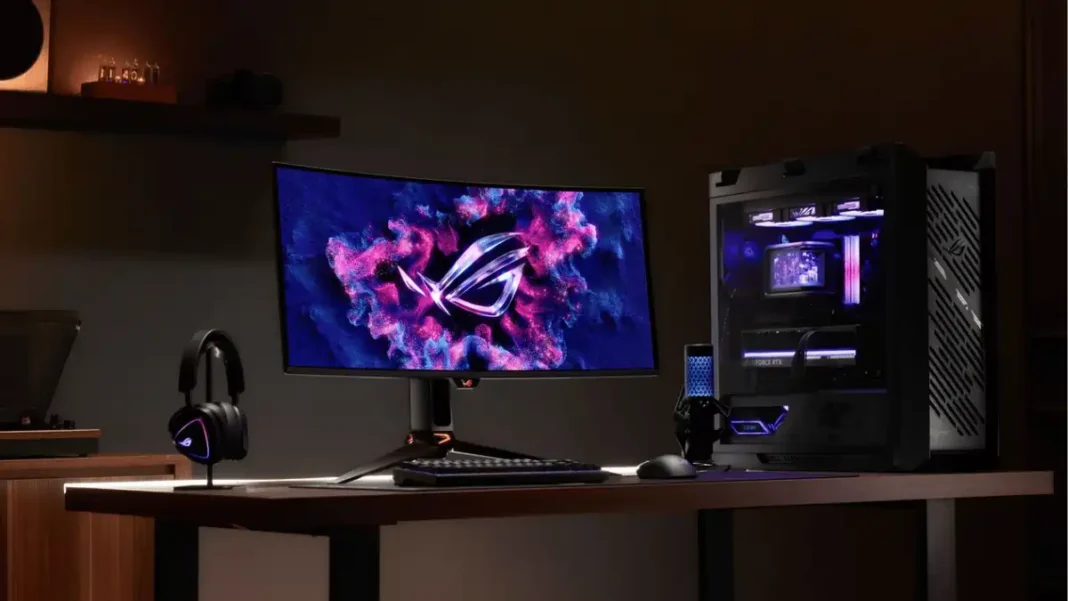
ASUS Republic of Gamers announced four next-generation OLED gaming monitors at CES 2026 featuring RGB stripe pixel technology that eliminates color fringing for crystal-clear text and visuals. The lineup includes the world’s first RGB OLED gaming monitor the ROG Swift OLED PG34WCDN alongside new BlackShield film that boosts perceived black levels by 40% and increases scratch resistance by 2.5 times compared to previous QD-OLED panels. All models ship with ultra-fast refresh rates between 240Hz and 480Hz for competitive gaming.
What’s New in RGB OLED Technology
RGB stripe pixel OLED removes the triangular subpixel arrangement and extra white subpixels found in traditional WOLED panels, aligning red, green, and blue subpixels in vertical stripes. This structure solves the text fringing issue that has plagued OLED monitors for years with colorful borders around characters caused by misaligned subpixels during text rendering. ASUS applied this technology across both QD-OLED and Tandem OLED panels in its 2026 monitor lineup.
The ROG BlackShield film debuting on select models addresses ambient light performance, a known weakness of QD-OLED displays that can exhibit purple-ish tints in bright rooms. Combined with anti-reflection coating, the film maintains true black levels even under direct sunlight while protecting the panel surface during routine cleaning.
Four New Monitor Models
ROG Swift OLED PG34WCDN (34-inch WQHD)
- World’s first RGB OLED gaming monitor with 360Hz refresh rate
- QD-OLED panel with BlackShield film and 1800R curve
- DisplayPort 2.1a UHBR20 (80Gbps), USB-C 90W Power Delivery
- VESA DisplayHDR 500 True Black, 99% DCI-P3, 0.03ms response time
ROG Strix OLED XG34WCDMS (34-inch WQHD)
- RGB QD-OLED with BlackShield, 280Hz refresh rate
- Compact stand design for minimal desk footprint
- DisplayPort 1.4 DSC, HDMI 2.1, USB-C 15W
ROG Swift OLED PG27UCWM (26.5-inch 4K)
- Tandem RGB stripe OLED without white subpixel
- 27% larger color volume at high brightness vs standard WOLED
- Dual Mode: 4K@240Hz or FHD@480Hz
- Dolby Vision support, transparent rear panel design
ROG Swift OLED PG32UCDM Gen 3 (32-inch 4K)
- Third-gen update adds BlackShield film to proven QD-OLED
- Maintains 240Hz, 0.03ms response, now with DisplayHDR 500 True Black
- DisplayPort 2.1a UHBR20, USB-C 90W

Why RGB Stripe Matters for Creators and Gamers
Text fringing has been most visible on 1440p OLED monitors with lower pixel density, forcing productivity users to choose between OLED’s contrast and LCD’s text clarity. RGB stripe pixel layout solves this compromise by matching how operating systems render fonts, making these panels viable for coding, writing, and content creation alongside gaming. LG Display achieved this breakthrough by increasing the aperture ratio of the light-emitting area of each pixel allowing both stripe alignment and high refresh rates simultaneously.
The larger color volume in Tandem RGB OLED panels benefits HDR gaming and video editing, delivering more saturated colors at peak brightness levels where standard WOLED panels typically wash out. ASUS cites up to 27% improvement in color volume on the PG27UCWM compared to previous-generation WOLED technology.
BlackShield’s Dual Purpose
Beyond improving contrast in bright rooms, BlackShield’s hardness upgrade addresses a practical concern: QD-OLED panels lack the protective glass layer found on older monitor technologies, making them vulnerable to damage during cleaning. The 2.5x scratch-resistance increase lets users wipe down screens with standard microfiber cloths without risking permanent marks.
The 40% boost in perceived black levels targets the purple-tinted blacks some users report when QD-OLED monitors reflect ambient light. This positions the Gen 3 PG32UCDM and PG34WCDN as viable options for mixed-use environments where room-darkening isn’t always practical.
Availability and Unanswered Questions
ASUS has not announced pricing or release dates for the four models. All monitors include an OLED Care Pro with Neo Proximity Sensor (auto-dimming when users step away), DisplayWidget Center software for settings management, and ROG Gaming AI features like Dynamic Shadow Boost.
The company maintains its No. 1 global position in OLED monitor sales heading into 2026. Competing RGB OLED monitors using LG Display’s panels are expected from other manufacturers following CES 2026 announcements.
Featured Snippet Boxes
What is RGB stripe pixel OLED technology?
RGB stripe pixel OLED arranges red, green, and blue subpixels in vertical stripes instead of triangular patterns, eliminating the color fringing around text that affects traditional WOLED monitors. This layout matches how operating systems render fonts for sharper text clarity.
How does ASUS BlackShield film work?
BlackShield is a protective film applied to QD-OLED panels that increases perceived black levels by up to 40% in bright environments while making the screen 2.5 times more scratch-resistant. It prevents the purple tint some QD-OLEDs show under ambient lighting.
Which ASUS monitors have RGB OLED panels?
The ROG Swift OLED PG34WCDN and Strix OLED XG34WCDMS use RGB QD-OLED panels, while the ROG Swift OLED PG27UCWM features Tandem RGB OLED. The PG32UCDM Gen 3 uses standard QD-OLED with BlackShield film but not RGB stripe technology.
When will these monitors be available?
ASUS announced the monitors at CES 2026 on January 4 but has not provided release dates or pricing. Historical patterns suggest availability within Q1-Q2 2026, though official confirmation is pending.

