

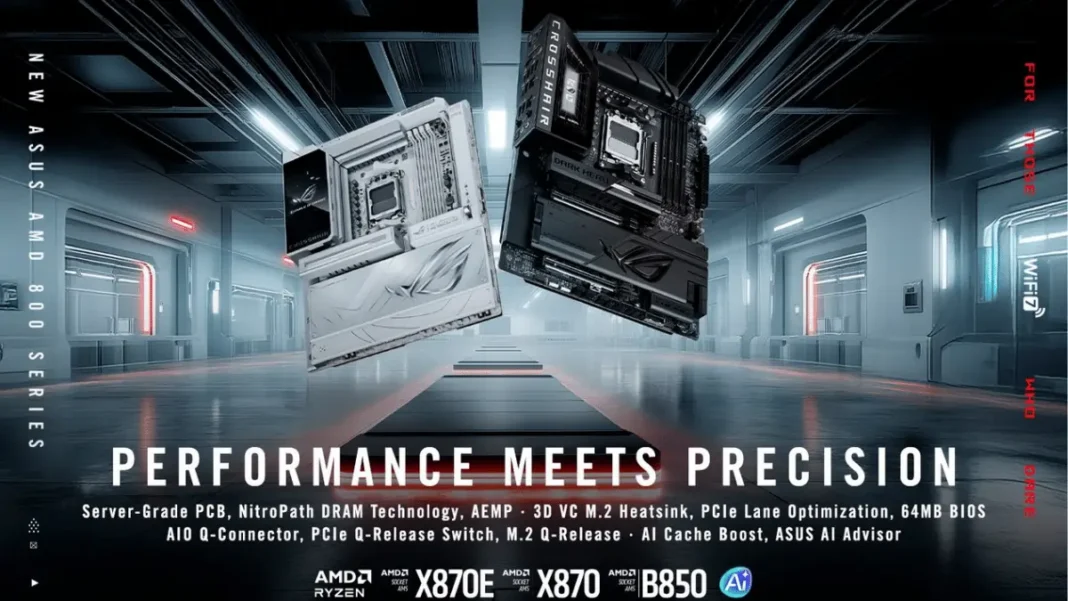
ASUS announced its new AMD 800 series motherboards at CES 2026, featuring the industry-first wireless AIO Q-Connector technology that eliminates pump, fan, and LCD cables between coolers and motherboards. The lineup includes refreshed ROG Strix, TUF Gaming, and ProArt models across X870E, X870, and B850 chipsets, all supporting AMD Ryzen 9000 series processors.
What’s New in the AMD 800 Series Lineup
ASUS introduced motherboards across three chipsets X870E, X870, and B850 with official availability starting January 2026. The X870E represents the flagship tier with dual Promontory 21 chipset dies plus USB4 support, while X870 uses a single die with USB4, and B850 serves as the mainstream option. All models feature a 64-megabyte BIOS chip (up from previous 32MB), enabling extended CPU compatibility with current and future AM5 processors.
The refresh brings NitroPath DRAM technology with shorter gold finger pins and optimized signal pathways for enhanced DDR5 stability and overclocking. Server-grade PCB enhancements include ultra-low-etch manufacturing, back drilling, 2-ounce copper power planes, and 8-layer design for cleaner signal integrity. ASUS also introduced AEMP (ASUS Enhanced Memory Profile) and DIMM Fit Pro for automatic memory optimization.
Select models now support 4-rank memory using UDIMM modules, developed in partnership with G.SKILL for the ROG Crosshair X870E Apex 4-RANK. This configuration targets data-intensive AI, engineering, and content creation workloads requiring high capacity with low latency.
AIO Q-Connector Eliminates Cable Clutter
The ROG Strix LC IV AIO cooler series debuts with wireless AIO Q-Connector technology, transmitting pump control, fan signals, and LCD data through contact points without physical cables. When paired with compatible motherboards, builders simply align the connector with no manual cable routing to motherboard headers. The coolers feature a 5.08-inch full-color IPS display and come in standard-tubing and short-tubing (SLC) variants.
This addresses a long-standing pain point in PC building, where AIO installations typically required connecting two or more cables between the pump block and motherboard. The technology debuts on select ASUS AMD 800 series boards announced at CES 2026.

PCIe Lane Optimization for Multi-Drive Setups
ASUS redesigned PCIe lane allocation to support multiple high-speed SSDs without reducing GPU bandwidth. The ROG Strix X870E-E Gaming WiFi7 Neo enables two PCIe 5.0 M.2 SSDs and three PCIe 4.0 M.2 SSDs while maintaining full PCIe 5.0 x16 for graphics cards. This is achieved by bandwidth sharing between USB4 ports and the second M.2 slot.
The flagship ROG Crosshair X870E Glacial winner of a CES 2026 Innovation Award runs the first PCIe 5.0 x16 slot and two PCIe 5.0 M.2 slots at full speed while allowing the second PCIe slot to operate at PCIe 3.0 x4 for capture cards. For multi-GPU configurations, the ProArt B850-Creator WiFi Neo and ROG Crosshair X870E Glacial support x8/x8 splits on dual PCIe x16 slots.
AI Features and DIY Enhancements
New AI-powered features include AI Cache Boost for accelerating large language model (LLM) tasks, ASUS AI Advisor as a natural-language build assistant, and updated AI Overclocking, AI Cooling II, and AI Networking II tools. The pre-installed WiFi driver in BIOS enables internet connectivity during Windows installation without USB flash drives.
DIY-friendly upgrades include the PCIe Q-Release Switch on ROG Crosshair X870E Glacial, which uses a lever mechanism to unlock two expansion slots for tool-free graphics card removal. Other Q-series features include M.2 Q-Release heatsinks, M.2 Q-Latch, M.2 Q-Slide, Q-Antenna, and front-panel USB-C with 60W Quick Charge 4+ support. The ROG Crosshair X870E Glacial adds a magnetically attached ROG Memory Q-Fan for DDR5 cooling.
The refreshed ROG Q-DIMM.2 and ROG Hyper M.2 add-in cards now use screw-less designs, allowing up to seven M.2 storage devices on select motherboards. A new MLO Wizard feature assesses network environments for Multi-Link Operation support and visualizes traffic capacity across router frequency bands.
AMD AM5 Socket and Chipset Support
All ASUS AMD 800 series motherboards use the AM5 socket and support AMD Ryzen 7000, 8000, and 9000 series processors with compatible BIOS versions. The AM5 platform supports DDR5 memory exclusively DDR4 is not compatible. AMD confirmed AM5 socket support through 2027, ensuring longevity for builders.
The X870E chipset provides PCIe 5.0 x16 (or dual x8) from the CPU, plus PCIe 5.0 x4 for SSDs and mandatory USB4 support. B850 offers CPU overclocking support and PCIe 5.0 for NVMe SSDs with PCIe 4.0 for the primary graphics card slot. The B850 and B840 chipsets launched in early 2025 after initial X870/X870E availability in September 2024.
What This Means for PC Builders
The wireless AIO Q-Connector represents the most significant installation simplification since tool-free M.2 latches became standard. Cable routing between AIO pump blocks and motherboard headers has traditionally added 5-10 minutes to build time and created visual clutter in windowed cases. The technology requires compatible hardware on both ends, limiting immediate adoption but setting a new industry direction.
The optimized PCIe lane layouts address a real bottleneck for gamers expanding storage libraries. Previous-generation boards often forced users to choose between full GPU bandwidth and multiple PCIe 5.0 SSDs. ASUS solved this through creative bandwidth sharing, particularly beneficial as game install sizes continue growing past 100GB for AAA titles.
For memory-intensive workloads, 4-rank UDIMM support on select boards enables higher-capacity configurations without enterprise RDIMM pricing. Content creators and AI developers running local LLMs can now build workstation-class systems on mainstream AM5 platforms.
Availability and Pricing
ASUS announced the AMD 800 series motherboard refresh on January 6, 2026 at CES 2026. The company has not disclosed specific pricing or retail availability dates for individual models. The ROG Strix LC IV AIO cooler series launches alongside the motherboards with both standard and short-tubing (SLC) variants.
Feature sets vary by model, with flagship ROG Crosshair boards receiving the most comprehensive Q-series installation features and PCIe optimization. Budget-focused TUF Gaming and mainstream ProArt models include select features based on target use cases. Specific model SKUs and regional availability details remain pending official retail announcements.

Featured Snippet Boxes
What is AIO Q-Connector technology?
AIO Q-Connector is ASUS’s wireless connection system that transmits pump control, fan signals, and LCD display data between compatible AIO coolers and motherboards through contact points, eliminating the need for separate cables to motherboard headers.
Which AMD processors work with 800 series motherboards?
ASUS AMD 800 series motherboards support all AM5 socket processors, including Ryzen 7000, 8000, and 9000 series CPUs. Older Ryzen 8000 and 9000 series processors may require BIOS updates on 600-series boards, but 800-series boards include native support.
What’s the difference between X870E and B850 chipsets?
X870E uses dual Promontory 21 chipset dies with mandatory USB4, PCIe 5.0 x16 GPU support, and more PCIe lanes, SATA ports, and USB ports. B850 uses a single die with CPU overclocking support, PCIe 5.0 for SSDs, and PCIe 4.0 for graphics cards, but no mandatory USB4.
Do AMD 800 series motherboards support DDR4 memory?
No. All AM5 socket motherboards, including the 800 series, exclusively support DDR5 memory in dual-channel configuration. DDR4 is not compatible with the AM5 platform, unlike Intel’s LGA 1700 socket which supports both.

