

Quick Brief
- Apple begins Mac mini production at a new 220,000 sq ft Houston factory later in 2026, the first time ever on US soil
- The Houston campus expands to 500,000 sq ft total, combining Mac mini and AI server manufacturing
- Apple’s $600 billion US investment commitment, expanded in August 2025, underpins this move alongside 20 billion US-made chips already sourced
- A 20,000 sq ft Advanced Manufacturing Center opens in Houston later this year to train students, suppliers, and small businesses
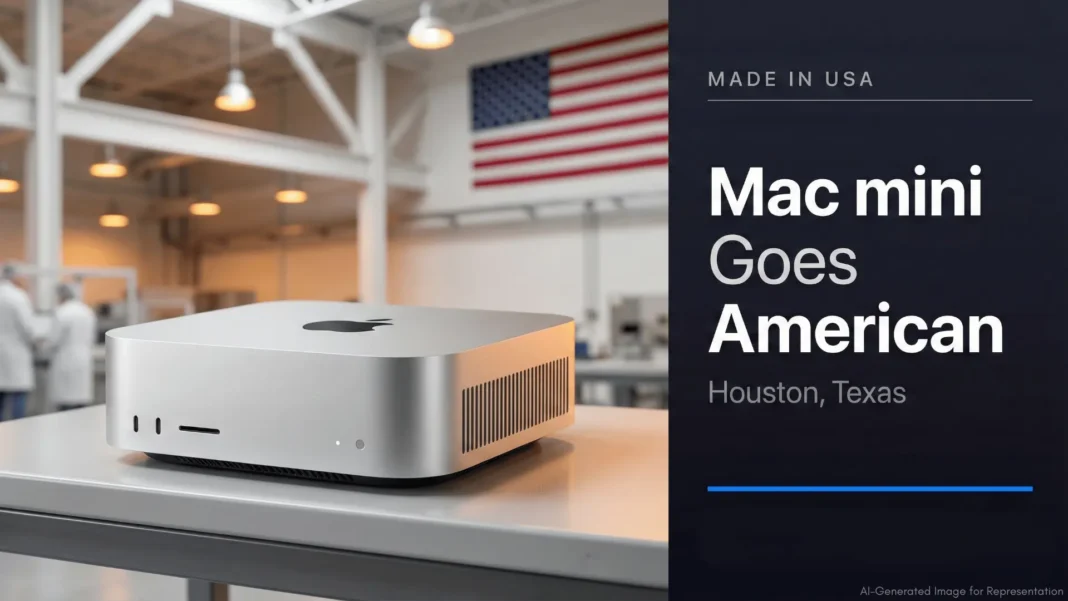
Apple just moved one of its most iconic products to American soil, and the decision carries weight far beyond a single factory. For the first time in its history, the Mac mini will be assembled in the United States, at a Foxconn-operated campus in north Houston, Texas.
This is not a symbolic gesture. Apple COO Sabih Khan told The Wall Street Journal directly, in the first public tour Apple has granted of the facility, that a 220,000 sq ft warehouse is being converted for Mac mini production. The move is part of Apple’s $600 billion US investment commitment expanded at the White House in August 2025.
Why Apple Is Bringing Mac Mini Production to Houston
Apple’s decision is driven by two documented forces: tariff pressure from the Trump administration and a strategic push to reduce dependency on Asian supply chains. President Trump threatened 25% tariffs on cellphones manufactured abroad as early as May 2025, and Apple’s manufacturing guidance now explicitly assumes “global tariff rates, policies, and their application remain in effect.”
The Houston site already produces Apple’s advanced AI servers, which power Apple Intelligence and Apple’s Private Cloud Compute infrastructure. That server facility shipped its first units in late 2025, ahead of schedule, and assembles approximately 10 servers per hour. Adding Mac mini production to the same campus is a deliberate escalation from enterprise infrastructure to consumer hardware.
COO Sabih Khan confirmed that Mac mini production in Asia will continue to serve customers outside the United States. The Houston output targets domestic demand specifically, running in parallel with, not replacing, existing Asian manufacturing.
What the Houston Factory Actually Looks Like
Apple’s Houston campus began as a 250,000 sq ft AI server facility, operational in late 2025. The Mac mini expansion adds a newly converted 220,000 sq ft building, bringing the total campus footprint to approximately 500,000 sq ft.
The facility is operated by Foxconn, Apple’s longtime contract manufacturing partner. Rather than building a greenfield campus, Apple repurposed existing industrial space to compress setup timelines, though this approach limits initial throughput compared to high-scale Asian production lines. Foxconn’s established presence bridges logistics and labor gaps during the production ramp.
Apple has signaled cautious volume forecasting for this line. Expect staged capacity increases and prioritization of US retailer and enterprise inventory buffers before any broader scaling.
The Mac Mini M4: What You Are Actually Buying
The Mac mini M4 starts at $599 in the US, making it Apple’s most affordable desktop computer. It was redesigned in late 2024 with a dramatically smaller 5-by-5-inch enclosure and ships with Apple’s M4 and M4 Pro chips. In India, the base model is priced at approximately Rs 59,900.
The base M4 chip packs a 10-core CPU, 10-core GPU, and 16-core Neural Engine inside a sub-20W power envelope. This configuration handles 4K video editing, machine learning workloads, and Apple Intelligence features at a performance level that competing Windows desktops at this price struggle to match.
The M4 Pro variant steps up to a 12-core CPU, 16-core GPU, and 24GB unified memory. For content creators, developers, and small businesses running AI-intensive workflows, the Pro model delivers desktop-class performance at a fraction of a traditional workstation’s footprint.
Apple Intelligence and AI Server Production: The Bigger Picture
Apple’s Houston campus serves a dual function. The AI server line supplies Apple’s data centers across the US, providing the compute backbone for Apple Intelligence features on every iPhone, iPad, and Mac. CEO Tim Cook confirmed on Apple’s January 2026 earnings call: “We’re especially proud of the work we’re doing to support American innovation.”
Apple sourced over 20 billion US-made chips from 24 factories across 12 states in 2025, from partners including TSMC, Broadcom, and Texas Instruments. In 2026, Apple is on track to purchase well over 100 million advanced chips from TSMC’s Arizona facility alone. Apple is also working with Micron on a new advanced chip packaging and test facility.
Apple’s Q1 2026 revenue reached $143.8 billion, with a gross profit of $69.2 billion, providing the financial foundation for this manufacturing expansion. The company’s Q2 2026 gross margin guidance of 48 to 49% signals confidence that US manufacturing costs remain manageable.
Apple’s US Supply Chain Milestones
| Milestone | Partner | Detail |
|---|---|---|
| 20B+ US-made chips sourced in 2025 | TSMC, Broadcom, Texas Instruments | 24 factories across 12 states |
| AI server facility operational | Foxconn, Houston | 250,000 sq ft; shipping since late 2025 |
| $4B silicon wafer plant | GlobalWafers | Sherman, Texas; supplies Apple’s US chip partners |
| $7B packaging facility | Amkor | Peoria, Arizona; Apple is first and largest customer |
| $2.5B cover glass partnership | Corning | Harrodsburg, Kentucky; 100% dedicated to Apple iPhone and Apple Watch |
| Mac mini production facility | Foxconn, Houston | 220,000 sq ft; production begins later in 2026 |
The Advanced Manufacturing Center: Training the Next Workforce
Apple is opening a 20,000 sq ft Advanced Manufacturing Center at the Houston campus later in 2026. The facility offers hands-on training in the exact techniques Apple uses to build its own products, open to students, supplier employees, and US businesses of all sizes.
Apple already operates a Manufacturing Academy in Detroit, currently supporting more than 130 small and medium-sized American manufacturers with training in AI, automation, and smart manufacturing. The Houston center extends this program to the South, with virtual programming for nationwide reach.
For Indian tech professionals watching US manufacturing trends, this shift signals Apple is reshoring skills and workforce infrastructure alongside assembly lines, not treating them as separate investments.
Limitations and Considerations
Apple’s US Mac mini production will initially be limited in volume and scope. Asian factories will continue supplying the majority of global Mac mini units, and the repurposed Houston warehouse will ramp capacity gradually. Buyers outside the US should not expect “Made in USA” units. US manufacturing typically carries higher labor costs, and investors will watch closely for any margin pressure as Houston volumes scale.

Frequently Asked Questions (FAQs)
Where will Apple manufacture the Mac mini in the US?
Apple will produce Mac mini at a newly converted 220,000 sq ft building within its north Houston, Texas campus, operated by Foxconn. The site already runs AI server production and will begin Mac mini assembly later in 2026, targeting US domestic demand.
Will Apple stop making Mac mini in Asia?
No. Apple COO Sabih Khan confirmed that Mac mini production in Asia continues for customers outside the United States. The Houston line runs in parallel with Asian manufacturing, not as a replacement. Global volumes will still be sourced from Asia for the foreseeable future.
What is Apple’s total US investment commitment?
Apple initially committed $500 billion in February 2025, then expanded that pledge to $600 billion at a White House event in August 2025. The investment covers manufacturing, chip supply chain partnerships, AI infrastructure, workforce training, and R&D across multiple states.
What does the Mac mini M4 cost in the US and India?
The Mac mini M4 starts at $599 in the US and approximately Rs 59,900 in India. Apple has not announced any price changes tied to US production. Cost implications of domestic manufacturing will depend on production scale and tariff outcomes.
What is the Apple Advanced Manufacturing Center in Houston?
It is a 20,000 sq ft training facility opening at Apple’s Houston campus later in 2026. It offers hands-on instruction in Apple’s manufacturing techniques for students, supplier employees, and businesses nationwide, expanding on Apple’s existing Detroit Manufacturing Academy model.
Why is Apple moving manufacturing to the US now?
Two primary factors drive the shift: the Trump administration’s tariff pressure on goods manufactured in Asia, and Apple’s $600 billion US investment commitment expanded in August 2025. Apple’s own guidance now explicitly accounts for current tariff policies remaining in effect.
What other US supply chain investments has Apple made?
Apple secured US chip production through TSMC Arizona, GlobalWafers Texas, and Amkor Arizona. Corning’s Kentucky facility is now 100% dedicated to iPhone and Apple Watch cover glass. Apple also sourced 20 billion US-made chips from 24 factories across 12 states in 2025.
Could Apple expand US manufacturing to other products beyond Mac mini?
Apple has not announced plans for other consumer products. However, Fintool’s analysis notes that if Mac mini production succeeds, Apple could extend US manufacturing to other product lines. The Mac mini was chosen partly because it is a low-volume, lower-complexity product relative to iPhone.

