

Quick Brief
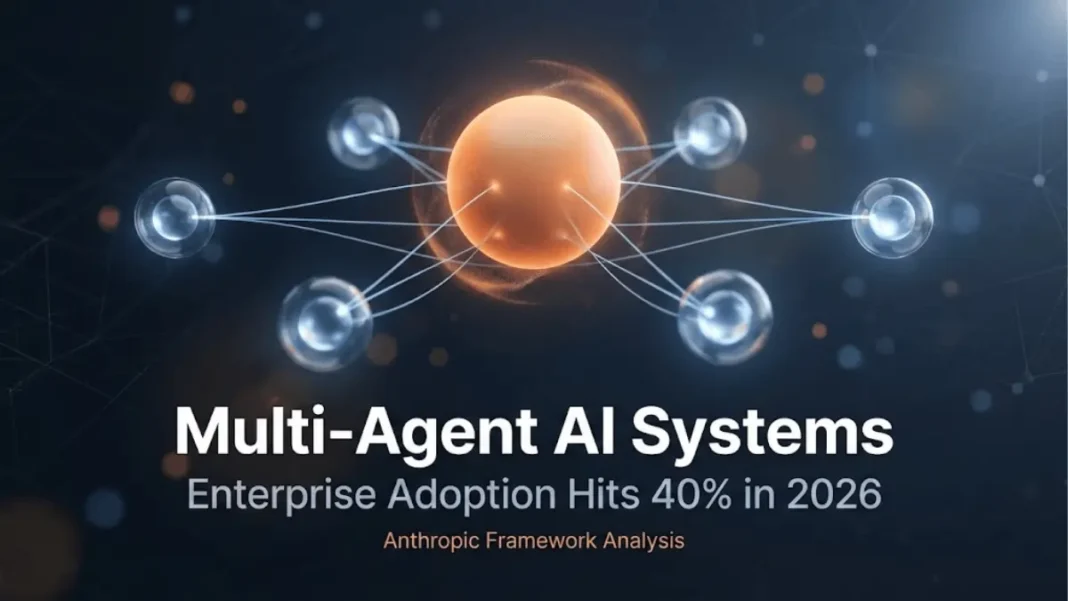
- The Framework: Anthropic published technical guidance on January 22, 2026, identifying three scenarios where multi-agent architectures justify 3-10x token cost increases over single-agent implementations: context protection, parallelization, and specialization
- The Market Context: Gartner projects 40% of enterprise applications will integrate task-specific AI agents by December 2026, up from less than 5% in 2025, while only 2% of organizations have achieved full-scale deployment
- The Financial Impact: Organizations deploying multi-agent systems report 171% average ROI within 12-18 months, 30% cost reductions, and 35% productivity gains, with multi-agent architectures delivering 45% faster problem resolution and 60% more accurate outcomes than single-agent approaches
Anthropic released technical documentation on January 22, 2026, establishing decision frameworks for multi-agent AI system implementation as enterprise adoption accelerates toward Gartner’s 40% year-end target. The framework addresses a persistent implementation challenge: companies frequently build elaborate multi-agent architectures only to discover improved prompting on single agents achieves equivalent results at significantly lower cost.
The guidance arrives as enterprises navigate the gap between pilot success and production deployment. While 65% of organizations test AI agents, only 2% have achieved full-scale implementation, revealing structural challenges in transitioning from controlled experiments to enterprise rollouts.
The Three Deployment Scenarios Justifying Multi-Agent Costs
Anthropic identifies context protection, parallelization, and specialization as the only scenarios consistently delivering positive returns on multi-agent investment. Multi-agent implementations typically consume 3-10x more tokens than single-agent approaches due to context duplication across agents, coordination overhead, and result summarization during handoffs.
Context protection applies when subtasks generate over 1,000 tokens of information but most remains irrelevant to the main task. Customer support agents retrieving order history while diagnosing technical issues exemplify this pattern spawning specialized order lookup subagents prevents context pollution in the main diagnostic agent.
Parallelization enables exploration across larger information spaces than single agents can cover within context limits. Anthropic’s Research feature decomposes queries into independent facets and runs subagents concurrently, demonstrating substantial accuracy improvements over single-agent sequential approaches. The primary benefit is thoroughness rather than speed, as parallel agents often require longer total execution time despite reduced per-task latency.
Specialization addresses tool selection degradation when agents manage 20+ tools spanning multiple unrelated domains. Splitting generalist agents with 40+ tools across CRM, marketing automation, and messaging platforms into specialized agents with focused 8-10 tool subsets resolves selection errors and confusion between similar operations across platforms.

Orchestrator-Subagent Pattern Architecture
The orchestrator-subagent pattern implements a hierarchical model where a lead agent spawns and manages specialized subagents for specific subtasks. This coordination model provides a straightforward starting point for teams new to multi-agent systems, though Anthropic notes other patterns including agent swarms, capability-based systems, and message bus architectures exist.
Critical to successful implementation is context-centric decomposition rather than problem-centric division. Teams frequently make incorrect decomposition choices by dividing work by type separate agents for planning, execution, review, and iteration creating constant coordination overhead where each handoff loses context. Effective decomposition follows context boundaries: independent research paths investigating separate geographic markets, separate components with clean API interfaces, or blackbox verification requiring no implementation context.
The verification subagent pattern consistently delivers value across domains by dedicating agents solely to testing or validating main agent work. Verification succeeds because it requires minimal context transfer verifiers blackbox-test systems without needing full build history. However, verification subagents face an “early victory problem” where agents mark outputs as passing after running one or two tests without comprehensive validation.
Market Adoption Trajectories and Protocol Standardization
Three coordination protocols emerged to enable multi-agent collaboration across vendors: Anthropic’s Model Context Protocol (MCP) with 97 million+ monthly downloads, Google’s Agent-to-Agent (A2A) protocol with 50+ technology partners, and IBM’s Agent Communication Protocol (ACP) adding governance for regulated industries. The MCP GitHub repository climbed from zero to 42,000 followers in one year, signaling developer adoption velocity.
Anthropic announced Claude Cowork on January 12, 2026, extending multi-agent coordination beyond developers to non-technical knowledge workers. Cowork implements subagent coordination for parallelizable tasks, spawning multiple Claude instances that execute concurrently and aggregate results. The feature launched initially on macOS preview, expanded to Pro plans on January 16, and became available to Team and Enterprise plans on January 23, 2026.
IDC expects 80% workplace integration of AI agents by year-end, but implementation challenges remain severe: 65% of organizations cite system complexity, 33% report quality issues, and 46% face integration problems. Gartner predicts 40%+ of agentic AI projects will fail by 2027 due to escalating costs, unclear business value, or insufficient risk controls.
Infrastructure Cost-Benefit Analysis
Multi-agent architectures introduce measurable overhead: every additional agent represents another potential failure point, another set of prompts to maintain, and another source of unexpected behavior. Token usage increases 3-10x compared to single-agent approaches for equivalent tasks, but organizations achieving successful deployment report 171% average ROI within 12-18 months.
Performance metrics from enterprise deployments validate the specialization advantage: multi-agent systems deliver 45% faster problem resolution and 60% more accurate outcomes compared to single-agent approaches. Gartner projects that by 2029, 80% of standard customer service queries will be handled autonomously by AI agents, enabling up to 30% operating cost reductions.
Digital marketing agencies demonstrate concrete time savings: content audits completing 81% faster (8 hours to 1.5 hours) using subagent orchestration, with 70% cost reduction through intelligent model allocation across Haiku, Sonnet, and Opus tiers. Dynamic model selection where Claude automatically chooses which model each subagent uses based on task complexity enables cost-optimized multi-model orchestration for marketing workflows.
Implementation Thresholds and Single-Agent Limits
Anthropic identifies three signals indicating single-agent architectures have been outgrown: approaching context limits where agents routinely use large context volumes with degrading performance, managing 15-20+ tools where models spend significant attention understanding options, and parallelizable subtasks that naturally decompose into independent pieces.
Before adopting multi-agent architectures, Anthropic recommends considering Tool Search Tool, which lets Claude dynamically discover tools on-demand rather than loading all definitions upfront. This approach reduces token usage by up to 85% while improving tool selection accuracy. Recent advances in context management including compaction are reducing context limitations, allowing single agents to maintain effective memory across longer horizons.
Current thresholds represent practical guidelines rather than fundamental constraints as models improve. Anthropic emphasizes starting with the simplest approach that works and adding complexity only when evidence supports the transition. Teams should confirm genuine constraints exist context limits, parallelization opportunities, or specialization needs before introducing multi-agent coordination overhead.
Production Deployment Considerations
The 2% full-scale deployment rate despite 65% experimentation reveals a production readiness gap. Companies successfully run pilots and demonstrate value in controlled environments before encountering barriers during enterprise rollouts.
Organizations must invest in proper integration and observability infrastructure while committing to realistic implementation timelines and budgets. Anthropic reports thousands of Claude Code sessions launched daily since the web rollout in October 2025, compared to narrower highly technical audiences for earlier CLI-only workflows. Integrating agents inside familiar IDEs and chat interfaces broadens adoption beyond core platform engineers.
Frequently Asked Questions (FAQs)
When should enterprises use multi-agent AI systems?
Deploy multi-agent architectures when context pollution degrades performance, tasks can run in parallel, or specialization improves tool selection. Outside these scenarios, coordination costs typically exceed benefits.
What is the orchestrator-subagent pattern in AI?
A hierarchical model where a lead agent spawns and manages specialized subagents for specific subtasks, providing straightforward coordination for teams new to multi-agent systems.
How do multi-agent systems reduce enterprise costs?
Organizations report 30% cost reductions and 171% ROI within 12-18 months through 45% faster problem resolution and 60% more accurate outcomes compared to single-agent approaches.
Why do 40% of agentic AI projects fail?
Gartner attributes failure to escalating token costs (3-10x higher than single agents), unclear business value, and insufficient risk controls. Implementation challenges include system complexity (65%), quality issues (33%), and integration problems (46%).

