

Quick Brief
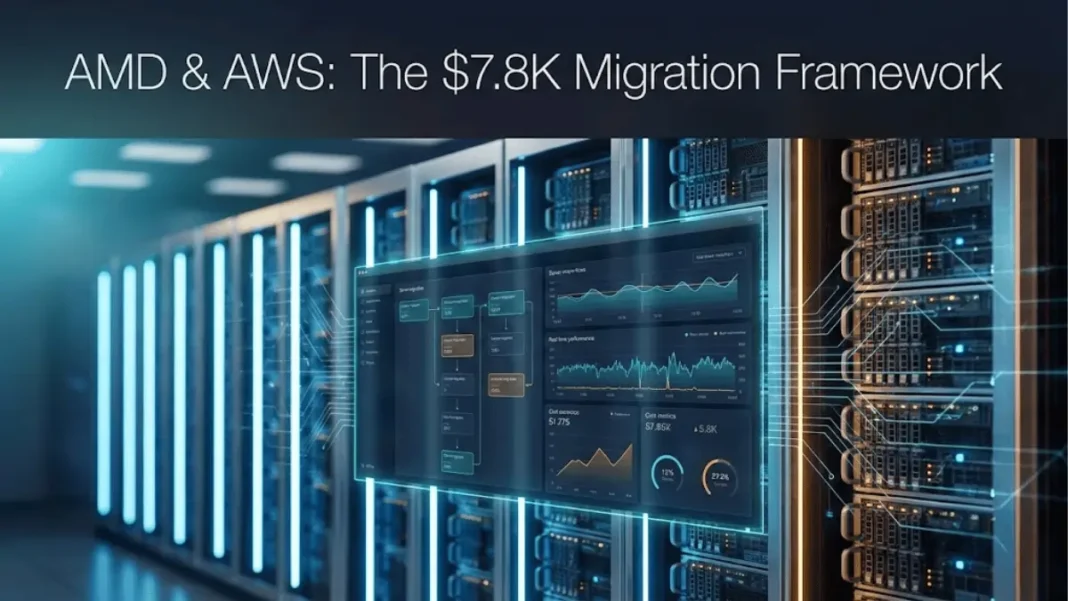
- The Framework: AMD published a five-step EC2 migration protocol on January 16, 2026, targeting enterprises running AWS workloads with documented cost reductions of 10-15% (up to 45% regionally)
- The Financial Impact: Organizations achieve $7,880 annual savings per instance through optimized AMD EPYC-powered configurations, with Capital One benchmarking 43% performance improvements
- The Market Context: Over 100 AMD EPYC EC2 instance types now operate across 25 AWS regions, marking aggressive infrastructure competition against Intel-based alternatives
AMD released a technical migration framework for AWS EC2 workloads on January 16, 2026, addressing enterprise demand for cost-optimized cloud infrastructure. The five-step protocol enables organizations to transition existing x86 workloads to AMD EPYC-powered instances without architectural changes, targeting immediate operational expense reductions across compute-intensive environments.
AMD’s Five-Step EC2 Migration Protocol
The framework eliminates traditional cloud migration complexity by restricting changes to instance type modifications. Organizations validate instance compatibility by examining AWS naming conventions the “a” suffix in instance types like c7a.xlarge or m8a.2xlarge indicates AMD EPYC processors. Critical validation includes confirming x86 compatibility, as ARM-based Graviton instances (g, m1ultra, m2, m2pro designations) require application recompilation and cannot use this streamlined approach.
The backup phase mandates EBS snapshots or AMI captures immediately before migration, regardless of existing backup schedules. AMD emphasizes stopping instances rather than terminating them, a distinction that prevents accidental data loss when “Delete on Termination” flags exist on attached volumes. The actual migration executes through AWS Console for small deployments, AWS CLI/PowerShell/Boto3 for production environments, or AWS Systems Manager for enterprise-scale automation.
Post-migration validation requires EC2 health check confirmation, application service testing, and performance monitoring before declaring success. Failure scenarios trigger either instance type reversion or AMI restoration, with AMD documenting Microsoft SQL Server as requiring extended shutdown windows due to memory flush operations.
Infrastructure Economics: The Cost-Performance Equation
AMD EPYC-powered EC2 instances deliver 10-15% baseline cost reductions compared to comparable x86 alternatives, with regional pricing variations reaching 45% in specific AWS zones. Benchmark testing published January 14, 2026, quantifies $7,880 annual savings per instance through vCPU optimization organizations reducing virtual CPU allocations while maintaining or improving workload performance.
Capital One’s engineering team benchmarked 7th-generation AMD-powered M8a instances, documenting 43% performance gains that Senior Distinguished Engineer Brent Segner characterized as “a step-function increase in performance for the cost“. The M8a series delivers 45% greater memory bandwidth versus M7a predecessors, with specific workload acceleration reaching 60% for GroovyJVM applications and 39% for Cassandra databases. Digital services provider 9.9 Group reported 35% cost savings paired with 45% latency reductions after migrating to 3rd Gen AMD EPYC instances.
Energy efficiency metrics show AMD instances consume 213 fewer watts on average, achieving 2.7x better performance-per-watt ratios against Intel-based configurations. This positions AMD EPYC infrastructure as dual-optimization for both operational costs and ESG compliance targets.
Technical Specifications: AMD EPYC EC2 Instance Portfolio
| Instance Series | Generation | Core Frequency | Key Performance Metric | Primary Use Case |
|---|---|---|---|---|
| M8a | 5th Gen EPYC | N/A | 45% more memory bandwidth vs M7a | High-performance databases, SAP workloads |
| M7a | 4th Gen EPYC | N/A | Same throughput as M6i with fewer instances | General-purpose computing |
| C6a | 3rd Gen EPYC (Milan) | 3.6 GHz all-core turbo | 15% better price-performance vs C5a | Compute-intensive workloads |
| R6a | 3rd Gen EPYC (Milan) | 3.6 GHz all-core turbo | 35% better price-performance vs R5a | Memory-intensive applications |
| Hpc7a | 4th Gen EPYC | N/A | 2.5x better performance vs prior HPC instances | High-performance computing |
AMD EPYC instances maintain x86 architecture compatibility, enabling low-friction migrations without application recompilation. The portfolio spans 100+ instance types across 25 AWS regions, with sizes ranging from 2 vCPUs to 192 vCPUs and up to 384 GiB memory in C6a configurations.
Strategic Partnership: AMD-AWS Cloud Infrastructure Alignment
Mission Cloud (a CDW company) formalized a strategic collaboration with AMD in September 2025 to accelerate enterprise EC2 migrations. The partnership leverages Mission’s AWS Premier Tier Services status to deploy AMD EPYC Advisory Suite tools, which algorithmically match workload requirements to optimal instance configurations. CDW President Ted Stuart framed the collaboration as addressing pressure to “do more with less while advancing innovation and sustainability“.
AMD Corporate Vice President Brian Holley stated that EPYC-powered instances “continue to grow in popularity with their price-performance, scalability, and efficiency leadership for the most demanding cloud-based workloads“. The November 2025 expansion of the AMD-AWS partnership introduced 5th Gen AMD EPYC processors into the EC2 portfolio, targeting AI-ready enterprise deployments and generative AI workloads. This positions AMD against Intel’s Xeon Scalable processors and AWS’s proprietary Graviton ARM chips in the $200+ billion cloud infrastructure market.
Enterprise Adoption Roadmap and Regulatory Considerations
AMD’s migration framework emphasizes maintenance window alignment for workloads requiring extended downtime, particularly database systems with large memory footprints. The company recommends automating migrations through AWS Systems Manager for organizations managing hundreds of instances, transforming the process into “a reboot with benefits“.
Regulated industries face additional validation requirements, as AMD advises double-checking vendor documentation for Intel-specific instruction set dependencies though such constraints are increasingly rare in modern software. Third-party tools like CloudFix now automate AMD migration candidate identification and execute instance type changes programmatically.
The AMD EPYC Advisory Suite provides pre-migration workload analysis, while the company offers direct engineering support through AWS@AMD.com for complex architectural decisions. Organizations combining multiple optimization strategies across heterogeneous workloads report maximum ROI, according to AMD technical documentation.
Frequently Asked Questions (FAQs)
What cost savings do AMD EC2 instances provide?
AMD EPYC instances cost 10-15% less than Intel equivalents, with specific configurations saving $7,880 annually per instance through optimized vCPU allocation.
Can ARM-based instances migrate to AMD using this framework?
No. AWS Graviton (ARM) instances require application recompilation. AMD’s framework applies only to x86-to-x86 migrations.
How long does EC2 instance type migration take?
The process requires stopping the instance, changing type, and restarting typically under 10 minutes excluding application-specific validation.
Do AMD instances support all AWS regions?
AMD EPYC-powered instances operate across 25 AWS regions with 100+ instance type options.

