

Key Takeaways
- Cursor cloud agents now autonomously create more than one-third of all internal pull requests at Cursor
- The developer ratio flipped: Cursor now has 2x more agent users than Tab users, reversed from 2.5x more Tab users in March 2025
- Each cloud agent runs on its own dedicated virtual machine, enabling hours-long autonomous task execution
- Agents return logs, video recordings, and live previews instead of diffs, making parallel review fast and practical
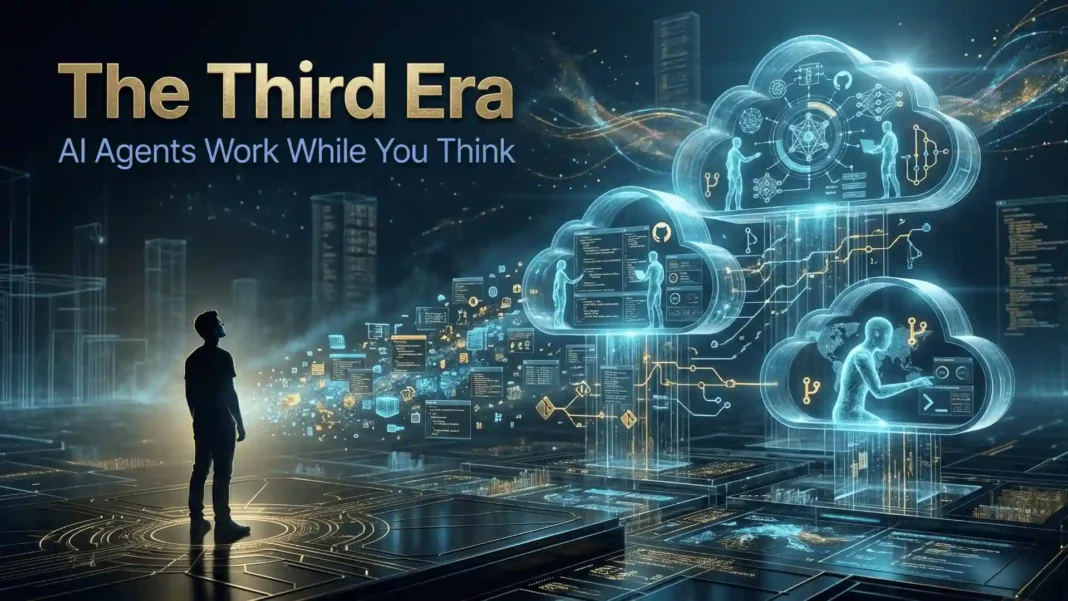
Software development just crossed a threshold that most developers have not fully registered yet. Cursor’s cloud agents no longer assist with code. They write it, test it, and return merge-ready pull requests while the developer focuses elsewhere entirely. This is the third era of AI software development, and the gap between teams using it and teams that are not is widening fast.
How We Got Here: Three Eras in Three Years
The first era started with Tab autocomplete. Cursor’s Tab feature identified low-entropy, repetitive code patterns and automated them, delivering significant leverage for nearly two years. Most developers at the time still wrote the majority of their logic manually, using Tab to remove friction at the margins.
The second era arrived when large language models improved enough to function as synchronous agents. Developers shifted from typing code to directing agents through back-and-forth prompt loops. This kept humans in the loop at every step, which was useful but limiting. Synchronous agents competed with local machine resources and demanded near-constant developer attention.
The third era removes both constraints. Cloud agents run on isolated virtual machines, take a task, work through it over hours, and return logs, video recordings, and live previews for review. The developer’s role shifts from writing code to defining problems and evaluating outcomes.
The Numbers Behind the Shift
In March 2025, Cursor had roughly 2.5x as many Tab users as agent users. That ratio has fully inverted. Cursor now has 2x as many agent users as Tab users, driven by rapid adoption following the releases of Opus 4.6, Codex 5.3, and Composer 1.5.
Developer habits shifted slowly through the summer of 2025, then accelerated sharply in the months that followed those model releases. Cursor’s own team believes the synchronous agent era may not survive a full year before cloud-native, autonomous workflows become the new baseline, a faster transition than the nearly two years the Tab era lasted.
What Cloud Agents Actually Do Differently
Synchronous agents keep the developer present at every decision point. Cloud agents do not. Each runs on its own dedicated virtual machine with full access to tools, test runners, and terminals, without competing for resources on the developer’s local machine.
The output format is built for fast human review. Instead of diffs that require reconstructing full session context, agents return logs, video recordings, and live previews. This makes parallel evaluation practical: developers can assess multiple agent outputs without rebuilding the context for each one individually.
Cursor describes this as a shift from guiding each line of code to defining the problem and setting review criteria. The factory metaphor Cursor uses is precise: developers no longer build the product directly, they build and oversee the system that builds it.
How Developers Are Adapting
Cursor’s internal data identifies three behavioral traits shared by developers who have fully adopted third-era workflows:
- Agents write close to 100% of their code
- Developers spend their time breaking down problems, reviewing artifacts, and giving feedback
- Multiple agents run simultaneously rather than guiding one agent through to completion
This restructuring shifts the core developer skill set. The highest-leverage activity is no longer writing clean functions. It is scoping tasks precisely enough that an agent can execute them autonomously, then evaluating output efficiently enough to stay unblocked.
Cursor vs. Competing Platforms in 2026
The agent-driven development market is now crowded, but each tool takes a distinct approach:
| Tool | Core Strength | Agent Model | Starting Price |
|---|---|---|---|
| Cursor | Cloud VM agents, parallel execution, full IDE integration | Asynchronous + synchronous | $20/month |
| GitHub Copilot Pro+ | Broadest model access, deep GitHub workflow integration | Synchronous with PR integration | $39/month |
| Windsurf | Fast performance, lower cost, large task delegation | Asynchronous, lighter setup | $10-15/month |
| Devin (Cognition) | High raw autonomy, browser and terminal access | Fully autonomous, enterprise-focused | Enterprise pricing |
For developers already inside a VS Code-based workflow, Cursor’s combination of IDE familiarity and cloud VM execution is currently the strongest option for parallel agentic work. GitHub Copilot Pro+ leads for teams deeply integrated with GitHub’s PR tooling. Windsurf offers a comparable agentic experience at lower cost for solo developers.
What Still Needs Work
Cursor directly acknowledges that cloud agents are not production-perfect. At industrial scale, a flaky test or broken environment that a single developer can work around becomes a failure that interrupts every agent run.
More broadly, Cursor states that agents still need to operate with full and consistent access to the tools and context they require before this approach becomes standard across software development. Teams without clean CI/CD pipelines and stable test infrastructure will encounter more noise than value from this workflow at this stage.
What This Means for Developers in India and the US
For developers in India, where engineering teams often work at high output-to-headcount ratios, cloud agents offer a structural advantage: one developer can direct multiple parallel agent tasks instead of executing each one manually. For US-based teams operating under faster sprint cycles, the ability to hand off overnight tasks to agents and review results at standup changes iteration speed meaningfully. Both contexts benefit from the same core shift: less time writing, more time deciding.
Frequently Asked Questions (FAQs)
What is the third era of AI software development according to Cursor?
The third era is defined by autonomous cloud agents that tackle large tasks independently over extended timescales with minimal human direction. Unlike synchronous agents that require constant developer input, these agents run in isolated cloud VMs, iterate on their own, and return reviewable artifacts including logs, video recordings, and live previews when finished.
How is Cursor’s cloud agent different from its previous Tab and Composer features?
Tab automated repetitive, low-complexity code. The second era introduced synchronous agent loops requiring developer presence at each step. Cloud agents operate asynchronously on dedicated virtual machines, running tests and iterating without interrupting the developer’s local workflow. Artifacts replace session transcripts as the primary review format.
What percentage of Cursor’s internal pull requests are now created by AI agents?
Cursor reports that more than one-third of all pull requests merged internally are created by autonomous agents running in cloud virtual machines. The company believes the vast majority of development work industry-wide will be done by these kinds of agents within one year.
How did the release of Opus 4.6, Codex 5.3, and Composer 1.5 affect adoption?
These three model releases triggered a sharp acceleration in agent adoption at Cursor. Developer habits had been shifting gradually through summer 2025, but following these releases, the shift moved rapidly, ultimately flipping the Tab-to-agent user ratio from 2.5x more Tab users to 2x more agent users.
Is the third-era workflow ready for all engineering teams?
Not universally. Cursor acknowledges that flaky tests and unstable environments that individual developers can navigate become consistent blockers at agent scale. Teams with solid CI/CD pipelines and clean test infrastructure will see the most reliable results. Teams without that foundation should stabilize their environment before adopting cloud agent workflows.
What skills matter most for developers working in the third era?
The highest-value skills shift from syntax fluency to task decomposition and artifact evaluation. Developers who can scope a problem clearly, anticipate where agents will fail, and review outputs efficiently will produce more than those focused primarily on writing speed or memorizing API patterns.
How does Cursor compare to GitHub Copilot and Windsurf for agentic development in 2026?
Cursor leads in parallel cloud agent execution and IDE integration for VS Code users. GitHub Copilot Pro+ offers the strongest GitHub workflow ties and broadest model access. Windsurf provides comparable autonomous task delegation at lower cost, making it a practical option for solo developers exploring agentic workflows.

