

Quick Brief
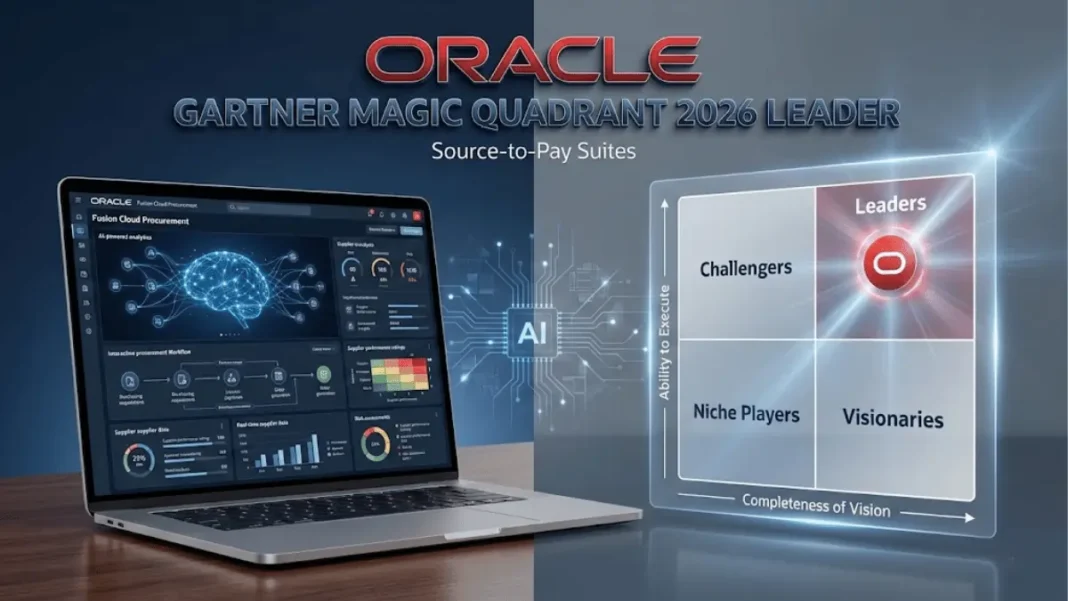
- Oracle recognized as Leader in 2026 Gartner Magic Quadrant for Source-to-Pay Suites
- Embedded AI agents automate requisitions, approvals, and supplier recommendations
- Gartner evaluated Oracle on Ability to Execute and Completeness of Vision
- Oracle joins GEP, SAP Ariba, Coupa, and Zycus in Leaders quadrant
Oracle has secured Leader positioning in Gartner’s 2026 Magic Quadrant for Source-to-Pay Suites, marking a significant validation of its AI-powered procurement strategy. The recognition highlights Oracle Fusion Cloud Procurement’s embedded automation capabilities that streamline workflows from sourcing to payment. Gartner published the report on January 21, 2026, evaluating vendors on execution strength and strategic vision.
Oracle’s AI-Powered Procurement Capabilities
Oracle Fusion Cloud Procurement differentiates itself through embedded AI agents that automate core source-to-pay tasks. These agents drive faster decision-making by handling product recommendations, supplier selection, requisition creation, and exception management without manual intervention. Tom Anthony, Oracle’s vice president of procurement product strategy, emphasized how organizations face pressure to operate efficiently amid volatility and complexity.
The platform integrates agentic AI a 2026 advancement that enables autonomous decision-making across procurement workflows. This approach contrasts with traditional automation by allowing systems to independently assess situations and execute actions based on predefined business rules and real-time data analysis.

Six Strategic Advantages for Procurement Teams
Accelerate procurement execution with AI agents
Embedded agents reduce manual effort across requisition-to-pay cycles. Organizations automate approval routing, supplier matching, and product recommendations, cutting processing time by eliminating repetitive administrative tasks.
Improve agility with AI-driven supplier management
Real-time visibility into supplier health and performance helps organizations anticipate risk. Self-service collaboration tools support onboarding, qualification, and monitoring while enabling suppliers to update information directly.
Drive greater value with AI-augmented strategic sourcing
Advanced analytics identify cost reduction opportunities and accelerate deal cycles. The system recommends sourcing strategies, selects optimal suppliers, and summarizes negotiation insights to support procurement teams during contract discussions.
Simplify complex requisitions and ordering with AI
Complex buying across multiple suppliers and locations becomes streamlined through tighter integration with item and supplier data. Purchase order capabilities improve fulfillment accuracy by validating orders against contracts and availability.
Streamline contract lifecycle management with generative AI
Contract authoring tools accelerate creation and reduce legal overhead. AI-powered policy insights support negotiations, amendments, and lifecycle management by flagging non-standard clauses and suggesting compliant language.
Enhance purchasing efficiency with intelligent search
Self-service capabilities increase spend control through AI-powered search. Automated purchase order creation and invoice processing streamline the buying experience while maintaining budget compliance.
Gartner’s Evaluation Criteria Explained
What is the Gartner Magic Quadrant for Source-to-Pay Suites?
The Gartner Magic Quadrant for Source-to-Pay Suites evaluates vendors on two dimensions: Ability to Execute and Completeness of Vision. Ability to Execute assesses product capabilities, customer experience, sales execution, and operations. Completeness of Vision examines market understanding, innovation strategy, and go-to-market approach. Gartner analysts Micky Keck, Kaitlynn Sommers, Lynne Phelan, Magnus Bergfors, and Alex Brady authored the 2026 report published January 21, 2026.
Competitive Landscape Analysis
Oracle joins four other vendors in the Leaders quadrant: GEP, SAP Ariba, Coupa, and Zycus. Coupa positioned highest for Ability to Execute among Leaders. Each vendor brings distinct capabilities to the enterprise procurement market.
GEP earned Leader positioning for the second consecutive year with its agentic AI platform for orchestration across procurement and supply chain operations. SAP Ariba operates the world’s largest business-to-business supplier network connecting millions of companies. The vendor modernized its architecture with AI-native capabilities in 2026.
Zycus also earned Leader recognition with its Intake-to-Outcomes approach and Merlin Agentic AI platform. The vendor emphasizes autonomous negotiation for tail spend and comprehensive S2P suite depth built organically rather than through acquisitions. Zycus demonstrates strong brand trust across US, EMEA, and APAC markets with superior customer satisfaction scores.
| Vendor | Key Differentiator | Primary Strength | Notable Feature |
|---|---|---|---|
| Oracle | Embedded AI agents | ERP integration | Generative AI contracts |
| Coupa | Highest Ability to Execute | Community Intelligence | Business Spend Management |
| GEP | Agentic AI orchestration | Unified supply chain | Fortune 500 focus |
| SAP Ariba | Largest B2B network | Supplier discovery | AI-native architecture |
| Zycus | Intake-to-Outcomes (I2O) | Merlin Agentic AI | Organic S2P suite |
Zip earned Visionary positioning as the only procurement orchestration platform in the analysis. The vendor represents the first new globally deployable procurement option in two decades.
Integration with Oracle Fusion Applications
Oracle Fusion Cloud Applications provide an integrated suite connecting procurement with finance, HR, supply chain, and customer experience on a single cloud platform. This architecture eliminates data silos that typically slow procurement decisions and create compliance gaps.
Oracle Fusion Cloud ERP delivers comprehensive finance and operations applications that increase productivity and reduce costs. Oracle Fusion Cloud Supply Chain & Manufacturing integrates with procurement to enhance resilience and adapt to market changes. Organizations using Oracle ERP gain native integration advantages compared to third-party procurement solutions requiring custom connections.
Implementation Considerations
What are the limitations of Oracle Fusion Cloud Procurement?
TOrganizations should evaluate integration complexity when connecting Oracle Procurement with non-Oracle ERP systems. The platform’s advanced capabilities require a clear internal strategy to avoid over-complicating workflows. Oracle’s supplier network operates at a different scale than SAP Ariba’s extensive B2B marketplace.
Market Impact and Future Direction
Gartner’s recognition reflects Oracle’s continued focus on innovation, execution, and measurable business outcomes. The embedded AI approach positions Oracle for organizations prioritizing automation over manual procurement processes. Oracle’s strategy emphasizes turning data into action through analytics that streamline source-to-pay processes, increase spend visibility, and enhance supplier collaboration.
The 2026 Magic Quadrant highlights industry shift toward agentic AI and autonomous procurement. Organizations evaluating source-to-pay platforms should assess AI maturity, integration requirements, and vendor alignment with existing technology stacks. Oracle’s positioning benefits enterprises already invested in Oracle Cloud Infrastructure and Fusion Applications seeking procurement capabilities without multi-vendor complexity.

Frequently Asked Questions (FAQs)
What is source-to-pay procurement software?
Source-to-pay software manages the complete procurement lifecycle from supplier sourcing and contract negotiation through purchase orders, invoicing, and payment. These integrated platforms reduce manual processes, improve spend visibility, and strengthen supplier relationships through automated workflows.
How does Oracle Fusion Cloud Procurement compare to competitors?
Oracle differentiates through native ERP integration and embedded AI agents for automation. SAP Ariba offers the largest supplier network with AI-native architecture. Coupa positioned highest for Ability to Execute among Leaders. GEP focuses on agentic AI orchestration across supply chains. Zycus emphasizes Intake-to-Outcomes with Merlin AI platform.
What does Leader positioning in Gartner Magic Quadrant mean?
Leader positioning indicates strong performance on both Ability to Execute and Completeness of Vision. Leaders demonstrate market-leading products, strong customer satisfaction, proven track records, and strategic vision for future market needs.
Who are the Leaders in the 2026 Gartner Magic Quadrant for Source-to-Pay?
Five vendors earned Leader positioning in 2026: Oracle, Coupa, GEP, SAP Ariba, and Zycus. Coupa positioned highest for Ability to Execute. Zip earned Visionary status.
Can Oracle Procurement integrate with non-Oracle ERP systems?
Oracle Fusion Cloud Procurement integrates with third-party ERP systems through APIs and middleware. However, native integration advantages favor organizations using Oracle ERP for finance and operations.
What industries benefit most from Oracle Fusion Cloud Procurement?
Oracle serves Fortune 500 and Global 2000 enterprises across manufacturing, retail, healthcare, and financial services. Organizations with complex procurement requirements, multiple suppliers, and global operations gain maximum value from Oracle’s comprehensive capabilities.
How does AI improve procurement efficiency?
AI automates requisition creation, supplier recommendations, contract analysis, and exception handling. Generative AI accelerates contract authoring and policy compliance checking. Advanced analytics identify cost reduction opportunities and optimize sourcing strategies.

