


Quick Brief
- The Launch: OpenAI will test contextual ads in ChatGPT’s free and Go tiers for logged-in adults in the US, while expanding low-cost ChatGPT Go worldwide, including India.
- The Impact: Enterprises, developers, and SMBs gain cheaper access to GPT‑5.2-class models, as OpenAI introduces an ad-funded path to sustain heavy inference costs.
- The Context: With only a minority of users paying subscriptions, OpenAI turns to advertising to monetize 90%+ of non-paying usage while pledging strict privacy and safety constraints.
- The Risk: Ads inside core AI workflows raise questions on attention, bias, and compliance for regulated sectors, even as OpenAI promises non-intrusive formats and no sale of user data.
OpenAI announced that it will start testing advertising inside ChatGPT for logged‑in adults in the United States, alongside a global rollout of its lower‑priced ChatGPT Go plan. The company frames the move as a way to expand “affordable access” to its models while funding the heavy computational costs of serving hundreds of millions of users.
Inside OpenAI’s ChatGPT Ad Tests and Access Expansion
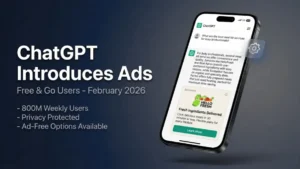
OpenAI’s new policy outlines a limited ad experiment that will show sponsored products and services at the bottom of relevant ChatGPT answers, clearly labeled as advertising. The initial test covers the free tier and the new ChatGPT Go plan in the US, while Plus and higher enterprise plans remain ad‑free.
The company states that ads will not affect how the underlying model generates responses and that it will not sell personally identifiable user data to advertisers. Instead, advertisers receive aggregated performance metrics such as impressions and engagement counts, and users can limit how their data contributes to ad personalization.
In parallel, OpenAI has launched ChatGPT Go, a lower‑cost subscription tier providing higher usage limits and access to GPT‑5.2 Instant‑class capabilities with longer memory, now available globally after debuting in India and other markets. This Go tier sits below Plus, targeting individuals and small teams who outgrow the free tier but cannot afford enterprise pricing.
How Ads Reshape OpenAI’s Revenue and the AI Market
OpenAI’s pivot to advertising responds to mounting infrastructure and R&D costs, with analysts estimating that 90–95% of ChatGPT users generate no direct subscription revenue. Industry analysis projects that up to 20% of OpenAI’s future revenue could come from advertising and related commercial features, including commissions from in‑chat commerce.
For business leaders, this move signals a strategic shift toward a dual‑model economy: ad‑funded access for mass users and premium ad‑free plans for enterprises and power users. Enterprises that require deterministic behavior and compliance may increasingly favor paid, ad‑free tiers and dedicated API access, even as employees continue to use the free consumer app.
Competitively, OpenAI’s ad strategy mirrors mature internet platforms: contextual placements within search‑like interactions, sponsorships around commercial queries, and possible affiliate recommendations integrated into conversations. This approach directly challenges Google, Meta, and other ecosystems where AI‑enhanced search and assistants already drive performance marketing budgets.
Technical and Policy Parameters of ChatGPT Advertising
OpenAI positions the initial ad rollout as contextual and additive rather than interstitial or interruptive. Early descriptions suggest formats such as sponsored links at the bottom of responses for commercial or navigational queries and clearly separated ad blocks from the model’s explanatory text.
On the data side, OpenAI emphasizes three constraints:
- It will not sell user conversations or personal information to advertisers.
- It provides advertisers with only aggregated, campaign‑level metrics, not user‑level profiles.
- Users can adjust settings to limit or disable data used for ad personalization without losing other personalization features like memory.
From a safety standpoint, OpenAI commits to restricting ads in sensitive categories and applying its existing content and safety policies to advertising inventory. This includes filters around health, politics, and other domains that could conflict with regulatory expectations in regions like the EU and India.
ChatGPT Tiers, Ads, and Access – Snapshot
| Tier / Channel | Ads Presence (Test Phase) | Target Users | Key Value Proposition |
|---|---|---|---|
| Free ChatGPT (US) | Yes – contextual, labeled ads at bottom of relevant replies | Mass consumers, casual workers | Zero‑cost access subsidized by advertising |
| ChatGPT Go | Yes – same experiment as free, in supported markets | Price‑sensitive pros, SMBs | Lower subscription price with higher limits than free |
| ChatGPT Plus / Pro | No ads; subscription‑funded experience | Professionals, prosumers | Faster models, higher caps, ad‑free usage |
| Enterprise / API plans | No ads in contracted environments | Enterprises, developers, platforms | Dedicated SLAs, compliance controls, integration flexibility |
Roadmap for Ad Rollout, Governance, and Enterprise Choices
Analysts expect OpenAI to begin with a narrow beta in the US focusing on logged‑in adults, then expand to more verticals and markets through 2026 if engagement and revenue metrics meet targets. Industry reports forecast initial emphasis on commercial categories such as travel, retail, and technology tools before broadening to more segments.
For regulators and policymakers, the next phase will involve scrutinizing how AI‑driven assistants display sponsored information, particularly for health, finance, and elections. Transparency requirements around labeling, ranking logic, and data usage are likely to tighten, especially in jurisdictions implementing AI‑specific regulations.
For enterprises and developers, the strategic choice will be where to draw the boundary between ad‑funded consumer surfaces and paid, controlled environments. Many organizations will likely:
- Permit employees to experiment with free or Go tiers while mandating ad‑free enterprise instances for sensitive workloads.
- Integrate directly with OpenAI’s APIs or through partners like Microsoft Azure to maintain data‑processing agreements and compliance coverage.
AdwaitX expects this mixed model consumer ad‑funded access plus contractually governed enterprise usage to become the default pattern for AI platforms at scale.

Frequently Asked Questions (FAQs): OpenAI ChatGPT Advertising and Access
Will ads change ChatGPT’s answers?
OpenAI states that ads appear as separate, labeled units and do not influence how the model generates its core responses.
Which ChatGPT users will see ads?
The initial tests apply to logged‑in adults using the free and ChatGPT Go tiers in the US, with potential expansion to other markets later.
Does OpenAI sell my ChatGPT data to advertisers?
OpenAI says it does not sell user information and shares only aggregated metrics like impressions and clicks with advertisers.
How can businesses avoid ads in mission‑critical workflows?
Organizations can use Plus, enterprise, or API‑based deployments, which remain ad‑free and operate under contractual data‑protection terms.

