

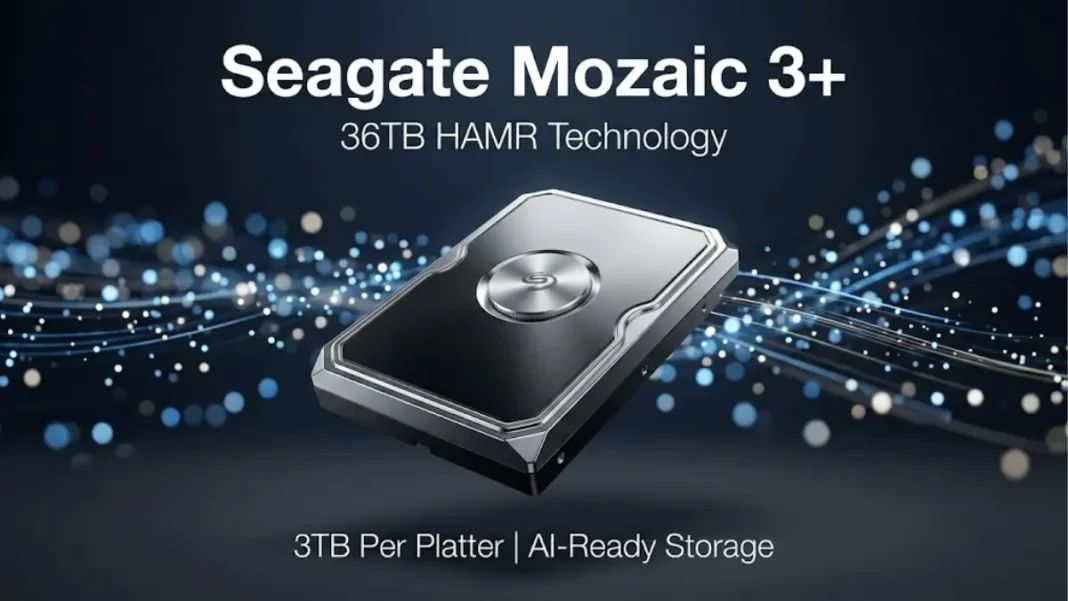
Seagate Mozaic 3+ hard drives now ship in capacities up to 36TB, marking a significant leap in enterprise storage built on heat-assisted magnetic recording (HAMR) technology. The company announced sample shipments to select customers on January 21, 2025, with the Exos M series delivering industry-leading areal density of 3TB per platter. This breakthrough addresses the explosive growth in AI-generated data, which is expected to increase 167 times by 2028.
What’s New in Mozaic 3+
Seagate officially began shipping 36TB Exos M hard drive samples in January 2025, extending its Mozaic 3+ platform beyond the 30TB models introduced in 2024. The drives are the industry’s first to achieve 3TB per platter areal density, with a roadmap targeting 4TB+ and 5TB+ per platter in coming releases.
Key specifications include:
- Capacity range: 28TB, 30TB, and 36TB models
- Interface: 6Gbps SATA (12Gbps SAS planned for Mozaic 4+ in 2025)
- Form factor: 3.5-inch, helium-filled, 7,200 RPM
- Reliability: 2.5 million hours MTBF with 5-year warranty
- Availability: Global channel distribution launched July 2025 after shipping over 1 million HAMR drives to hyperscalers
The technology represents decades of research in nanotechnology, photonics, and quantum mechanics, with Seagate being the only manufacturer currently offering 3TB+ per platter density.
Why Mozaic 3+ Matters for AI Workloads
AI models are doubling annually, creating unprecedented storage demands that traditional perpendicular magnetic recording (PMR) drives cannot efficiently meet. Seagate Mozaic 3+ addresses three critical pain points: capacity, cost, and sustainability.
Cost efficiency: The technology reduces total cost of ownership by over 25% per terabyte through higher density, allowing data centers to store three times more data in the same physical footprint. A single 36TB drive replaces multiple lower-capacity units, cutting hardware acquisition costs.
Energy savings: Mozaic 3+ drives consume 62% less power per terabyte compared to legacy 10TB PMR drives. The 30TB model reduces embodied carbon by 71.7%, making it 3.5 times more efficient in carbon footprint per terabyte.
AI checkpointing: Large language model training requires checkpoint snapshots every 5 minutes to ensure accountability and trustworthy AI. These checkpoints are stored on hard drives for the training duration, with Mozaic 3+ providing the high-capacity foundation needed to retain full data lineage without infrastructure expansion.

How HAMR Technology Works
Heat-assisted magnetic recording uses a nanophotonic laser to temporarily heat disk media to over 800°F in nanoseconds, allowing data to be written on high-coercivity materials that remain stable at room temperature. This process enables dramatically higher areal density than conventional PMR technology.
The Mozaic 3+ platform integrates four breakthrough components:
- Superlattice platinum-alloy media: Enables stable data storage at ultra-high densities
- Plasmonic writer: Focuses laser energy onto an extremely precise disk area without affecting adjacent data
- Gen 7 spintronic reader: Quantum-based magnetic sensor detects minuscule magnetization changes in densely packed tracks
- 12nm integrated controller: Manages thermal processes and maintains drive stability
The laser heats only the target bit area, reducing magnetic resistance long enough for the write head to inscribe data, then immediately cools to lock the magnetic state. This allows tracks to be written closer together without thermal interference, boosting capacity without adding platters.
Enterprise Impact and Adoption
Seagate has shipped over 1 million HAMR drives since launch, with hyperscale cloud providers completing extended qualification testing before general availability in July 2025. The technology targets three deployment scenarios where capacity density drives ROI:
Data center consolidation: Enterprises can triple storage capacity without expanding rack space, reducing real estate and cooling costs. A single server populated with 36TB drives can reach petabyte-scale storage in a 4U chassis.
AI training infrastructure: Organizations training foundation models require long-term retention of training datasets and checkpoint histories to validate model behavior. Mozaic 3+ provides the mass capacity to archive source data sets and checkpoint snapshots at lower cost than adding SSDs.
Rich media workloads: AI systems processing video, images, and 3D data generate unstructured datasets that demand high capacity and reliable access. The drives support these workloads with stable performance comparable to PMR drives, without the write penalty issues associated with shingled magnetic recording (SMR).
CEO Dave Mosley noted in the January announcement that AI adoption and cloud expansion create “unprecedented levels of data creation” requiring long-term retention to ensure trustworthy outcomes.
What’s Next for Mozaic Platform
Seagate is developing Mozaic 4+ with 4TB per platter density, expected to include 12Gbps SAS interfaces for performance-sensitive applications. The roadmap extends to Mozaic 5+ with 5TB per platter, potentially enabling 50TB+ drive capacities in standard 3.5-inch form factors.
The company has not disclosed specific release dates but indicated 4TB+ per platter will arrive in the “near horizon”. IronWolf Pro versions targeting NAS and edge AI deployments are also available in 28TB and 30TB capacities, expanding beyond hyperscale data centers.
Competitive pressure from Western Digital’s UltraSMR and energy-assisted technologies may accelerate innovation timelines. However, Seagate remains the only vendor mass-producing drives above 3TB per platter as of January 2026.

Featured Snippet Boxes
What is Seagate Mozaic 3+ technology?
Mozaic 3+ is Seagate’s HAMR-based hard drive platform achieving 3TB per platter areal density using nanophotonic lasers, plasmonic writers, and quantum spintronic readers. It enables 30TB to 36TB capacities in standard 3.5-inch drives, cutting data center storage costs by 25% per terabyte.
How does HAMR improve storage density?
HAMR (heat-assisted magnetic recording) uses lasers to heat disk media to 800°F for nanoseconds, temporarily reducing magnetic resistance so data can be written on high-stability materials. This allows tracks to be packed closer together, tripling areal density compared to traditional perpendicular recording.
Are Mozaic 3+ drives reliable for enterprise use?
Yes, Mozaic 3+ drives carry a 2.5 million-hour MTBF rating and 5-year warranty, matching enterprise PMR drives. Seagate has shipped over 1 million HAMR drives to hyperscalers who completed extended qualification testing before general availability.
What AI applications benefit from Mozaic 3+ storage?
AI model training requires checkpoint snapshots every 5 minutes, stored on hard drives for data lineage and accountability. Mozaic 3+ provides cost-effective mass capacity for retaining training datasets, checkpoint histories, and rich media content like video used in AI workloads.

