

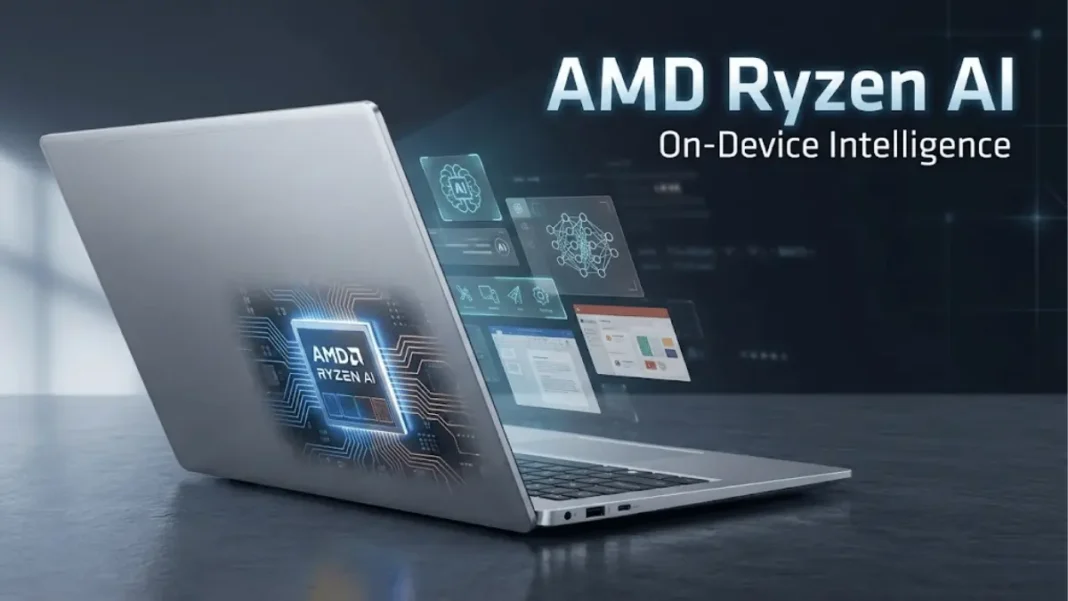
AMD showcased six AI-powered applications optimized for its Ryzen AI processor lineup on January 5, 2026, emphasizing on-device performance and privacy. The announcement highlights tools for productivity, content creation, and business workflows that leverage AMD’s dedicated AI hardware including its NPU (Neural Processing Unit), Ryzen processors, and Radeon graphics to run AI tasks locally without cloud dependency.
What AMD Announced
AMD’s blog post features Belt, Nexa Hyperlink, CyberLink Promeo, Adobe Photoshop Elements & Premiere Elements, Distinct RenderFX/VectorFX, and Iterate.AI as standout apps designed to exploit Ryzen AI’s on-device capabilities. Belt connects email, calendars, and project tools to deliver automated insights for project managers and busy professionals. Nexa Hyperlink, a free offline AI assistant, runs entirely on-device for research and brainstorming without sending data to external servers.
CyberLink Promeo generates professional social media graphics and marketing materials using AI-powered design templates, accelerated by AMD Radeon graphics. Adobe’s Elements suite Photoshop and Premiere offers user-friendly photo and video editing with AI features like auto-reframe for quick social media reformatting, powered by the synergy between Ryzen CPUs and Radeon GPUs. Distinct’s RenderFX and VectorFX plug-ins provide Hollywood-grade visual effects for product videos and e-commerce content, rendered in real-time on Radeon hardware. Iterate.AI targets enterprise users with a low-code platform for building custom AI applications, supported by AMD EPYC processors and Instinct accelerators.
Why On-Device AI Matters Now
AMD Ryzen AI processors integrate a dedicated AI engine optimized for tasks like natural language processing, image recognition, and real-time content generation. Unlike cloud-based AI that transmits data to remote servers, on-device processing keeps user files, queries, and outputs local critical for freelancers handling client work, businesses managing sensitive data, or anyone prioritizing digital privacy. Nexa Hyperlink exemplifies this shift: it indexes thousands of local files and delivers cited, natural-language answers across documents, screenshots, and PDFs without internet connectivity.
Performance gains also matter. AMD’s architecture offloads AI workloads from the CPU, freeing resources for multitasking and reducing power consumption essential for thin-and-light laptops that need all-day battery life. Real-time AI features in creative apps, like instant previews in Promeo or 4K export acceleration in Premiere Elements, become practical when the processor can handle inference locally at speed.
App Breakdown: Who Benefits
| App | Primary Use | Best For | AMD Hardware Advantage |
|---|---|---|---|
| Belt | Productivity automation | Project managers, multi-taskers | Instant insights on Ryzen processors |
| Nexa Hyperlink | Offline AI assistant | Freelancers, privacy-focused users | NPU-powered local search |
| CyberLink Promeo | Graphic design | Small business owners, marketers | Radeon-accelerated rendering |
| Adobe Elements | Photo/video editing | Content creators, YouTubers | Ryzen + Radeon for 4K exports |
| Distinct RenderFX/VectorFX | Visual effects | E-commerce, videographers | Real-time GPU rendering |
| Iterate.AI | Enterprise AI apps | IT teams, mid-size companies | EPYC + Instinct scalability |
How Ryzen AI Processors Work
AMD Ryzen AI chips feature three compute engines: traditional CPU cores for general tasks, integrated Radeon graphics for visual workloads, and a neural processing unit (NPU) dedicated to AI inference. This tri-engine design lets apps like Nexa Hyperlink query massive file indexes while simultaneously running background processes, something single-engine architectures struggle with. The NPU handles repetitive AI operations (like object detection in videos or semantic search) at lower power draw than CPU or GPU execution.
Nexa’s architecture is instructive. Its NexaML inference engine automatically distributes models across NPU, GPU, and CPU depending on workload type, file size, and available resources. A document search with 10,000 files might prioritize NPU efficiency, while a complex image analysis task taps Radeon’s parallel processing. AMD claims Hyperlink achieves “lightning-fast” search speeds on Ryzen AI hardware specifically because the NPU keeps the main CPU free for user interactions.
What’s Next for AMD AI PCs
AMD’s roadmap indicates expanded AI features arriving with Zen 6 architecture in 2026, followed by a “New Matrix Engine” in Zen 7 (expected 2027–2028). Zen 6 chips codenamed Olympic Ridge for desktops and Medusa Point for laptops will leverage TSMC’s 2nm process for IPC improvements and broader AI functionality across consumer and enterprise lineups. Current Ryzen AI 300 Series processors already qualify as Copilot+ PCs under Microsoft’s standards, which require on-device NPUs for Windows AI features.
App availability remains variable. Nexa Hyperlink is free and supports AMD Ryzen AI PCs with full NPU acceleration. Adobe Elements and CyberLink Promeo are commercial products with existing AMD optimizations. Distinct’s plugins and Iterate.AI target professional tiers. AMD has not specified whether these apps will receive exclusive features on future Zen 6 hardware or remain compatible across current-gen Ryzen AI chips.
The broader industry trend favors local inference. Microsoft’s rumored Windows 12 requirements may mandate NPU-equipped CPUs, pushing competitors like Intel and Qualcomm to accelerate their AI silicon roadmaps. AMD’s advantage lies in its mature Radeon GPU ecosystem and EPYC server chips, enabling cross-platform AI development from consumer laptops to data center deployments.
Featured Snippet Boxes
What makes AMD Ryzen AI PCs different from regular laptops?
AMD Ryzen AI PCs include a dedicated Neural Processing Unit (NPU) alongside CPU and GPU, enabling on-device AI tasks like natural language search, image generation, and real-time editing without cloud reliance. This improves privacy and battery life.
Can Nexa Hyperlink work completely offline?
Yes. Nexa Hyperlink runs entirely on-device using AMD Ryzen AI processors, indexing local files and providing cited answers without internet connectivity. All processing happens on your PC’s NPU and GPU.
Which apps work best on AMD Ryzen AI hardware?
Belt (productivity automation), Nexa Hyperlink (offline AI assistant), CyberLink Promeo (graphic design), Adobe Elements (photo/video editing), Distinct effects plugins, and Iterate.AI (enterprise AI) are optimized for Ryzen AI processors.
Do I need an AMD Ryzen AI PC to use these apps?
Most apps run on standard hardware but perform faster on AMD Ryzen AI PCs due to NPU acceleration and Radeon GPU optimizations. Nexa Hyperlink specifically recommends Ryzen AI for “best” performance.

