

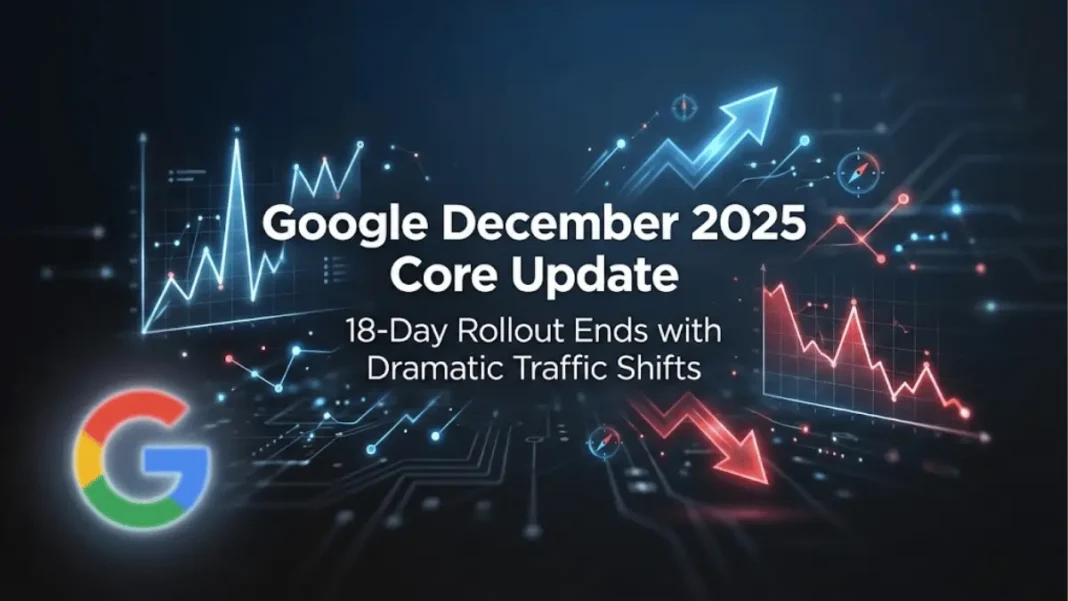
Google officially concluded its December 2025 core algorithm update on December 29, wrapping up an 18-day rollout that displayed uncommon volatility patterns and triggered significant traffic fluctuations across the web.
The update launched on December 11 at 12:25 p.m. ET and took approximately 18 days and two hours to complete, making it the third core update of 2025 following March and June releases. The extended rollout period and unpredictable volatility patterns left many site owners questioning their search performance heading into 2026.
Unusual Weekend Volatility Pattern
Unlike typical core updates that show consistent weekday volatility, the December update exhibited an irregular pattern centered on Saturdays. The first major spike hit on December 13, just two days after the initial announcement. After a calm weekday period, a second substantial surge occurred on December 20.
Google’s John Mueller acknowledged the update’s progress on Bluesky when asked on December 28 about completion timing. “It’s possible, I’ll ask tomorrow. Usually folks watch out more for the starting time than the finishing time,” Mueller wrote, suggesting the company prioritizes launch announcements over completion confirmations.
The volatility decreased significantly during the final days, allowing some SEO professionals to predict the update’s conclusion before Google’s official statement.
Dramatic Traffic Shifts Across Sites
The update’s impact varied drastically depending on site type and content quality. Community data tracking revealed that approximately 59% of monitored sites experienced traffic drops of 15% or more, with 12% losing over 70% of their organic visibility.
One webmaster reported catastrophic losses on Search Engine Roundtable: “I lost over 90% of my traffic during this core update, impressions tanked, I was wiped from Discover, wiped from News, and wiped from Search.” Another site owner noted recovery timing: “Conversions returned exactly the day after Christmas. Traffic is absolutely terrible still, but at least sales are coming in.”
The update particularly targeted:
- E-commerce platforms
- YMYL (Your Money or Your Life) content
- Affiliate marketing sites
- Content farms and low-quality aggregators
However, approximately 23% of tracked sites gained traffic, with winners reporting average increases of 42%. These gains typically went to sites with strong E-E-A-T signals, original reporting, and helpful user experiences.
Google’s Standard Response
Google provided minimal guidance beyond its typical core update messaging. The company described the December update as “a regular update designed to better surface relevant, satisfying content for searchers from all types of sites.”
The search giant offered no specific recovery advice, instead pointing site owners to its standard helpful content guidelines. Google emphasizes creating people-first content that demonstrates experience, expertise, authoritativeness, and trustworthiness.
What This Means for Site Owners
The December update reinforces Google’s continued focus on content quality and user satisfaction. Sites that lost traffic should audit their content for:
- Thin or AI-generated content without human expertise
- Aggressive affiliate practices
- Poor user experience or excessive ads
- Lack of original value or analysis
Winners typically demonstrated clear expertise, original research, and content that genuinely helps users accomplish their goals. The update’s timing ending just before 2026 gives site owners a fresh baseline for planning content strategies.

Recovery and Next Steps
Site owners affected by the update should avoid making hasty changes immediately. Google recommends waiting for volatility to settle, then conducting comprehensive content audits focused on helpfulness rather than SEO tactics.
Key recovery actions include:
- Review dropped pages for quality issues
- Improve E-E-A-T signals with author bios and credentials
- Remove thin or duplicate content
- Enhance user experience and page speed
- Focus on original, expert-driven content
Google has not announced when the next core update will occur, though the company typically releases 2-4 core updates annually. The March 2026 timeframe seems likely based on historical patterns, though Google rarely confirms future update schedules.

