

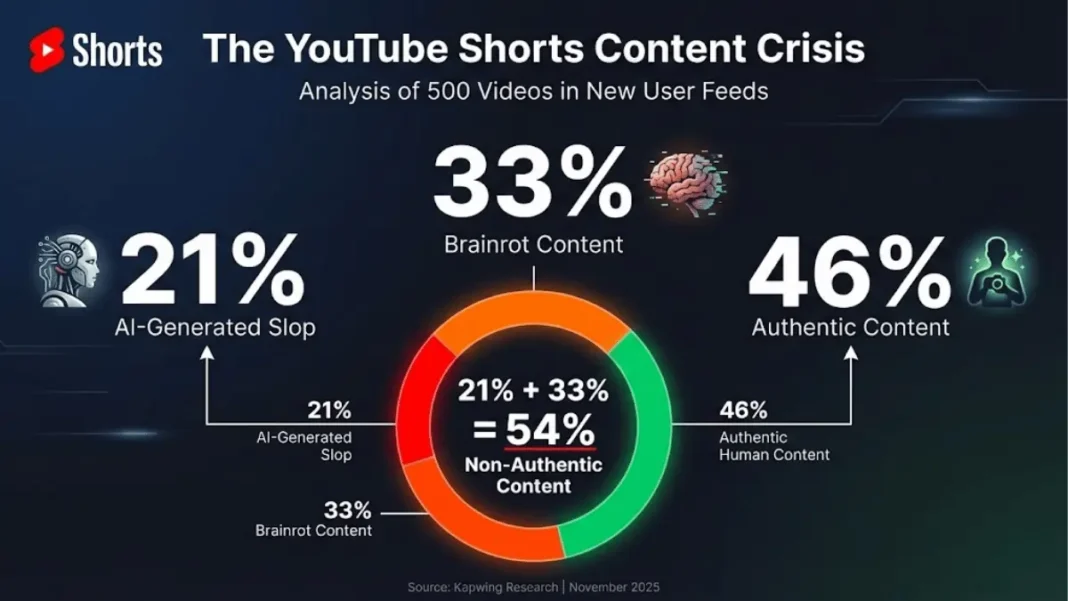
A Kapwing study analyzing 15,000 YouTube channels found that 21% of videos served to new Shorts users are AI-generated “slop” low-quality, view-farming content. An additional 33% consists of “brainrot” videos. Globally, 278 AI slop channels have accumulated 63 billion views and $117 million in annual revenue, with South Korea leading in consumption (8.45B views). India’s Bandar Apna Dost channel earns an estimated $4.25M yearly. Tools like OpenAI Sora and Google Veo have accelerated production, while YouTube’s July 2025 policy update targets mass-produced content though enforcement at scale remains challenging.
YouTube Shorts is facing a content quality crisis. More than one in five videos served to new users are AI-generated “slop” low-quality content designed purely to farm views according to a comprehensive report published by video editing platform Kapwing in late November 2025. The study, which analyzed 15,000 of the world’s most popular YouTube channels, raises urgent questions about the platform’s ability to surface authentic human creativity amid an accelerating flood of machine-generated material.
What the Kapwing Report Reveals About YouTube’s AI Problem
The research paints a sobering picture of YouTube’s current content ecosystem. By creating a fresh YouTube account and examining algorithmic recommendations with zero viewing history, Kapwing simulated the experience of a completely new user encountering the Shorts feed for the first time.
The Methodology: Testing a Fresh YouTube Account
Researchers created an untainted YouTube account to observe pure algorithmic behavior without personalization bias. They manually scrolled through the first 500 videos recommended by the Shorts algorithm, categorizing each as human-made, AI-generated slop, or brainrot content. To establish global scale, the team identified the top 100 trending YouTube channels in every country using playboard.co, then cross-referenced view counts, subscriber numbers, and estimated revenue via socialblade.com. All data reflects conditions as of October 2025.
33% Brainrot, 21% AI Slop in the First 500 Videos
The initial 16 videos appeared to be authentic human-created content. But the algorithm’s recommendations quickly degraded: 104 of the next 484 videos, approximately 21 percent were AI-generated slop. Even more concerning, an additional 33 percent of the feed consisted of “brainrot” content, a broader category of low-quality, attention-grabbing videos designed to exploit engagement metrics rather than provide genuine value.
What percentage of YouTube Shorts are AI-generated?
According to Kapwing’s November 2025 research, 21% of YouTube Shorts shown to new users are AI-generated slop, while 33% consist of brainrot content. This means over half of new user recommendations are low-quality, algorithmically optimized videos rather than authentic human creativity.
The Global Scale of AI Content Farms
The analysis identified 278 channels worldwide consisting entirely of AI slop. Together, these channels have accumulated more than 63 billion views and 221 million subscribers, generating an estimated $117 million in annual revenue. These numbers reveal a massive, profitable ecosystem built entirely on automated content generation.
Top Countries Consuming AI Slop
South Korea leads global AI slop consumption, with top channels amassing 8.45 billion views, nearly 1.6 times more than second-placed Pakistan (5.34 billion views). The United States ranked third with 3.39 billion views. Spain, despite having only eight AI slop channels among its top 100 trending channels, leads in subscriber counts with 20.22 million total subscribers across AI content farms.
The South Korean channel Three Minutes Wisdom alone recorded 2.02 billion views with photorealistic videos of wild animals being defeated by domestic pets. The channel’s estimated annual earnings reach $4,036,500, and its bio contains what appears to be an affiliate link to Coupang, South Korea’s largest online retailer.
Highest-Earning AI Channels Revealed
India’s Bandar Apna Dost holds the distinction of highest global views with 2.07 billion. The channel features “a realistic monkey in hilarious, dramatic, and heart-touching human-style situations,” with over 500 videos following nearly identical formulas. Its estimated annual earnings reach $4.25 million, based on Social Blade’s revenue-per-thousand-views calculations.
In the United States, the Spanish-language channel Cuentos Fascinantes (Fascinating Tales) leads in subscribers with 5.95 million making it the most-subscribed AI slop channel globally. Despite being established in 2020, the earliest video currently hosted dates from January 8, 2025, suggesting the channel deleted previous content. It has garnered 1.28 billion views and an estimated $2.66 million in annual revenue serving up low-quality Dragon Ball-themed videos.
Comparison Table: Top AI Slop Channels by Revenue
| Channel Name | Country | Views | Subscribers | Est. Annual Revenue | Content Type |
|---|---|---|---|---|---|
| Bandar Apna Dost | India | 2.07B | N/A | $4.25M | Monkey scenarios |
| Three Minutes Wisdom | South Korea | 2.02B | N/A | $4.04M | Animal vs. pet battles |
| Cuentos Fascinantes | United States | 1.28B | 5.95M | $2.66M | Dragon Ball themes |
| Imperio de jesus | Spain | N/A | 5.87M | N/A | Religious quizzes |

How AI Video Tools Accelerated the Problem
The prevalence of AI slop has accelerated dramatically with the release of sophisticated video generation tools. These platforms can produce video clips from simple text prompts, requiring minimal creative input or technical expertise.
OpenAI Sora and Google Veo Integration
OpenAI’s Sora and Google’s Veo represent the cutting edge of text-to-video generation. Sora allows videos ranging from 10 to 15 seconds (or 25 seconds for Pro users) with both portrait and landscape orientations. Google’s Veo 3 was the first to offer synchronized audio, though videos are limited to 8 seconds and landscape-only format. YouTube has directly integrated Veo 3 into Shorts, allowing users to create AI-generated vertical videos within the platform itself.
Automation platforms like n8n even offer workflows that can generate videos via both Sora 2 and Veo 3.1 in parallel, then automatically email the results streamlining mass production to an unprecedented degree.
YouTube’s July 2025 Policy Update on Mass-Produced Content
In July 2025, YouTube updated its Partner Program monetization policies to better identify “mass-produced and repetitive content”. The platform renamed its “repetitious content” policy to “inauthentic content” and provided clearer definitions of what constitutes demonetizable material.
YouTube clarified that AI-assisted content can still be monetized if it is unique, significantly transformed, and provides added human value. Content that is mass-produced using templates or automation, highly repetitive with little variation, or lacking original commentary and insight faces demonetization. However, enforcement at scale remains challenging given the sheer volume of uploads.
Can you monetize AI-generated videos on YouTube?
Yes, but only if they add significant human value and originality. YouTube’s July 2025 policy update allows AI as a creative tool but demonetizes fully automated, repetitive videos lacking unique perspective. Mass-produced AI content violates the updated “inauthentic content” policy.
How to Identify AI-Generated YouTube Shorts
As AI video quality improves, distinguishing authentic content from machine-generated material becomes increasingly difficult. However, several telltale signs can help viewers identify AI slop.
Visual Tells: Faces, Hands, and Physics
AI-generated videos often struggle with human anatomy and natural physics. Watch for unnatural eye movements, overly perfect facial symmetry, or micro-expressions that don’t match emotional context. Hands remain particularly problematic: look for extra fingers, odd shapes, morphing digits, or stiff movements that don’t align with speech. Objects may defy gravity, glide unnaturally across surfaces, or pass through each other in impossible ways.
Audio Synchronization Issues
Even with tools like Veo 3 offering synchronized audio, lip-sync problems frequently expose AI generation. The human brain is highly sensitive to audiovisual timing delays as small as 100 milliseconds stand out. Watch for lips that don’t match spoken words, creating an effect similar to poorly dubbed foreign films.
Check for AI Disclosure Labels
YouTube now requires creators to disclose when realistic content has been altered or synthetically generated. Videos using AI tools should display an “altered or synthetic content” label in the description. OpenAI’s Sora videos include a small cloud icon watermark that bounces around the screen edge. However, not all creators comply with disclosure requirements, and enforcement remains inconsistent.
What This Means for Authentic Content Creators
The AI slop phenomenon creates significant challenges for human creators investing time and creativity into original work.
The Discoverability Challenge
Authentic creators producing handcrafted content struggle to compete with the sheer volume of AI-generated material. AI content farms can publish dozens or hundreds of videos daily, flooding recommendation algorithms and crowding out human creativity. Kapwing’s research notes that “sloppers are making it tough for principled and talented creators to get their videos seen”.
Monetization and Competition
Channels generating millions in revenue from AI slop create an economic incentive that undermines the creator ecosystem. While YouTube CEO Neal Mohan told Wired that “the genius is going to lie whether you did it in a way that was profoundly original or creative,” the platform’s algorithms haven’t consistently rewarded originality over volume. Revenue flows to whoever captures attention most efficiently, regardless of creative merit.
Platform Response and Enforcement Gaps
YouTube faces a fundamental dilemma: CEO Neal Mohan cites generative AI as “the biggest game-changer for YouTube” since the platform’s founding, comparing it to how synthesizers transformed music. Yet the company simultaneously worries that advertisers will feel devalued by having their ads attached to slop. Enforcement at scale proves difficult when AI tools make it trivially easy to produce thousands of videos.
How does AI slop affect real YouTube creators?
AI-generated slop floods recommendation algorithms with high-volume, low-quality content, making authentic human creativity harder to discover. Channels producing mass AI content capture billions of views and millions in revenue, creating economic pressure that undermines creators investing time in original work.
YouTube’s Defense and Future Actions
YouTube defended its approach in a statement to multiple outlets: “Generative AI is a tool, and like any tool it can be used to make both high- and low-quality content”. The company emphasized that all content must comply with community guidelines regardless of production method, pledging to remove policy violations.
Google CEO Sundar Pichai acknowledged the challenge during a June interview at the Bloomberg Tech Summit, noting “any time there are tech inflection points, it’s always a cat and mouse game”. He stated the company is using its Gemini AI to “help improve YouTube’s recommendations” and surface higher-quality content. Whether algorithmic solutions can effectively combat algorithmically optimized spam remains to be seen.

Frequently Asked Questions (FAQs)
What is AI slop on YouTube?
AI slop refers to low-quality, AI-generated video content designed primarily to farm views and revenue rather than provide genuine value. These videos are mass-produced using tools like OpenAI Sora or Google Veo, often featuring repetitive scenarios, photorealistic but uncanny visuals, and minimal creative input. Examples include channels showing animals in implausible situations or religious figures in quiz scenarios.
How much money do AI slop channels make?
Top AI slop channels generate millions annually through ad revenue. India’s Bandar Apna Dost earns an estimated $4.25 million yearly with 2.07 billion views, while South Korea’s Three Minutes Wisdom makes approximately $4.04 million from 2.02 billion views. Collectively, the 278 identified AI slop channels worldwide generate an estimated $117 million in annual revenue.
What is brainrot content?
Brainrot is a broader category of low-quality, attention-grabbing videos designed to exploit engagement metrics. The term describes trivial online material that viewers consume compulsively to “numb” themselves or follow emergent subgenre “lore”. Unlike AI slop, brainrot can be human-made but shares the characteristic of prioritizing addictive viewing over meaningful content.
Will YouTube ban AI-generated videos?
No, YouTube is not banning AI-generated content. The platform’s July 2025 policy update targets “inauthentic” mass-produced content but explicitly allows AI as a creative tool when it adds human value and originality. Content violating the updated policies faces demonetization or removal, but AI assistance itself doesn’t disqualify videos from monetization.
How can I tell if a YouTube Short is AI-generated?
Look for visual tells like unnatural facial expressions, incorrect hand anatomy (extra fingers, morphing), and physics violations. Check for audio-visual sync issues where lip movements don’t match speech. YouTube requires disclosure labels reading “altered or synthetic content” on AI-generated videos, and some tools like Sora add watermarks. Examine the channel’s upload frequency dozens of videos daily often indicates automation.
Why does YouTube’s algorithm recommend so much AI content?
YouTube’s Shorts algorithm prioritizes engagement metrics like watch time, likes, and shares over content origin. AI slop is specifically optimized for these metrics, using attention-grabbing visuals and rapid pacing. New user accounts receive less personalized recommendations, making them more vulnerable to trending low-quality content. Whether this reflects algorithmic design or sheer AI content volume remains unclear.
What countries watch the most AI slop?
South Korea leads with 8.45 billion views across trending AI slop channels, nearly 60% more than second-place Pakistan (5.34 billion). The United States ranks third with 3.39 billion views. Spain has the most AI slop channel subscribers (20.22 million), despite having fewer AI channels than Pakistan, Egypt, or South Korea.
Can authentic creators compete with AI slop?
Authentic creators face significant disadvantages in volume but can compete through quality, originality, and community building. YouTube’s updated policies theoretically favor value-driven content, though enforcement remains inconsistent. Building a loyal audience, focusing on unique expertise, and maintaining consistent branding help human creators stand out. However, the sheer scale of AI production (some channels publish hundreds of videos) makes discoverability increasingly challenging.

