

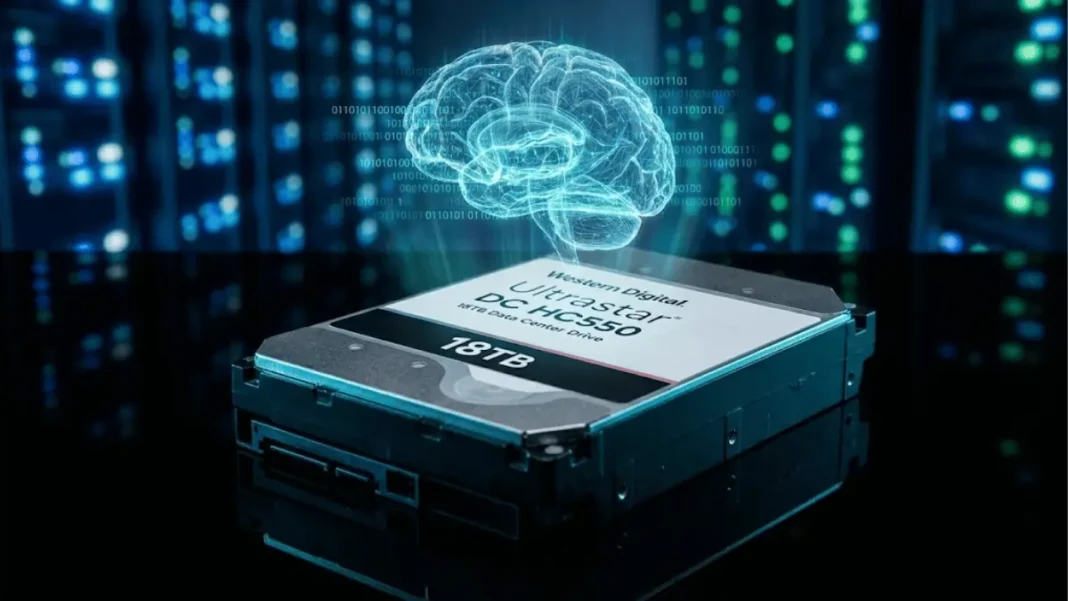
Western Digital Corporation is capitalizing on explosive AI infrastructure demand, with shares climbing over 280% in 2025 and an additional 7.4% in early January 2026. The storage giant is showcasing AI-optimized solutions at CES 2026 while preparing to launch 44TB heat-assisted magnetic recording (HAMR) hard drives by late 2026.
What’s Driving the Surge
Western Digital’s transformation accelerated after spinning off its flash memory division (SanDisk) in February 2025, allowing the company to focus exclusively on high-capacity hard disk drives for cloud and AI workloads. Fiscal 2026 revenue is projected to grow approximately 23%, driven by cloud segment demand that accounts for nearly 90% of total revenue.
Morgan Stanley elevated its price target from $188 to $228, citing Western Digital as the top pick in storage due to “thriving end markets, strong pricing capabilities, and multiple near-term opportunities”. Supply constraints have pushed lead times for high-capacity drives to 12 months a level not seen since the 2011 Thailand floods.
HAMR Technology Roadmap
Western Digital’s first HAMR-based HDDs will deliver 36TB capacity using conventional magnetic recording (CMR) and 44TB with UltraSMR technology. CEO Irving Tam confirmed customer qualification will complete by the end of calendar year 2026, with volume shipments beginning in the first half of 2027.
The HAMR process uses laser heating to briefly reduce disk coercivity, enabling smaller magnetic grains that improve data density and long-term reliability. By 2030, Western Digital envisions 80TB CMR drives and 100TB UltraSMR models through combined advances in HAMR, OptiNAND technology, and increased platter counts.
Two hyperscale customers are already testing HAMR prototypes, according to company statements.

Why It Matters for Data Centers
AI workloads require massive archival storage for training datasets and model outputs, creating structural demand that differs from cyclical enterprise spending. Western Digital’s total cost of ownership (TCO) approach allows data centers to expand capacity without building new facilities, a critical advantage as hyperscalers deploy multi-year AI infrastructure.
India’s data center capacity alone is projected to jump from 1 gigawatt in 2025 to 8 gigawatts by 2030, requiring over $30 billion in capital expenditure. Western Digital executives stated the country will remain a key growth market and engineering hub.
What’s Next
Analysts project fiscal 2026 adjusted earnings per share of $7.66, representing 55% year-over-year growth. The company maintains strategic partnerships to bundle high-capacity HDDs with AI-optimized enterprise SSDs, positioning itself for both “hot” and “cold” storage tiers in AI data cycles.
HAMR qualification success in late 2026 could serve as a major stock catalyst, while expansion into edge AI deployments (localized servers for autonomous vehicles and industrial applications) represents additional upside. Growth is expected to moderate to 13% in fiscal 2027, though analysts emphasize this still reflects expansion rather than cyclical decline.

Featured Snippet Boxes
When will Western Digital’s 44TB hard drives be available?
Western Digital plans to complete customer qualification for 44TB HAMR drives by the end of 2026, with volume shipments starting in the first half of 2027. Two hyperscale cloud providers are currently testing prototypes.
Why did Western Digital stock increase 280% in 2025?
The surge followed Western Digital’s February 2025 SanDisk spinoff and explosive AI-driven demand for high-capacity storage. Cloud infrastructure buildouts and supply constraints pushed pricing power and margins higher throughout the year.
What is HAMR technology in hard drives?
Heat-Assisted Magnetic Recording uses a laser to temporarily heat the disk surface during writing, enabling denser data packing. This allows manufacturers to create higher-capacity drives. Western Digital targets 100TB by 2030 using HAMR.
How does AI affect hard drive demand?
AI training and inference require petabytes of archival storage for datasets and model outputs. Unlike cyclical enterprise spending, AI workloads create sustained structural demand, with the AI storage market projected to grow from $30 billion in 2025 to $187 billion by 2035.

