

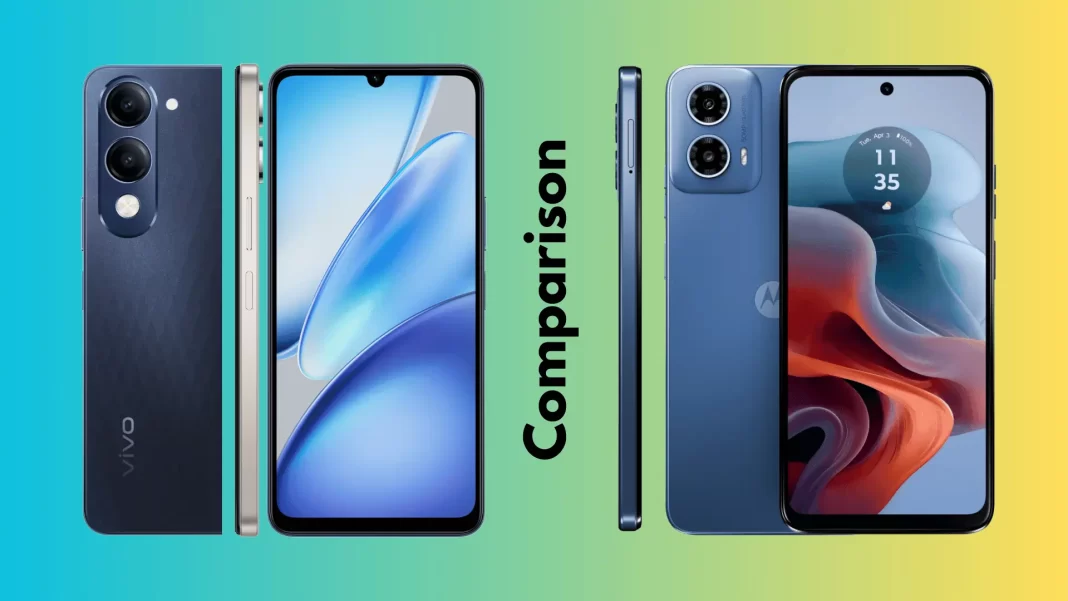
You’re choosing between two of India’s most searched budget 5G phones: Vivo T4 Lite and Moto G34. Both pack fast 5G, big batteries, and friendly prices. But they trade wins in display smoothness, camera behavior, and software polish. This guide compares the two with real world priorities in mind, not just spec sheet flex.
You’ll get: clear pros/cons, current India pricing, practical picks by use case, and a 30 second quiz that ends the indecision.
Who should buy and which?
-
Pick Vivo T4 Lite if you value a bigger 6,000 mAh battery, IP64 splash/dust resistance, and the latest Android version out of the box at the same price bracket.
- Pick Moto G34 if you want a smoother 120 Hz display, stereo speakers with Dolby Atmos, and cleaner software feel at this price.
Comparison Specs Vivo T4 and Moto G34
| Spec | Vivo T4 Lite 5G | Moto G34 5G |
|---|---|---|
| Chipset | MediaTek Dimensity 6300 (6nm) | Snapdragon 695 (6nm) |
| RAM / Storage | 4/6/8 GB; 128/256 GB; microSD up to 2 TB | 4/8 GB; 128 GB; microSD (hybrid) |
| Display | 6.74″ HD+ 90 Hz; ~1000 nits HBM | 6.5″ HD+ 120 Hz; ~500 nits |
| Cameras | Rear 50 MP + 2 MP; Front 5 MP | Rear 50 MP + 2 MP; Front 16 MP |
| Battery / Charging | 6000 mAh; 15 W; charger in box | 5000 mAh; up to 20 W |
| Software | Android 15 (Funtouch OS 15) | Android 14 (My UX, near-stock) |
| Extras | IP64, BT 5.4 | Stereo speakers, Dolby Atmos, vegan-leather option |
| Weight | ~202 g | ~180 g |
| Starting price (India) | ₹9,999 (4/128) | ₹10,999 (4/128) |

Pricing and variants in India
Entry pricing and what you actually get
Moto G34 5G typically starts at ₹10,999 for 4/128 on Flipkart. Expect a 120 Hz screen and stereo speakers even on the base model. Stock fluctuates, but pricing stays close to launch levels.
Vivo T4 Lite 5G starts at ₹9,999 for 4 GB RAM and 128 GB storage on Flipkart. You get a charger in the box and IP64 at this price, which is rare under ₹10k.
RAM, storage, and microSD notes
Vivo offers up to 8/256 with UFS 2.2 on the 8/256 variant and microSD up to 2 TB. The 6/128 uses eMMC 5.1, so power users should prefer 8/256. Moto sticks to 4/128 or 8/128 and uses a hybrid slot, so it’s either dual SIM or a microSD card, not both.
Performance and daily use
Chipsets specification
- Dimensity 6300 (Vivo): efficient 6 nm chip with solid everyday speed and dual-5G support. It clocks up to 2.4 GHz and handles social, banking, UPI, and casual games without drama.
- Snapdragon 695 (Moto): still the segment’s favorite for smooth scrolling and stable gaming at this price. Many Indian apps are well-optimized for this chip, and it pairs nicely with the 120 Hz panel.
Reality check: neither is meant for heavy AAA gaming. Think BGMI on balanced settings, Instagram Reels, WhatsApp backups, and Maps navigation. That’s their lane.
UI, updates, and bloat
Moto G34 ships with Android 14 and Motorola’s My UX skin. Moto’s strength is a cleaner feel plus handy gestures like chop for flashlight. It typically offers at least one major OS upgrade here and three years of security patches.
Vivo T4 Lite launches with Android 15 and Funtouch OS 15. Vivo promises 2 OS updates and 3 years of security updates for this device. Expect more features and some pre-installed apps; most can be uninstalled.
Network bands and connectivity notes
Both support SA/NSA 5G on common Indian bands. Vivo lists n1/n3/n5/n8/n28B/n38/n40/n77/n78. Moto advertises 13 5G bands with VoNR. If you live in a new 5G rollout area, both will latch on fine.
Display and speakers
Size, resolution, and refresh rate
- Vivo: 6.74-inch HD+ at 90 Hz. It’s large and smooth enough for scrolling and video.
- Moto: 6.5-inch HD+ at 120 Hz. The extra fluidity is visible when you scroll news feeds or swipe between apps. Note: the India model is HD+ (1600×720), not FHD+.
Brightness and outdoor use
Vivo specifies ~1000 nits HBM which helps under harsh sun. Moto lists around 500 nits. If you spend a lot of time outdoors, Vivo’s brighter panel is easier on the eyes.
Audio quality and extras
Moto brings stereo speakers with Dolby Atmos, which you will hear in YouTube and games. Vivo focuses on a 200% volume booster trick but sticks to a single loudspeaker. Both keep the 3.5 mm jack.
Cameras
Daylight, portraits, and night photos
Hardware is similar on paper at the rear: 50 MP main + 2 MP secondary. Vivo’s second sensor is for depth; Moto’s is a macro. In daylight, both capture social-ready shots with boosted colors. At night, processing matters more than sensors. Expect more noise and motion blur unless you hold steady.
- Vivo touts a “Sony AI camera,” Night mode, and AI Photo Enhance. Useful for first-time users who want easy shares. Front camera is 5 MP, which is basic but fine for video calls.
- Moto tends to keep skin tones more neutral and offers Image Auto Enhance and a 16 MP selfie that is cleaner for Instagram Stories.
Our guidance: if your priority is selfies, Moto has the edge. If you often shoot family indoors with mixed lighting, both will struggle a bit; Vivo’s Night mode can help but do not expect mid-range magic.
Video and stabilization
Both cap at 1080p/30 fps. There’s digital stabilization, but sudden pans will still wobble. For steady clips, use good light and move slowly.
Battery and charging
Real-world endurance
- Vivo’s 6,000 mAh battery is the headline. Vivo cites up to ~22.7 hours of video playback in lab tests, and 70 hours of music. In plain speak, it’s a solid two-day phone for average users.
- Moto’s 5,000 mAh still clears full day to 1.5 days with Wi-Fi, messaging, and short videos.
Charging speeds and what’s in the box
Vivo supports 15 W, and includes the charger. Moto supports up to 20 W and usually includes a charger as well. Vivo ships with a case and pre-applied screen protector which is handy if you’re gifting.
Design and durability
Build, finish, and in-hand feel
- Vivo has clean lines with Prism Blue and Titanium Gold options. It’s ~202 g but feels balanced for the big battery.
- Moto offers a vegan-leather Ocean Green that hides smudges and feels nicer than glossy plastic. At ~180 g, it’s lighter.
IP rating and drop claims
Vivo is IP64-rated and advertises SGS five-star drop resistance and MIL-STD-810H tests. Moto lists IP52 water-repellent design. Either can handle light rain; Vivo’s higher IP rating is a plus if you commute on foot.
Software updates and support
Vivo guarantees 2 OS updates and up to 3 years of security updates. Moto promises at least one major OS update and 3 years of security for G34, which aligns with the product page notes. If long support is your top concern at this price, Vivo wins on OS version today and the stated policy.
Which is best for you? Based on usage
- For long outdoor days: Vivo T4 Lite for 6,000 mAh and brighter screen.
- For buttery scrolling and social: Moto G34 for 120 Hz and stereo speakers.
- For selfie-heavy users: Moto G34 with its 16 MP front camera.
- For dust/splash worry: Vivo T4 Lite with IP64.
- For absolute lowest starting price: Vivo T4 Lite at ₹9,999 (4/128) vs ₹10,999 for Moto (4/128).
30 second picker quiz to select best for you
Answer quickly. Count how many A vs B.
- My top priority is
A) Battery life and durability
B) Smooth display and speakers - I take more
A) Rear camera shots of people and places
B) Selfies and front camera videos - I’m often outdoors in bright sun
A) Yes
B) Not really - I want the lowest price for 128 GB
A) Yes
B) I can pay a bit more - I prefer
A) Latest Android version now
B) Clean feel and simple gestures
Mostly A: Vivo T4 Lite fits you better.
Mostly B: Moto G34 is the smoother choice.
Mini case studies – Original Insights
- College commuter: Long classes, metro rides, streaming on the go. T4 Lite’s brighter panel and 6,000 mAh battery meant the phone survived a day of Maps, Spotify, and WhatsApp voice notes without a top-up. The 15 W charge is slower, so the habit became overnight charging.
- Reels-first creator: Moto’s 120 Hz feed scrolling, louder stereo speakers, and 16 MP selfie kept Stories looking clean and audio checks easy, especially indoors. The HD+ resolution did not bother them in daily use, but they did notice the screen is dimmer in afternoon sun.
FAQs
Is Moto G34 display Full HD?
No. The India model is HD+ (1600×720) with 120 Hz refresh rate.
Does Vivo T4 Lite have IP rating?
Yes. IP64 dust and splash resistance.
Which has better battery life?
Vivo, thanks to 6,000 mAh vs Moto’s 5,000 mAh. Expect roughly another half-day for light users.
Which phone is better for selfies?
Moto G34 with 16 MP front camera. Vivo’s 5 MP front cam is basic.
Do they include a charger in the box?
Yes for Vivo T4 Lite. Moto bundles can vary by listing, but typically include a charger. Check the product page before purchase.
Which gets more OS updates?
Vivo states 2 OS updates + 3 years security for T4 Lite. Moto lists 1 OS upgrade and 3 years security for G34.
Pick Vivo T4 Lite for battery, brighter screen, IP64, and Android 15 out of the box. Pick Moto G34 for the 120 Hz feel, stereo sound, and nicer selfies. Prices are close; choose by how you use your phone daily.
Checklist before you buy
- Turn screen to max brightness. Step outside for 30 seconds. Can you read WhatsApp easily?
- Record a 10-second clip while walking. Check wobble and mic clarity.
- Open YouTube, set 720p. Listen to a music video at 60–70% volume.
- Take a selfie under tube light. Zoom in on skin texture.
- Toggle 90/120 Hz settings. Scroll a long webpage.
- Confirm charger in box, RAM/storage variant, and return policy.

