

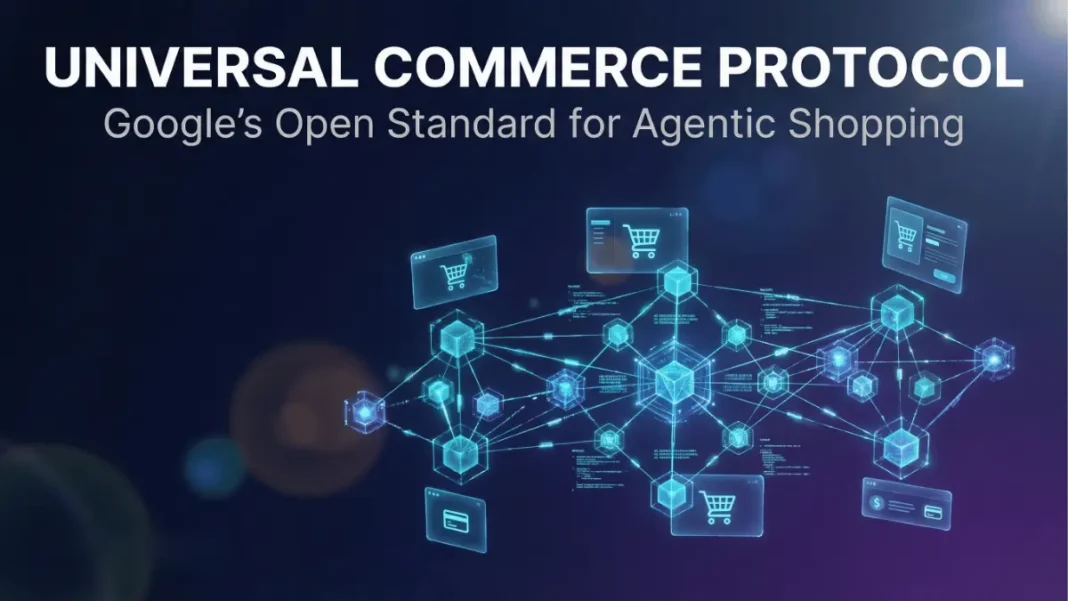
Google’s launch of the Universal Commerce Protocol (UCP) on January 10, 2026, marks the first industry-wide attempt to standardize how AI agents execute transactions across competing retail platforms. Unlike previous proprietary checkout systems, UCP creates interoperable infrastructure that lets autonomous agents navigate product discovery, payment authorization, and fulfillment tracking using a unified protocol layer.
Quick Brief
The Core Update:
Google announces Universal Commerce Protocol (UCP), an open standard co-developed with 20+ retailers including Walmart, Shopify, and Target enabling AI agents to complete purchases across platforms without custom integrations.
Key Technical Components:
- Protocol Compatibility: Works with Agent2Agent (A2A), Agent Payments Protocol (AP2), and Model Context Protocol (MCP)
- Initial Deployment: Powers AI Mode checkout in Google Search and Gemini app for U.S. retailers
- Security Layer: Cryptographically signed mandates via AP2 for verifiable transaction audit trails
- Merchant Control: Retailers remain seller of record with customizable integration parameters
The Bottom Line:
Retail platform architects and e-commerce CTOs evaluating agentic commerce infrastructure now have an endorsed standard that reduces multi-agent integration complexity while preserving direct customer relationships.
What Agentic Commerce Means for Retail Infrastructure
Agentic commerce refers to online transactions where AI agents autonomously execute multi-step purchasing workflows from product discovery through checkout on behalf of users. Unlike rule-based automation, these agents use reasoning models to handle exceptions, evaluate trade-offs, and negotiate terms across distributed systems.
McKinsey reports that 80% of organizations implementing agentic AI have observed unintended agent behaviors, including unauthorized data exposure and transaction execution outside defined parameters. This creates architectural challenges for retailers: how to enable agent access while maintaining transaction integrity, fraud prevention, and customer relationship visibility.
The shift toward agent-mediated shopping threatens traditional e-commerce metrics. BCG analysis shows agentic platforms reduce direct website traffic, erode first-party data collection, and weaken brand loyalty as AI agents prioritize utility over merchant preference. Retailers face disintermediation risk where the entire shopping journey occurs within AI platforms without customer interaction with branded properties.
Universal Commerce Protocol (UCP) is an open standard launched by Google in January 2026 that enables AI agents to interact with retailers across discovery, checkout, and post-purchase support. Co-developed with Shopify, Walmart, Target, Etsy, and Wayfair, UCP establishes a common language for autonomous agents to complete transactions without requiring individual integrations for each platform.
UCP Technical Architecture: Protocol Stack Analysis
Multi-Protocol Integration
Universal Commerce Protocol functions as a coordination layer that orchestrates three complementary standards:
Model Context Protocol (MCP): Developed by Anthropic, MCP provides agents with structured access to external tools and APIs, acting as a universal interface for resource discovery. It handles how agents understand available capabilities and format requests.
Agent2Agent (A2A): Google’s A2A protocol enables direct communication between autonomous agents, allowing task delegation and workflow orchestration. When Agent A needs hotel booking capabilities owned by Agent B, A2A handles service discovery and task submission.
Agent Payments Protocol (AP2): The transaction security layer uses Verifiable Credentials (VCs) as cryptographically signed digital contracts called “Mandates”. AP2 supports two transaction modes:
- Cart Mandates: Real-time approvals for immediate purchases with unchangeable item/price records
- Standing Mandates: Pre-authorized recurring transactions triggered by specified conditions (e.g., price thresholds)
This modular architecture allows UCP to remain payment-agnostic and vertically flexible, supporting both B2C retail and B2B procurement workflows.
Security and Accountability Framework
AP2 creates non-repudiable audit trails by separating three critical roles:
- Principal: The user granting authorization
- Agent: The AI system executing transactions
- Issuer: The payment provider processing charges
Each transaction generates cryptographic proof of user intent, enabling clear dispute resolution when agent behavior deviates from authorized parameters. Initial AP2 versions support card payments, with roadmap expansion to bank transfers and digital currencies.
Business Agent: Google’s Branded Retail Interface
Launching January 11, 2026, Business Agent allows shoppers to interact with retailers directly on Google Search via AI-powered virtual sales associates. Unlike generic chatbots, Business Agent operates within the retailer’s brand identity, answering product questions and guiding purchase decisions during high-intent search moments.
Technical Capabilities:
- Customizable training on merchant-specific product data and FAQ repositories
- Integration with existing Merchant Center feeds and inventory systems
- Direct purchase functionality using UCP-enabled agentic checkout
Initial Partner Roster: Lowe’s, Michaels, Poshmark, Reebok.
Eligible U.S. retailers can activate Business Agent through Merchant Center, with planned expansion to include customer insight analytics, loyalty reward application, and related product recommendation engines.
Conversational Commerce Data Attributes
Google is deploying dozens of new Merchant Center data attributes optimized for discovery in AI-driven interfaces like AI Mode, Gemini, and Business Agent. These attributes extend beyond traditional keyword metadata to include:
- Common product question-answer pairs
- Compatible accessory recommendations
- Substitute product suggestions
- Use-case scenarios and contextual fit data
This semantic enrichment allows agents to match products against nuanced user intent rather than exact keyword strings. For example, a query like “modern rug for high-traffic dining room that’s easy to clean” can be resolved through multi-dimensional attribute matching rather than title/description text search.
Implementation Timeline: Rolling out with select retailers in Q1 2026, broader availability by Q2.
Direct Offers: AI-Native Advertising
Direct Offers represent Google’s first native ad format for agentic commerce, piloting in AI Mode during Q1 2026. The system allows advertisers to present contextually relevant discounts when AI determines a shopper exhibits high purchase intent but price sensitivity.
Workflow Example:
User query: “Modern, stylish rug for high-traffic dining room, easy to clean, budget-conscious”
AI Mode surfaces relevant products → Participating retailers present exclusive offers (e.g., 20% discount) labeled “Sponsored deal”.
Retailers configure offer parameters in Google Ads campaign settings. AI determines offer relevance and display timing dynamically based on:
- Search intent signals
- Product category relevance
- Competitive pricing context
- User purchase probability scores
Pilot Partners: Petco, e.l.f. Cosmetics, Samsonite, Rugs USA, Shopify merchants.
Roadmap Expansion: Beyond discounts, Direct Offers will support bundle deals, free shipping promotions, and value-based differentiation beyond price alone.
Comparative Analysis: UCP vs. Proprietary Agent Systems
| Dimension | Universal Commerce Protocol | Platform-Specific Agents |
|---|---|---|
| Integration Scope | Single protocol for multi-platform agent access | Custom API integration per agent platform |
| Merchant Control | Retailer remains seller of record | Varies; some platforms intermediate transactions |
| Payment Security | AP2 cryptographic mandates | Platform-dependent security models |
| Data Ownership | First-party customer data retained by merchant | Often shared or aggregated by agent platform |
| Protocol Interoperability | Compatible with A2A, MCP, AP2 | Typically siloed within ecosystem |
| Vertical Flexibility | Cross-vertical support (retail, travel, services) | Often category-specific |
Security Challenges and Mitigation Strategies
Fraud Vector Analysis
Visa reports a 450% increase in dark web posts mentioning “AI Agent” over the past six months, indicating rapid fraud tactic evolution. Key exploit vectors include:
Counterfeit Merchant Impersonation: Malicious actors create fake storefronts with optimized APIs designed to deceive legitimate shopping agents, diverting transactions to fraudulent endpoints.
Automated Checkout Exploitation: Bots navigate UCP checkout workflows dynamically, retry declined payments with timing patterns that mimic human behavior, and conduct large-scale card testing attacks undetected.
Agent Behavior Mimicry: Distinguishing legitimate agents (e.g., ChatGPT’s Instant Checkout) from malicious bots becomes difficult when both announce themselves via protocol compliance.
Enterprise Defense Posture
Behavioral Analytics Layers: Deploy systems that monitor navigation sequences, typing rhythms, session duration patterns, and device consistency to identify anomalous agent activity.
Adaptive Authentication: Implement risk-based verification that applies stricter checks to suspicious transactions while maintaining frictionless experiences for trusted agents.
Transaction Accountability: Leverage AP2’s cryptographic audit trails to establish clear fraud investigation pathways and chargeback dispute resolution.
Financial exposure from compromised agentic workflows ranges from $50,000 to $5 million per incident, according to security firm GeeTest.
UCP Protocol Stack Components
| Protocol | Function | Developed By | Primary Use Case |
|---|---|---|---|
| Universal Commerce Protocol (UCP) | Coordination layer for agentic commerce | Google + Retail Partners | End-to-end shopping workflow orchestration |
| Agent Payments Protocol (AP2) | Transaction security & authorization | Google, PayPal | Cryptographic payment mandates |
| Agent2Agent (A2A) | Inter-agent communication | Task delegation between autonomous agents | |
| Model Context Protocol (MCP) | Tool/API access interface | Anthropic | Resource discovery and request formatting |
Retail Partner Ecosystem
| Category | Confirmed Partners | Role |
|---|---|---|
| Co-Development Partners | Shopify, Etsy, Wayfair, Target, Walmart | UCP protocol design and initial implementation |
| Payment Processors | Visa, Mastercard, American Express, Stripe, Adyen | AP2 payment gateway integration |
| Retail Adopters | Best Buy, Home Depot, Macy’s, Flipkart, Zalando | UCP checkout integration (2026 rollout) |
| Business Agent Launch Partners | Lowe’s, Michaels, Poshmark, Reebok | AI-powered retail assistant pilots |
Adoption Strategy for Retail Platforms
Implementation Priorities
Phase 1 (Q1-Q2 2026): Integrate UCP checkout capabilities for Google AI Mode and Gemini app surfaces. Activate Business Agent in the Merchant Center with baseline product FAQ training.
Phase 2 (Q2-Q3 2026): Expand conversational commerce data attributes beyond core product catalog. Deploy Direct Offers campaigns for high-margin or overstocked inventory.
Phase 3 (Q3-Q4 2026): Implement cross-platform UCP support as additional agent ecosystems (e.g., OpenAI, Anthropic) adopt the protocol. Develop proprietary Business Agent training models using customer interaction data.
Risk Mitigation Framework
Disintermediation Protection: Maintain direct customer touchpoints through email confirmation workflows, loyalty program integration within agent transactions, and post-purchase engagement sequences.
Data Strategy: Structure first-party data collection mechanisms that capture agent-mediated transaction insights without violating UCP protocol terms. Monitor traffic source attribution to quantify agent vs. direct channel performance.
Competitive Positioning: Retailers unable to support agentic checkout risk exclusion from AI-driven discovery surfaces as zero-click search patterns accelerate.
AdwaitX Verdict: Strategic Outlook
Universal Commerce Protocol establishes the first credible infrastructure for multi-platform agentic commerce, backed by ecosystem endorsement from Walmart, Shopify, Visa, Mastercard, and American Express. For retailers, UCP adoption represents mandatory infrastructure modernization not optional innovation experimentation.
Immediate Action Items:
- Technical Assessment: Audit current checkout architecture for UCP compatibility. Evaluate AP2 payment gateway integration requirements.
- Data Enrichment: Prioritize Merchant Center attribute expansion for conversational commerce optimization.
- Security Hardening: Deploy agent behavior monitoring and fraud detection systems calibrated for autonomous transaction patterns.
The protocol’s success hinges on two critical factors: whether competing AI platforms (OpenAI’s operator agents, Anthropic’s Claude agents) adopt UCP versus building proprietary standards, and whether Google can prevent the disintermediation dynamics that have historically favored platform economics over merchant relationships.
Retailers evaluating 2026 technology roadmaps should allocate Q1 resources to UCP pilot programs while maintaining contingency architecture for multi-protocol agent support. The agentic commerce transition is inevitable but standardization outcomes remain contested.
Frequently Asked Questions
What is the Universal Commerce Protocol?
UCP is an open standard enabling AI agents to interact with retailers across discovery, payment, and fulfillment without custom integrations. It works with existing protocols like AP2 and MCP.
How does UCP differ from traditional APIs?
UCP provides a unified protocol layer for autonomous agent transactions rather than requiring per-platform API integrations. It standardizes how agents discover capabilities, authorize payments, and track orders.
Which retailers support UCP checkout?
Initial partners include Walmart, Shopify, Etsy, Wayfair, Target, Best Buy, Home Depot, Macy’s, and Flipkart. U.S. rollout begins January 2026 with global expansion planned.
What security risks does agentic commerce introduce?
Key risks include counterfeit merchant impersonation, automated checkout fraud, and agent behavior mimicry. AP2’s cryptographic mandates provide transaction audit trails for dispute resolution.
Can retailers customize UCP integration?
Yes. Merchants remain sellers of record with control over integration parameters, Business Agent training data, and customer relationship touchpoints.
How does Business Agent affect SEO strategy?
Business Agent shifts discovery toward conversational interfaces and semantic product attributes. Traditional keyword optimization becomes less relevant than FAQ-structured content and use-case metadata.

