

On November 18, 2025, a routine database permission change at a major CDN provider triggered a global network collapse that lasted nearly four hours. Millions of websites returned 5xx errors, leaving businesses blind as even vendor status pages went dark. The incident exposed a critical gap: enterprises rely too heavily on vendor-reported health signals instead of independently verifying service availability from the user’s perspective.
What Happened During the November Outage
The Cloudflare network outage began at 11:20 UTC when a feature configuration file grew exponentially, exceeding memory limits and triggering a cascade of failures. Core services including CDN, access controls, and Workers KV returned HTTP 500 and 503 status codes to users worldwide. The incident was initially misidentified as a DDoS attack, delaying proper response.
Observability systems consumed excessive CPU while recording uncaught errors, causing console logins to fail. Global traffic exhibited a five-minute pattern of recovery followed by collapse, obscuring root-cause analysis. Services gradually recovered only after engineers manually injected corrected configurations at 14:30 UTC.
Why Traditional Monitoring Failed
Standard monitoring approaches could not detect or respond to the outage effectively. Infrastructure monitoring showed healthy origin servers while issues occurred at the edge layer. Application Performance Monitoring (APM) only recorded requests that reached applications, missing traffic blocked at the frontend.
Log management failed as collection agents stopped reporting data. The vendor’s status page became inaccessible during the crisis. Basic connectivity tools like ping or traceroute could not simulate HTTPS or business logic. This left enterprises without trustworthy data sources to determine whether failures originated upstream or internally.

How Synthetic Monitoring Provides Independent Verification
Synthetic monitoring operates from real user perspectives, actively validating service accessibility and performance without relying on vendor infrastructure. Using distributed probing networks across ISPs, regions, and vendors, it creates an independent verification layer decoupled from any single provider.
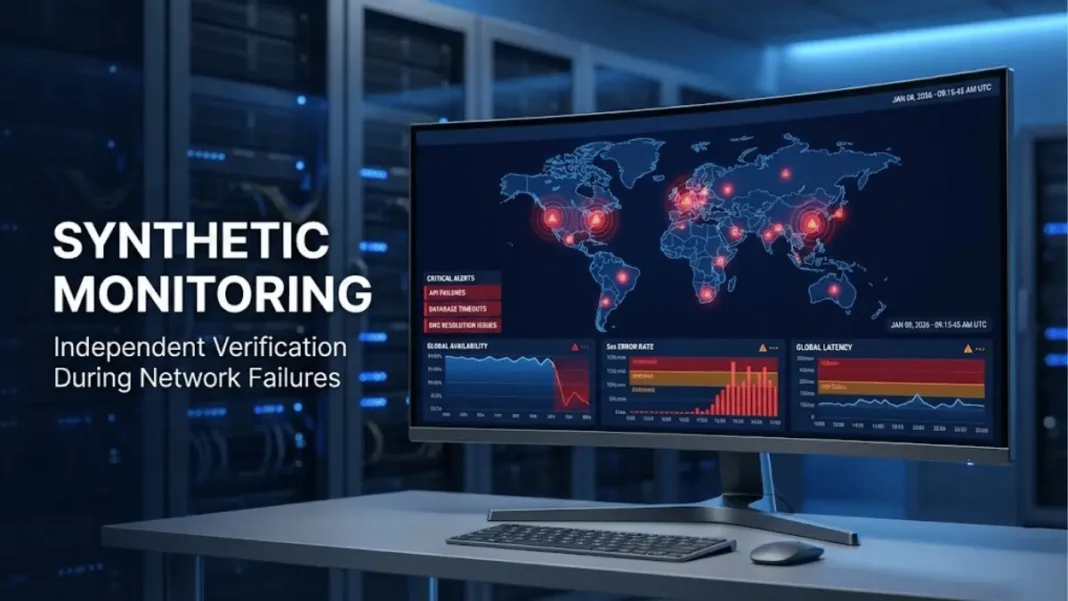
During the November outage, synthetic monitoring would have immediately triggered multi-level alerts when global nodes detected 5xx errors and connection timeouts across Asia, Europe, Americas, and Africa. While Cloudflare’s dashboard became inaccessible, synthetic monitoring dashboards remained available for remote SRE decision-making.
The technology’s minute-level polling captured the repeated “up-down-up” cycles, visualized as alternating peaks and troughs that indicated configuration synchronization issues rather than permanent failures. After services recovered, automated validation confirmed 10 consecutive successful checks before clearing the incident.
Types of Synthetic Monitoring Probes
Modern synthetic monitoring extends far beyond simple website checks. HTTP/HTTPS probing supports custom headers, cookies, request bodies, and expected status codes to simulate logins, API calls, and payment workflows.
DNS probing measures resolution latency, validates authoritative server responses, and checks TTL settings to detect hijacking or cache poisoning. TCP/UDP probing tests port accessibility and handshake latency for databases, game servers, and VoIP services.
SSL/TLS probing validates certificate validity, cipher suites, and OCSP responses to provide early warnings for certificate expiration. Step-by-step browser checks perform real browser rendering with JavaScript execution for single-page applications, single sign-on, and CAPTCHA testing. API transaction probing orchestrates multi-step API workflows with variable extraction to simulate complete order creation processes.
Market Growth and Cloud Adoption
The global synthetic monitoring market reached $1.42 billion in 2024 and is projected to grow to $3.78 billion by 2033 at an 11.5% CAGR. Cloud-based deployment dominates due to scalability, cost-effectiveness, and ease of implementation.
Alibaba Cloud’s Synthetic Monitoring service deploys detection points globally to simulate user access under different network conditions. The service monitors mainstream protocols including ping, TCP, traceroute, and HTTP/HTTPS with real-time alerting and fault diagnostics. However, as of June 2024, Alibaba Cloud discontinued new activations for pay-as-you-go billing, focusing on enterprise subscriptions.
What Businesses Should Do Now
Enterprises must establish independent verification mechanisms beyond vendor-reported health signals. Critical questions include whether the organization can independently verify vendor failures, whether observability covers actual user access paths, and whether automated failover plans have been validated through probing.
Synthetic monitoring does not replace internal monitoring or challenge vendor authority. Instead, it acts as a digital sentry at internet edges, continuously asking: “Can I be accessed right now?”. This objective, evidence-based approach provides a baseline protection against the most dangerous failures those that eliminate service availability without immediate detection.

Featured Snippet Boxes
What is synthetic monitoring?
Synthetic monitoring uses distributed probing networks to actively test service availability from real user perspectives. It simulates user interactions across protocols like HTTP, DNS, TCP, and SSL to verify accessibility and performance independently of vendor infrastructure.
How does synthetic monitoring differ from APM?
APM only records requests reaching applications, missing traffic blocked at CDN or WAF layers. Synthetic monitoring probes from external locations to detect edge network failures, authentication issues, and soft outages before they reach origin servers.
Why couldn’t internal monitoring detect the November 2025 outage?
Internal observability systems were overwhelmed recording errors, consuming excessive CPU and causing console failures. Infrastructure showed healthy origin servers while edge layer failures blocked traffic. Vendor status pages went offline, eliminating external visibility.
What types of failures can synthetic monitoring detect?
Synthetic monitoring identifies 5xx errors, latency spikes, DNS resolution failures, TLS handshake issues, certificate problems, authentication failures, and regional POP node failures. It captures intermittent soft outages where services remain partially functional but unavailable to users.

