

Quick Brief
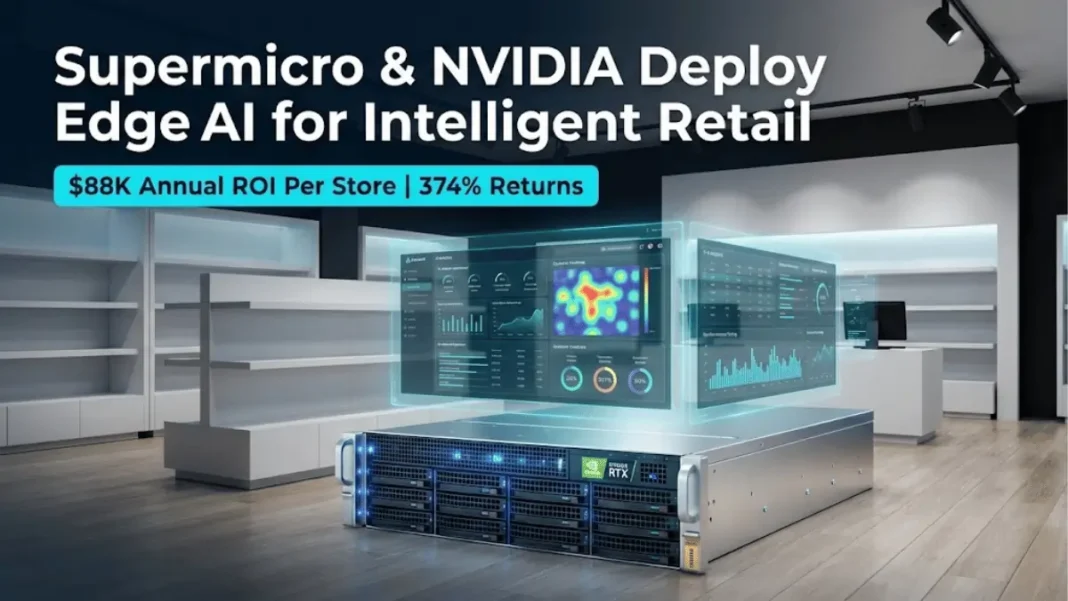
- The Announcement: Supermicro launched intelligent in-store retail solutions powered by NVIDIA RTX PRO Blackwell GPUs, partnering with Everseen, Wobot AI, LiveX AI, Kinetic Vision, ALLSIDES, Superb AI, and Aible at NRF’s Retail’s Big Show on January 11, 2026.
- The Impact: Partner Everseen reports 374% ROI over three years with $88,000 average annual value recovered per store, while 89% of retailers using AI report increased revenue.
- The Context: Global AI in the retail market reaches $13.86 billion in 2026, projected to hit $97.83 billion by 2033 at 32.2% CAGR, driving demand for edge computing infrastructure.
Supermicro Computer Inc. (NASDAQ: SMCI) announced a multi-partner collaboration to deploy AI-powered intelligent retail solutions at NRF: Retail’s Big Show in New York City, targeting loss prevention, customer analytics, and operational efficiency through edge AI infrastructure. The company partners with seven technology firms to deliver production-ready systems using NVIDIA RTX PRO Blackwell series accelerators for sub-second data processing at retail locations.
Hardware Architecture: E-Series to 4U GPU Systems
Supermicro’s retail deployment strategy centers on three product tiers designed for distributed edge environments. The fanless E103 series operates in harsh, non-conditioned spaces where traditional servers fail, while the compact E300 series brings GPU acceleration to small-footprint installations. For demanding workloads, the company offers 1U short-depth to 4U rack systems supporting NVIDIA RTX PRO 6000 Blackwell Server Edition GPUs with 24,064 CUDA cores and 96GB GDDR7 memory.
Charles Liang, Supermicro president and CEO, stated the collaboration combines “scalable AI platforms with NVIDIA RTX PRO accelerated computing solutions” to enable real-time video analysis for optimizing staff efficiency, reducing shrinkage, and preventing stock-outs. According to NVIDIA’s State of AI in Retail & CPG report, 95% of respondents confirm AI decreases annual costs while 89% report revenue increases.

Partner Solutions: From Loss Prevention to Digital Twins
Everseen’s Evercheck solution deploys Vision AI at checkout points to detect unwanted behaviors and recover losses. A Forrester Consulting Total Economic Impact study validates $88,000 average annual value recouped per store, demonstrating scalable edge AI economics. Joe White, Everseen CEO, emphasized the solution “delivers real-time computer vision at the edge” by transforming store activity into actionable intelligence.
Wobot AI converts existing CCTV infrastructure into autonomous Video AI Agents that recognize patterns and identify operational friction. Will Kelso, President of Revenue & Growth at Wobot AI, highlighted the partnership enables “scalable, reliable” deployment focused on real-time operational insights rather than experimentation.
LiveX AI deploys human-like AI agents in physical spaces through kiosks and holographic displays. Jerry Li, Co-Founder and CEO, described the technology as bringing “the speed, intelligence, and continuity of digital experiences into brick-and-mortar environments“. Kinetic Vision and ALLSIDES bundle expertise for True Digital Twin solutions optimizing supply chain processes and checkout stations.
Market Positioning: Edge vs. Cloud Economics
| Specification | Supermicro Edge AI | Cloud Processing |
|---|---|---|
| Response Time | Sub-second at edge | 50-200ms+ latency |
| Data Privacy | Processed locally | Transmitted to cloud |
| Operating Cost | One-time hardware | Ongoing bandwidth fees |
| ROI Timeline | $88K annual per store | Variable by volume |
| GPU Architecture | NVIDIA RTX PRO Blackwell | Data center GPUs |
Retailers leveraging AI experience 5-15% annual revenue growth while reducing operational costs up to 30%, according to Coherent Market Insights. AI-driven inventory optimization cuts stockouts by 50%, directly improving customer satisfaction and sales. Edge processing addresses retail-specific challenges including conditioned space limitations, distributed locations, and the need for immediate responsiveness.
Strategic Analysis: Infrastructure Competitive Landscape
Supermicro’s retail push positions the company against hyperscaler cloud offerings from Amazon Web Services, Microsoft Azure, and Google Cloud that dominate centralized AI workloads. The edge approach capitalizes on data sovereignty concerns and latency requirements that cloud architectures struggle to address for real-time retail applications.
Franz Tschimben, ALLSIDES CEO, stated the collaboration delivers “high-fidelity 3D digital twin data layer for AI training” enabling applications across the retail value chain from robot training to e-commerce integration. Aible’s automated agent solution analyzes millions of patterns to explain retail KPI changes including average purchase amounts and transaction frequencies. Arijit Sengupta, Aible CEO, noted “only autonomous agents can understand and adjust to ever-changing patterns” of customer behavior and inventory costs at scale.
The global AI industry including hardware, software, and services will reach $900 billion in 2026 with 18.6% CAGR, according to IDC reports. Supermicro’s January 6 announcement of expanded edge portfolios with NVIDIA and Intel processors demonstrates aggressive market positioning ahead of the retail industry’s digital transformation.
Production Deployment Timeline
Supermicro and partners demonstrated solutions at booth #5281 during NRF: Retail’s Big Show from January 11-13, 2026. The company hosted a speaking session featuring PepsiCo and Kinetic Vision discussing production implementation strategies. Jeremy Jarratt, Kinetic Vision CEO, stated the infrastructure foundation enables retailers to “move from experimentation to production-ready AI solutions that drive measurable operational and customer experience gains“.
Superb AI’s retail-focused VSS solution combines proprietary VLM with NVIDIA AI Blueprint components to enable natural-language search and automated incident summarization across store camera networks. The integration of subjective reasoning capabilities allows retailers to analyze customer behavior patterns beyond traditional analytics.
Frequently Asked Questions (FAQs)
What hardware does Supermicro use for intelligent retail stores?
Supermicro deploys E103 fanless systems, E300 compact servers, and 1U-4U rack systems with NVIDIA RTX PRO 6000 Blackwell GPUs featuring 24,064 CUDA cores and 96GB GDDR7 memory for edge AI processing.
How much ROI do retailers achieve with AI solutions?
Everseen’s Vision AI solution delivered 374% ROI over three years with $88,000 average annual value per store, validated by Forrester Consulting. Retailers using AI see 5-15% revenue growth and 30% cost reduction.
Which companies partnered with Supermicro for retail AI?
Seven partners joined: Everseen (loss prevention), Wobot AI (Video AI Agents), LiveX AI (holographic agents), Kinetic Vision and ALLSIDES (digital twins), Superb AI (VSS solutions), and Aible (automated analytics).
Why process retail AI at the edge instead of cloud?
Retail applications require sub-second responsiveness only achievable when data processes locally at the edge, avoiding cloud latency while maintaining data privacy and reducing bandwidth costs.
What is the AI in retail market size for 2026?
The global AI in retail market reached $13.86 billion in 2026, projected to grow to $97.83 billion by 2033 at 32.2% compound annual growth rate.

