

Quick Brief
- The Recognition: Siemens’ 73,000-square-meter Nanjing factory joins World Economic Forum’s Global Lighthouse Network with 78% lead time reduction and 28% emissions cut
- The Impact: Fifth Siemens facility worldwide to achieve Global Lighthouse status, demonstrating scalable industrial AI deployment across 50+ applications
- The Context: WEF expanded network to 224 sites globally in January 2026, recognizing manufacturers rewiring operations with AI amid geopolitical volatility and cost pressures
- The Numbers: 33% faster time-to-market, 14% productivity gain, 46% reduction in field failures compared to 2022 baseline
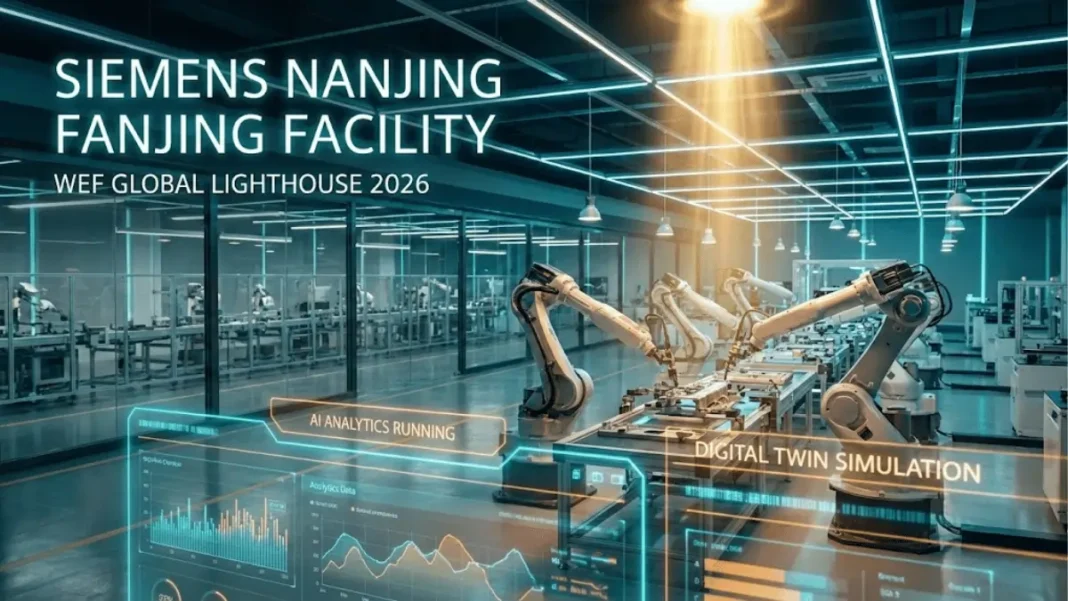
Siemens Digital Industries secured World Economic Forum Global Lighthouse Factory designation for its Nanjing manufacturing site on January 15, 2026, marking the company’s fifth facility to enter the elite network. The WEF cited exceptional cost and quality performance driven by digital twin architecture and continuous AI-driven transformation across production operations. Siemens generated €78.9 billion in fiscal 2025 revenue, with its Digital Industries segment projected to grow 5-10% in 2026.
Digital-Native Factory Architecture Delivers Measurable Productivity Gains
The Nanjing facility represents Siemens’ largest research and production center outside Germany for CNC systems, drives, and electric motors. Cedrik Neike, CEO of Siemens Digital Industries, positioned the site as a “digital-native factory” designed, tested, and optimized entirely in virtual environments before physical construction began. This approach enabled accelerated deployment and sustained operations under pandemic constraints while maintaining cost efficiency.
The factory reduced lead times by 78% and time-to-market by 33% compared to 2022 benchmarks. Productivity increased 14% by 2024, while field failures dropped 46% during the same period. Direct and energy-related carbon emissions declined 28% through optimization of resource management and asset utilization.
Operational Challenges Drive AI Application Deployment
Siemens confronted escalating operational pressures as customer order complexity intensified, requiring production line reconfiguration every four weeks. Delivery windows compressed from 45 days to 10 days while demand patterns fluctuated. The company deployed over 50 AI applications alongside end-to-end digital twins, modular automation systems, and manufacturing operations management platforms.
The WEF jury evaluated the site’s continuous digital transformation trajectory and AI integration depth. Recognition reflected improvements across asset utilization, worker enablement, and resource management metrics. The facility processes high-variety, low-volume manufacturing through a digital excellence strategy optimized for rapid changeover and quality consistency.
AdwaitX Analysis: Industrial AI Becomes Manufacturing Infrastructure
Siemens’ Nanjing designation underscores the industrial sector’s transition from AI experimentation to embedded intelligence systems. The WEF Global Lighthouse Network expanded to 224 sites across 30+ countries and 40 industries as of January 2026. The Forum introduced customer centricity and talent award categories in 2025, supplementing productivity, supply chain resilience, and sustainability pillars.
Siemens operates five Lighthouse facilities globally, including Amberg, Erlangen, and Fürth in Germany, plus Chengdu in China. This portfolio positions the company as a reference architecture provider for digital manufacturing transformation. Industrial AI adoption accelerates as manufacturers face geopolitical disruption and compressed margin environments requiring cognitive network capabilities.
The digital-first construction methodology enables virtual commissioning and stress testing before capital deployment. Siemens leveraged this approach to compress project timelines and reduce construction risk while maintaining operational flexibility. The model scales across discrete and process manufacturing sectors pursuing sustainability targets alongside productivity objectives.
Technical Specifications
| Metric | Performance | Comparison |
|---|---|---|
| Lead Time Reduction | 78% | vs. 2022 baseline |
| Time-to-Market | 33% faster | vs. 2022 baseline |
| Productivity Gain | 14% increase | Achieved by 2024 |
| CO₂ Emissions | 28% reduction | Direct and energy-related |
| Field Failures | 46% decrease | Quality improvement metric |
| Delivery Window | 10 days | Compressed from 45 days |
| Factory Size | 73,000 sq meters | Largest center outside Germany |
| AI Applications | 50+ deployed | Across operations |
Roadmap for Scaled AI Manufacturing Transformation
Siemens positions Nanjing as a showcase site for digital manufacturing methodologies and sustainability benchmarking. The company expects continued digital transformation expansion and broader AI application rollout across factory operations. The facility serves as a validation environment for Siemens Xcelerator, the company’s open digital business platform targeting process and discrete manufacturers.
The WEF Global Lighthouse Network functions as an industry learning community for achieving operational performance at scale. Member sites demonstrate that transformation represents a continuous capability rather than a destination, converting volatility into competitive advantage. Organizations adopting AI infrastructure with disciplined scaling approaches and human-centered oversight will define operational excellence benchmarks through 2030.
Siemens’ Digital Industries workforce of 70,000 globally supports enterprise customers pursuing digital transformation and sustainability objectives. The business unit targets 15-19% profit margins for fiscal 2026 alongside the 5-10% revenue growth projection. Industrial AI market analysts identify 2026 as the inflection point where trained intelligence systems transition from optional tools to core operational determinants.

Frequently Asked Questions (FAQs)
What is a WEF Global Lighthouse Factory?
A World Economic Forum designation for manufacturing sites demonstrating exceptional performance through advanced technology deployment at scale. The network includes 224 sites across 30+ countries.
How did Siemens reduce lead times by 78%?
Through digital twin architecture, over 50 AI applications, modular automation systems, and virtual factory planning before physical construction.
What is a digital-native factory?
A manufacturing facility designed, tested, and optimized entirely in virtual environments before construction, enabling accelerated deployment and continuous optimization.
How many Siemens factories are Global Lighthouses?
Five facilities: Nanjing and Chengdu in China, plus Amberg, Erlangen, and Fürth in Germany.
What AI applications does Siemens deploy in manufacturing?
Over 50 AI applications spanning predictive maintenance, quality control, asset optimization, and production planning integrated with digital twins.

