

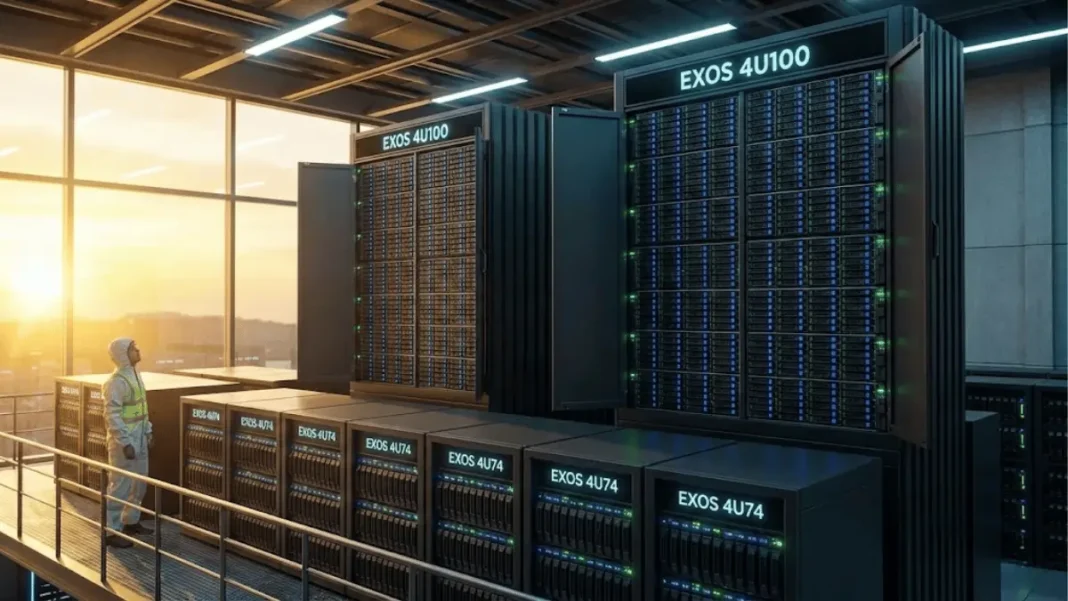
Seagate Technology unveiled its Exos 4U100 JBOD storage system in November 2025, claiming the highest-density single-enclosure enterprise storage on the market. The system packs up to 3.2 petabytes in a 4U rack form factor and targets AI training, edge analytics, and data-heavy workloads that demand petabyte-scale capacity at the network edge.
The launch comes as Seagate rides a storage demand wave fueled by AI infrastructure expansion. The company posted $2.63 billion in Q1 Fiscal 2026 revenue, a 21% year-over-year jump, with record 40.1% gross margins driven by its high-capacity HAMR (Heat-Assisted Magnetic Recording) drive technology.
What’s New in the Exos 4U100
Seagate’s Exos 4U100 and its sibling 4U74 JBOD systems are designed for petabyte-scale deployments at data centers and edge locations.
- Capacity: Up to 3.2 PB in a single 4U enclosure using Seagate’s latest Mozaic HAMR drives
- Technology: Leverages Mozaic 3+ platform with 32TB drives currently; roadmap includes 40TB+ drives in 2026
- Target use cases: AI model checkpointing, long-term data retention, real-time edge analytics, and ML workflows
- Availability: Ships in Q1 2026 through authorized channel partners worldwide
Melyssa Banda, SVP of Edge Storage at Seagate, called the 4U100 “a demonstration of Seagate’s commitment to empowering organizations to retain more data for longer periods” as businesses assess future data value.
Why AI Data Centers Need Dense Storage
Enterprise and hyperscale customers are consolidating massive datasets at the edge to support AI inference and training workloads. Traditional storage arrays can’t keep pace with the petabytes of training data, video content, and unstructured information AI models require.
Seagate’s HAMR technology reduces the cost per terabyte while delivering higher energy efficiency than older PMR (Perpendicular Magnetic Recording) drives. The company expects to hit a 50% exabyte crossover from legacy PMR to HAMR by the second half of 2026, marking a major platform shift.
Analysts project Seagate’s gross margins could approach 50% as 40TB drive production ramps in 2026, a profit level uncommon in hardware manufacturing.

HAMR Drive Roadmap and Competition
Seagate is currently sampling 40TB+ drives with volume production expected in the first half of 2026. The company plans to reach 50TB by late 2026 or early 2027, accelerating its density roadmap.
Competitors are pursuing alternative technologies. Toshiba is developing Microwave-Assisted Magnetic Recording (MAMR) and aims for a 35TB HAMR drive before 2026. Western Digital also posted strong 2025 performance on AI-driven storage demand but trails Seagate in HAMR commercialization.
What’s Next for Seagate Storage
The Exos 4U100 begins shipping in Q1 2026, but broader availability depends on 40TB drive production scaling. Seagate has not disclosed pricing, though enterprise JBOD systems typically require quotes based on configuration and volume.
The company continues investing in R&D, including a £115 million commitment to its Londonderry facility for next-gen recording head innovation. As AI inference and multimodal models expand, storage demand for “data lakes” is expected to grow exponentially, requiring massive capacity refreshes across existing data centers.

Featured Snippet Boxes
What is the Seagate Exos 4U100?
The Exos 4U100 is a JBOD (Just a Bunch of Disks) storage system announced in November 2025 that delivers up to 3.2 petabytes of capacity in a single 4U rack enclosure using Seagate’s Mozaic HAMR drive technology.
When will the Exos 4U100 be available?
Seagate plans to ship the Exos 4U100 and 4U74 JBOD systems in Q1 2026 through authorized channel partners worldwide. Mass availability depends on production scaling of 40TB HAMR drives.
What is HAMR technology in Seagate drives?
HAMR (Heat-Assisted Magnetic Recording) uses a laser to temporarily heat the disk surface, allowing data to be written more densely. This enables higher capacities (32TB today, 50TB+ by 2027) and lower cost per terabyte than older PMR drives.
Who is the Exos 4U100 designed for?
The system targets hyperscale data centers, enterprises running AI training and inference workloads, edge computing deployments, and organizations managing petabyte-scale data lakes that require long-term retention and high-density storage.

