

Quick Brief
- The Launch: SAP announced storefront MCP server for SAP Commerce Cloud at NRF 2026 (January 11-13, NYC), targeting Q2 2026 availability to enable AI agent transactions
- The Financial Scale: Global retail returns exceed $1.9 trillion annually while commerce cloud market reaches $26.9 billion in 2026, growing at 22.84% CAGR
- The Impact: Catalog Optimization Agent delivers 70% faster content processing, 63% reduced maintenance effort, and scales to 10 million+ SKUs
- The Context: Model Context Protocol (MCP), introduced by Anthropic in November 2024, now powers thousands of community-built AI agent servers
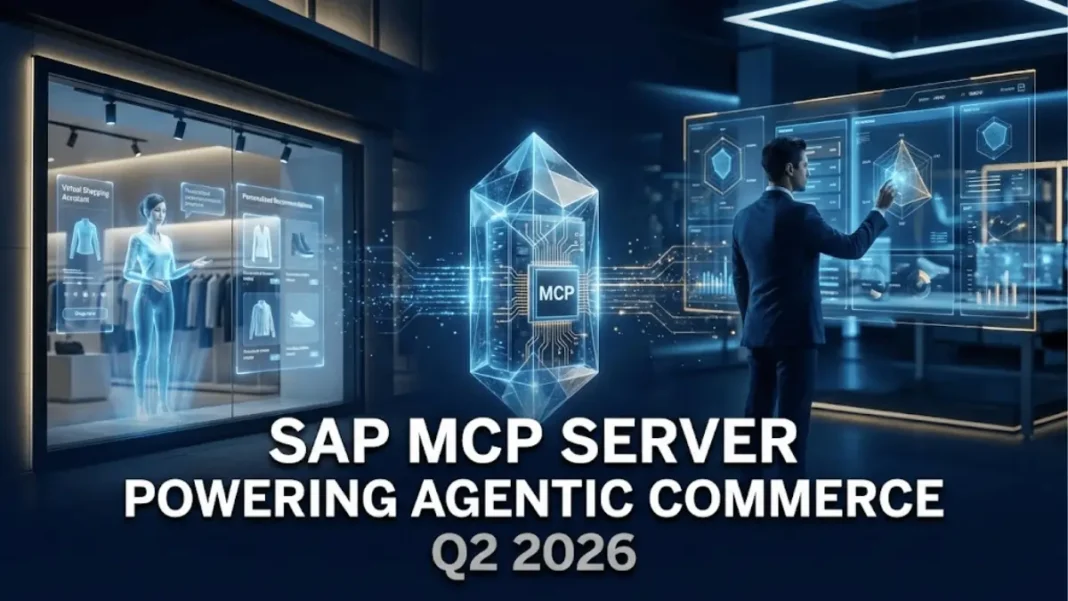
SAP announced its storefront Model Context Protocol (MCP) server for SAP Commerce Cloud at NRF 2026 in New York City (January 11-13), positioning the enterprise software giant to enable channel-less commerce transactions between retailers and autonomous AI shopping agents. The Q2 2026 deployment addresses a fundamental infrastructure gap as AI agents from ChatGPT, Perplexity, and other platforms increasingly mediate consumer purchases without visiting traditional storefronts.
The MCP Protocol Architecture for Retail
The storefront MCP server establishes standardized communication between SAP Commerce Cloud and third-party AI agents, allowing machines to discover products, verify inventory, and execute transactions autonomously. MCP functions as a coordination layer where AI clients send standardized requests, servers execute actions against commerce systems, and the protocol manages bidirectional communication. Unlike traditional search-based discovery, MCP-enabled agents reason about product attributes, compare specifications, and complete purchases based on user intent rather than explicit commands.
SAP’s implementation supports emerging agentic protocols including MCP, Agent Communication Protocol (ACP), and Universal Commerce Protocol (UCP). The infrastructure enables retailers to participate in what SAP global head Kollen Glynn describes as “channel-less commerce” transactions initiated by AI assistants operating outside retailer-owned digital properties.
Catalog Intelligence: 10 Million SKU Scalability
SAP’s Catalog Optimization Agent addresses the operational challenge of preparing product data for machine interpretation at enterprise scale. The AI system cleans catalogs, enriches attributes, standardizes specifications, and generates multilingual content using real-time data sources. Performance metrics demonstrate material efficiency gains:
| Metric | Improvement | Impact |
|---|---|---|
| Content Processing Speed | 70% faster | Accelerated time-to-market for product launches |
| Data Completeness | +5% | Enhanced AI agent product matching accuracy |
| Maintenance Effort | -63% reduction | Operational cost savings for merchandising teams |
| Catalog Scale | 10M+ items | Enterprise-grade SKU management |
This capability responds to what SAP identifies as “generative engine optimization” (GEO), the need to structure product data for AI interpretation rather than human search behavior. In agent-driven commerce, incomplete or inconsistent product attributes directly reduce visibility in AI-mediated recommendations.

Payment Infrastructure for Autonomous Transactions
SAP’s open payment framework for Commerce Cloud integrates with emerging real-time payment rails including FedNow, Real-Time Payments (RTP), and stablecoin networks. The headless, extensible architecture uses no-code and low-code configuration to support agent-initiated transactions while maintaining compliance through automatic regulatory updates. Visa and Mastercard have implemented consumer controls allowing users to set spending limits and authorization parameters for AI agent purchases.
The payment evolution addresses transaction fragmentation as buying journeys span devices, channels, and autonomous agents operating on consumer behalf. SAP’s framework positions payments as infrastructure that integrates into agent workflows rather than requiring manual checkout processes.
AdwaitX Analysis: The $1.9 Trillion Returns Intelligence Opportunity
Global retail returns surpassed $1.9 trillion annually, growing faster than sales according to IHL Group data. SAP’s strategy positions returns as a strategic intelligence engine rather than cost center through AI-driven “keep, reject, or return” decisioning based on customer lifetime value, margin impact, and behavioral signals.
Organizations deploying both SAP ERP and SAP Commerce Cloud achieve quantifiable integration benefits, according to Enterprise Strategy Group research:
- 80% lower total cost of ownership through unified data architecture
- 90% productivity gains from automated workflows
- 105-245% revenue uplift via hyper-personalized experiences
SAP Order Management Services extends this foundation by orchestrating centralized returns rules, guided workflows, real-time inventory visibility, and accelerated refunds. The commerce cloud market’s expansion from $21.9 billion in 2025 to projected $26.9 billion in 2026 reflects enterprise demand for integrated commerce infrastructure.
Trust Architecture in Agent-Mediated Commerce
SAP positions retailers as “AI trust custodians” responsible for data governance, preference management, and payment security as autonomous systems control more purchase decisions. The trust framework balances AI-driven personalization with deterministic constraints and enterprise policy enforcement. SAP Customer Loyalty Management enables adaptive reward strategies that recognize engagement across traditional channels and AI agent transactions, feeding behavioral data back to transactional agents for improved recommendation relevance.
The Order Reliability Agent proactively identifies and resolves fulfillment issues before customer impact, maintaining service levels as commerce detaches from direct storefront interactions. This operational reliability becomes foundational as discovery shifts from brand-owned properties to AI assistants that evaluate retailers based on structured signals including reviews, ratings, delivery accuracy, and issue resolution speed.
Q2 2026 Deployment and Protocol Roadmap
SAP’s MCP server targets Q2 2026 general availability, positioning early adopters to establish AI agent commerce capabilities before widespread consumer adoption. The protocol implementation follows Anthropic’s November 2024 MCP introduction, which generated thousands of community-built servers connecting AI models to enterprise systems including GitHub, Slack, and Kubernetes.
Red Hat’s integration of MCP into OpenShift AI demonstrates enterprise infrastructure readiness, providing developers with MCP server testing in playground environments, catalog publishing, and production deployment with governance controls. Payment networks, commerce platforms, and AI assistant providers are converging on interoperable standards that enable cross-platform agent transactions without proprietary integrations.

Frequently Asked Questions (FAQs)
What is agentic AI in commerce?
Agentic AI systems act autonomously on user intent, learning preferences and completing transactions without explicit commands, reshaping how consumers discover and purchase products.
How does SAP’s MCP server enable AI agent transactions?
The Model Context Protocol server provides standardized interfaces for AI agents to query product catalogs, verify inventory, and execute purchases through SAP Commerce Cloud.
What is generative engine optimization (GEO)?
GEO structures product data for AI agent interpretation, ensuring attributes, specifications, and availability signals are machine-readable for recommendation engines.
How much do global retail returns cost annually?
Retail returns exceed $1.9 trillion globally according to IHL Group, growing faster than sales and requiring AI-driven intelligence for profitable management.

