

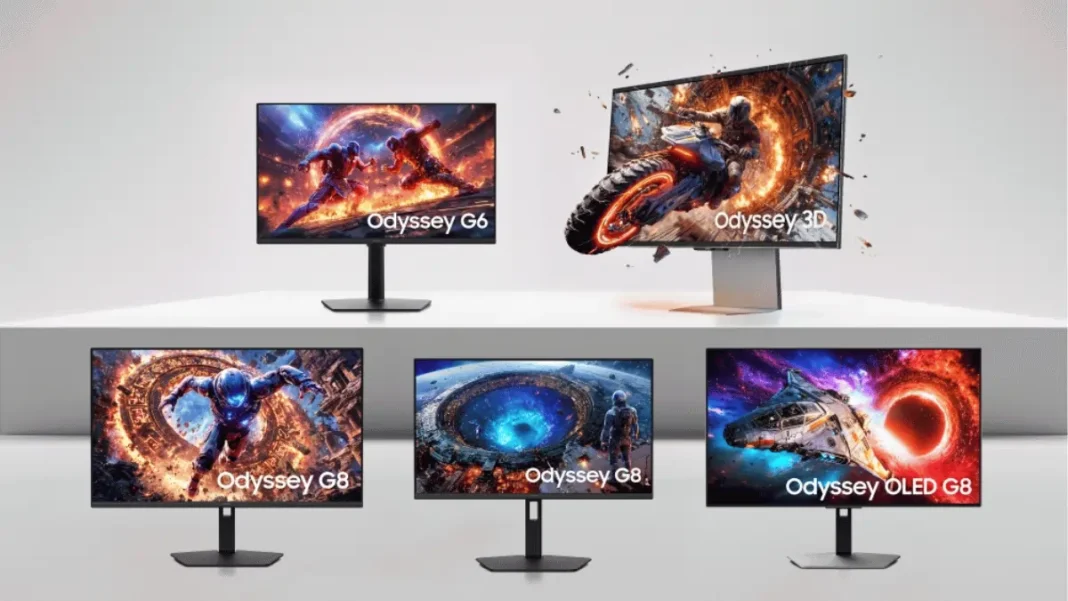
Summary: Samsung announced five 2026 Odyssey gaming monitors ahead of CES 2026, featuring industry-first technologies including a 6K glasses-free 3D display (Odyssey 3D) and the world’s first 1,040Hz refresh rate monitor (Odyssey G6). The lineup includes three Odyssey G8 variants spanning 6K IPS, 5K IPS, and 4K QD-OLED panels, all supporting DisplayPort 2.1 for cutting-edge bandwidth. The Odyssey 3D uses real-time eye tracking to create dimensional gaming without headsets, while the G6 delivers unprecedented 1,040Hz speeds in HD mode or 600Hz at native QHD. Pricing remains unannounced, with hands-on demos scheduled for CES 2026 from January 6-9.
Samsung just shattered two major gaming monitor barriers with its 2026 Odyssey lineup: the world’s first 6K glasses-free 3D display and a blistering 1,040Hz refresh rate that makes 360Hz monitors look sluggish. Announced today ahead of CES 2026, the five-monitor collection targets competitive gamers and early adopters willing to push hardware limits.
These aren’t incremental upgrades Samsung claims these displays use technologies that “weren’t possible even a year ago,” according to Hun Lee, Executive Vice President of Samsung’s Visual Display Business. The lineup includes the Odyssey 3D (G90XH), Odyssey G6 (G60H), and three distinct Odyssey G8 models covering 6K, 5K, and OLED configurations.
What Makes These Monitors Different
World’s First 6K Glasses-Free 3D Technology
The 32-inch Odyssey 3D eliminates the biggest complaint about 3D gaming: uncomfortable glasses or bulky VR headsets. Using real-time eye-tracking cameras, the monitor adjusts depth and perspective based on where you’re looking, creating a layered dimensional effect without accessories.
Unlike VR headsets that isolate you in a closed environment, glasses-free 3D monitors let you maintain peripheral awareness while adding depth cues that help judge distances in games. You can glance at a second screen, grab your drink, or interact with your surroundings without removing hardware.
Record-Breaking 1,040Hz Refresh Rate
The 27-inch Odyssey G6 demolishes the previous 750Hz record by delivering 1,040Hz in HD resolution mode. Even at its native QHD (2560×1440) resolution, it reaches 600Hz faster than most esports monitors claim at 1080p.
To put this in perspective: 144Hz remains the competitive gaming standard, 240Hz is considered premium, and anything above 360Hz was experimental until now. Samsung just nearly tripled that ceiling.
Odyssey 3D (G90XH): Glasses-Free Gaming Without Compromise
The Odyssey 3D uses dual eye-tracking cameras positioned around the display to monitor your head position in real-time. It renders separate images to each eye through a lenticular lens layer, creating stereoscopic 3D depth without glasses. The system adjusts perspective as you move, maintaining the 3D effect from different viewing angles.
How Eye-Tracking 3D Actually Works
The technology behind glasses-free 3D relies on a lenticular lens array built into the panel that directs different images to each eye simultaneously. Two front-facing cameras constantly track your pupil positions, calculating the exact angle needed to maintain proper depth separation.
When you lean left or right, the monitor recalculates the viewing cone within milliseconds, preventing the “sweet spot” problem that plagued older glasses-free 3D TVs. This means you can maintain the 3D effect even during intense gaming sessions where you might shift positions frequently.
The monitor also includes a 2D-to-3D conversion mode for non-optimized games, though the effect is most dramatic with officially supported titles. Think of it like spatial audio; it works everywhere, but content mixed specifically for it delivers superior results.
Supported Games and Performance Specs
Samsung partnered with game studios to optimize 3D effects for specific titles at launch. Confirmed games include:
- The First Berserker: Khazan – Enhanced terrain depth and distance rendering
- Lies of P: Overture – Improved object separation and environmental layering
- Stellar Blade – Optimized combat depth perception
The Odyssey 3D runs at 6K resolution (6144×3456) with a native 165Hz refresh rate. Dual Mode drops resolution to 3K while boosting refresh to 330Hz for competitive titles that prioritize speed over detail. Response time sits at 1ms gray-to-gray, eliminating motion blur during fast camera pans.
GPU Reality Check: Driving 6K at 165fps demands flagship GPU power. Expect to pair this with an NVIDIA RTX 4090 or upcoming RTX 50-series cards for demanding AAA titles. The 3K/330Hz mode becomes more practical for current-gen hardware in esports games.
Odyssey G6 (G60H): The Fastest Monitor Ever Made
The Odyssey G6 exists for one purpose: eliminating every possible frame of input lag in competitive gaming. Its 1,040Hz maximum refresh rate represents just 0.96 milliseconds between frame updates compared to 6.94ms at 144Hz.
Understanding 1,040Hz vs 600Hz Dual Mode
The G6 uses Dual Mode technology to toggle between two operating profiles:
- Native QHD Mode: 2560×1440 at 600Hz for sharp image quality
- HD Boost Mode: 1280×720 at 1,040Hz for maximum responsiveness
Competitive esports players in CS2, Valorant, or Overwatch 2 who already run games at low settings for maximum framerate will benefit most from HD mode. The reduced resolution matters less when you’re focused on target tracking and reaction time rather than scenic detail.
The monitor supports both AMD FreeSync Premium Pro and NVIDIA G-Sync Compatible (certification pending at launch) to prevent screen tearing. DisplayPort 2.1 and HDMI 2.1 connections ensure full bandwidth for the extreme refresh rates.
GPU Requirements for Extreme Refresh Rates
Reality check: Even at 720p, hitting 1,040fps consistently requires extreme hardware and optimized settings. Here’s what you realistically need:
- For 1,040Hz HD mode: RTX 4080 Super or RX 7900 XTX in esports titles with low/medium settings
- For 600Hz QHD mode: RTX 4090 or top-tier upcoming GPUs in optimized competitive games
- CPU bottleneck warning: Pair with Intel Core i9-14900K or AMD Ryzen 9 7950X3D to prevent CPU limitations
Most AAA games won’t approach these framerates. This monitor targets the 0.1% of players grinding rank in competitive shooters where every millisecond matters.
Three Odyssey G8 Models: Choose Your Resolution
Samsung split the Odyssey G8 line into three distinct products targeting different priorities.
6K G8 (G80HS): Maximum Workspace and Detail
The 32-inch 6K G8 shares the Odyssey 3D’s 6144×3456 resolution but removes the 3D technology for a lower price point. At 165Hz native (330Hz in 3K Dual Mode), it serves creators and gamers who want extreme detail for photo editing or immersive single-player games without the 3D gimmick.
This resolution provides 33.2 million pixels, nearly double a 5K display and 2.4 times more than 4K. Text rendering becomes extraordinarily sharp for productivity work between gaming sessions.
5K G8 (G80HF): Balanced High-Res Performance
The 27-inch 5K G8 hits 5120×2880 resolution at 180Hz, with Dual Mode boosting to 360Hz at QHD. This represents the sweet spot for high-end gaming rigs that can’t quite push 6K or 4K at high framerates consistently.
The smaller 27-inch size increases pixel density compared to the 32-inch 6K model, making it ideal for desk setups where you sit closer to the screen.
4K OLED G8 (G80SH): Contrast King
The 32-inch OLED G8 swaps resolution bragging rights for the superior contrast and color accuracy of QD-OLED technology. Its 4K (3840×2160) panel runs at 240Hz fast enough for competitive play while maintaining the inky blacks and per-pixel lighting that OLED delivers.
Samsung added Glare Free technology to minimize reflections, addressing OLED’s traditional weakness in bright rooms. The VESA DisplayHDR True Black 500 certification guarantees exceptional HDR performance with true black levels impossible on backlit displays.
DisplayPort 2.1 with UHBR20 provides 80Gbps bandwidth crucial for 4K 240Hz HDR with 10-bit color. A 98W USB-C port lets you drive the display and charge a laptop simultaneously.
Technical Comparison: Which Monitor Fits Your Setup
Specs Breakdown Table
| Model | Size | Resolution | Panel Type | Refresh Rate | Dual Mode | Response Time | Ports |
|---|---|---|---|---|---|---|---|
| Odyssey 3D (G90XH) | 32″ | 6K (6144×3456) | IPS | 165Hz | 330Hz (3K) | 1ms GtG | HDMI 2.1, DP 2.1 |
| Odyssey G6 (G60H) | 27″ | QHD (2560×1440) | IPS | 600Hz | 1,040Hz (HD) | 1ms GtG | HDMI 2.1, DP 2.1 |
| Odyssey G8 (G80HS) | 32″ | 6K (6144×3456) | IPS | 165Hz | 330Hz (3K) | 1ms GtG | HDMI 2.1, DP 2.1 |
| Odyssey G8 (G80HF) | 27″ | 5K (5120×2880) | IPS | 180Hz | 360Hz (QHD) | 1ms GtG | HDMI 2.1, DP 2.1 |
| Odyssey OLED G8 (G80SH) | 32″ | 4K (3840×2160) | QD-OLED | 240Hz | 240Hz | 0.03ms GtG | HDMI 2.1, DP 2.1 (UHBR20), USB-C 98W |
Resolution & Refresh Rate Comparison
| Feature | Odyssey 3D | Odyssey G6 | G8 6K | G8 5K | OLED G8 |
|---|---|---|---|---|---|
| Native Resolution | 6K (6144×3456) | QHD (2560×1440) | 6K (6144×3456) | 5K (5120×2880) | 4K (3840×2160) |
| Native Refresh | 165Hz | 600Hz | 165Hz | 180Hz | 240Hz |
| Dual Mode Refresh | 330Hz @ 3K | 1,040Hz @ HD | 330Hz @ 3K | 360Hz @ QHD | 240Hz |
| Panel Technology | IPS | IPS | IPS | IPS | QD-OLED |
| Response Time | 1ms GtG | 1ms GtG | 1ms GtG | 1ms GtG | 0.03ms GtG |
| Screen Size | 32″ | 27″ | 32″ | 27″ | 32″ |
Connectivity & Features Comparison
| Feature | Odyssey 3D | Odyssey G6 | G8 6K | G8 5K | OLED G8 |
|---|---|---|---|---|---|
| DisplayPort | 2.1 | 2.1 | 2.1 | 2.1 | 2.1 (UHBR20) |
| HDMI | 2.1 | 2.1 | 2.1 | 2.1 | 2.1 |
| USB-C Power | No | No | No | No | Yes (98W) |
| AMD FreeSync | Premium Pro | Premium Pro | Premium Pro | Premium Pro | Premium Pro |
| NVIDIA G-Sync | Compatible | Compatible | Compatible | Compatible | Compatible |
| HDR | HDR10+ Gaming | HDR10+ Gaming | HDR10+ Gaming | HDR10+ Gaming | VESA True Black 500 |
| Unique Feature | Glasses-Free 3D | 1,040Hz Record | 6K Workspace | Balanced 5K | Glare Free OLED |
DisplayPort 2.1 vs HDMI 2.1 Advantages
All five monitors include DisplayPort 2.1, which provides significantly more bandwidth than HDMI 2.1:
- DisplayPort 2.1 (UHBR20): Up to 80Gbps bandwidth
- HDMI 2.1: Maximum 48Gbps bandwidth
This matters for high-resolution, high-refresh-rate gaming with HDR enabled. The 6K monitors at 165Hz with 10-bit color require more than HDMI 2.1 can deliver without compression. For maximum fidelity, you’ll want DisplayPort cables rated for the full UHBR20 spec.
Pros and Cons of Each Model
Pros and Cons of Odyssey 3D (G90XH)
- Unique glasses-free 3D without headset discomfort
- Highest resolution in lineup (6K)
- 2D-to-3D conversion for any game
- Limited officially optimized game library at launch
- 3D effect requires specific viewing distance and angle
- Requires flagship GPU for native resolution gaming
Pros and Cons of Odyssey G6 (G60H)
- Unprecedented 1,040Hz refresh in HD mode
- Practical 600Hz at QHD resolution
- Eliminates motion blur for competitive advantage
- Extreme framerates need top-tier CPU and GPU
- Most games can’t utilize full refresh potential
- 27-inch size may feel small for immersive gaming
Pros and Cons of Odyssey G8 6K (G80HS)
- Massive detail for productivity and gaming
- No 3D premium if you don’t need that feature
- 32-inch screen size for immersive experience
- 6K gaming demands exceptional GPU power
- 165Hz may feel slow compared to 240Hz+ competitors
- IPS contrast inferior to OLED option
Pros and Cons of Odyssey G8 5K (G80HF)
- Balanced resolution and refresh rate
- 27-inch size ideal for competitive desk setups
- 360Hz Dual Mode for esports titles
- Not the highest resolution or fastest refresh in lineup
- Stuck between market segments (not specialized)
- May struggle to justify premium vs 4K 240Hz alternatives
Pros and Cons of Odyssey OLED G8 (G80SH)
- Superior contrast and true blacks from QD-OLED
- Glare Free technology for bright rooms
- 98W USB-C for laptop docking
- OLED burn-in risk for static UI elements
- Lower resolution than other G8 models
- Likely highest price point in lineup
Real-World Performance Expectations
For Competitive Esports Players: The Odyssey G6 delivers measurable advantages in reaction-time-critical games like CS2 and Valorant. The reduction from 6.94ms frame time (144Hz) to 0.96ms (1,040Hz) can mean spotting enemies 5-6ms sooner enough to win aim duels at the highest ranks.
For AAA Gamers: The 6K monitors (Odyssey 3D and G8 6K) require GPU compromises. Expect to run Cyberpunk 2077 or Red Dead Redemption 2 at medium-high settings with DLSS/FSR upscaling to hit 60-120fps. The resolution shines most in slower-paced games where you can appreciate detail.
For Content Creators: The 6K and 5K G8 models provide exceptional screen real estate for video editing timelines and Photoshop workspaces. The color accuracy of IPS panels suits professional work, though the OLED G8 offers superior contrast for color grading.
For VR Hesitant Gamers: The Odyssey 3D delivers dimensional gaming without VR’s isolation and nausea concerns. You maintain peripheral vision and spatial awareness, making it more suitable for extended sessions. However, the 3D effect requires you to sit within the eye-tracking zone lean too far, and depth perception breaks.
Market Impact and Availability
According to IDC data, Samsung holds an 18.8% global revenue share in gaming monitors with refresh rates above 144Hz, maintaining the number one position for six consecutive years. These 2026 Odyssey models aim to extend that lead by introducing technologies competitors haven’t announced yet.
The lineup will debut at CES 2026 in Las Vegas from January 6-9, with hands-on demos available. Pricing and exact release dates remain unannounced, but expect premium positioning given the world-first claims across multiple models.
For competitive gamers chasing every millisecond advantage, the Odyssey G6’s 1,040Hz represents a measurable edge. For those curious about 3D gaming without VR commitment, the Odyssey 3D offers a genuine innovation. And for users who simply want the sharpest image possible, the 6K G8 delivers pixel density rivals can’t match.
Frequently Asked Questions
What GPU do I need for the 1,040Hz Odyssey G6?
The 1,040Hz mode runs at 720p (HD) resolution, requiring an NVIDIA RTX 4080 or AMD RX 7900 XTX to consistently hit 700+ fps in optimized esports titles like CS2 or Valorant with low settings. For the native 600Hz QHD mode, you’ll need an RTX 4090 or equivalent upcoming GPU.
Does glasses-free 3D work as well as VR headsets?
No VR provides complete 360-degree immersion that 3D monitors can’t match. However, glasses-free 3D offers depth perception without headset discomfort, isolation, or nausea that some users experience with VR. It’s a middle ground: more immersive than standard 2D, less isolating than VR.
Will HDMI 2.1 support the full specs of these monitors?
Not for the 6K models. HDMI 2.1’s 48Gbps bandwidth can’t carry 6K at 165Hz with full color depth. You must use DisplayPort 2.1 for the full experience. HDMI works fine for the OLED G8 at 4K 240Hz.
What’s the difference between the three Odyssey G8 models?
The G80HS offers 6K resolution on a 32-inch IPS panel at 165Hz. The G80HF provides 5K on a 27-inch IPS panel at 180Hz. The OLED G80SH uses a 32-inch QD-OLED panel at 4K 240Hz with superior contrast and Glare Free technology. Choose based on whether you prioritize resolution (6K/5K models) or contrast and HDR (OLED model).
When will these monitors be available and how much will they cost?
Samsung hasn’t announced pricing or exact release dates. The monitors will be showcased at CES 2026 (January 6-9, 2026) in Las Vegas, with availability expected in Q1-Q2 2026. Based on previous Odyssey pricing, expect the Odyssey 3D and OLED G8 to exceed $1,200, with the G6 potentially starting around $800-900.
Can I use the Odyssey 3D monitor in regular 2D mode?
Yes the Odyssey 3D functions as a standard 6K monitor when you disable the 3D feature. The eye-tracking cameras simply turn off, and you get a high-resolution IPS display with 165Hz refresh and 330Hz Dual Mode.
Do these monitors work with consoles?
The monitors include HDMI 2.1 ports compatible with PlayStation 5 and Xbox Series X. However, consoles max out at 4K 120Hz, meaning you won’t utilize the high refresh rates or 6K/5K resolutions. The OLED G8 makes the most sense for console gaming due to its 4K resolution and exceptional HDR.
What is Dual Mode and how does it work?
Dual Mode lets you sacrifice resolution for doubled refresh rates. The monitor drops to a lower resolution (3K on 6K models, QHD on 5K models, HD on the G6) to free up bandwidth for higher frame rates. You can toggle between modes for competitive esports (high refresh) and immersive single-player (high resolution) without buying two monitors.
Featured Snippet Boxes
What is the Samsung Odyssey 3D?
The Samsung Odyssey 3D (G90XH) is the world’s first 6K gaming monitor with glasses-free 3D technology. It uses real-time eye-tracking to adjust depth and perspective based on viewer position, creating dimensional gaming without VR headsets or 3D glasses. The 32-inch display runs at 6K resolution (6144×3456) with 165Hz refresh rate.
What is the fastest gaming monitor refresh rate in 2026?
The Samsung Odyssey G6 (G60H) holds the world record at 1,040Hz refresh rate in HD mode, delivering frame updates every 0.96 milliseconds. At its native QHD resolution (2560×1440), it still reaches 600Hz. Both speeds require DisplayPort 2.1 and extreme GPU power.
How does Dual Mode work on Samsung Odyssey monitors?
Dual Mode lets Samsung Odyssey monitors switch between native resolution and a lower resolution that doubles the refresh rate. For example, the 6K Odyssey 3D runs at 6K/165Hz normally, but drops to 3K/330Hz in Dual Mode for competitive gaming that prioritizes speed over detail.
What are the three Odyssey G8 models in 2026?
Samsung offers three Odyssey G8 variants: (1) G80HS with 32″ 6K IPS at 165Hz, (2) G80HF with 27″ 5K IPS at 180Hz, and (3) G80SH with 32″ 4K QD-OLED at 240Hz. All support DisplayPort 2.1, AMD FreeSync Premium Pro, and NVIDIA G-Sync Compatible.
Do you need special glasses for the Odyssey 3D monitor?
No. The Odyssey 3D uses lenticular lens technology and eye-tracking cameras to create 3D effects without glasses or VR headsets. The system tracks your head position and adjusts the display in real-time to maintain depth perception as you move.
What GPU do you need for 6K gaming?
For 6K gaming (6144×3456), you need an NVIDIA RTX 4090 or AMD RX 7900 XTX to achieve 60-120 fps in AAA games with high settings. Competitive titles at lower settings or with upscaling (DLSS/FSR) can run on RTX 4080-class GPUs. The 6K monitors also offer 3K Dual Mode for easier GPU loads.

