

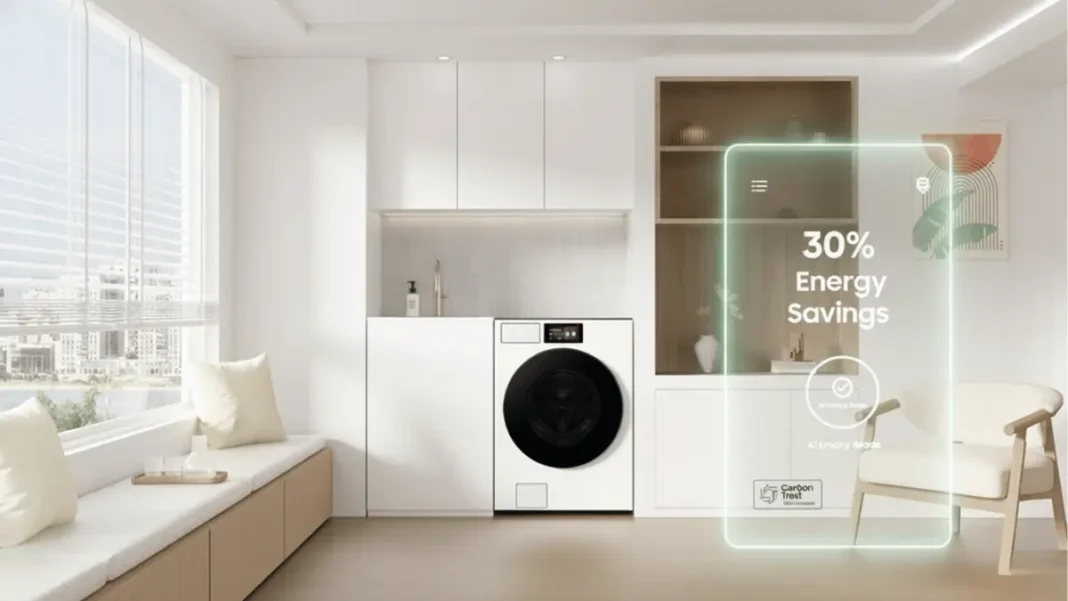
Summary: Samsung Electronics became the first company to receive third-party carbon reduction verification under the DUCD (Decarbonizing the Use-Phase of Connected Devices) specification. Testing 187,000 washing machines globally for 12 months, Carbon Trust Assurance verified that Samsung’s AI Energy Mode reduces energy consumption by approximately 30%, saving 5.02 GWh equivalent to powering 169,000 U.S. households for one day.
Samsung Electronics has become the first company to receive independent verification of carbon reduction effects under the DUCD (Decarbonizing the Use-Phase of Connected Devices) specification, proving its AI Energy Mode delivers real-world energy savings of approximately 30% in washing machines. The verification, conducted by Carbon Trust Assurance between July 2024 and June 2025, analyzed data from 187,000 high-efficiency washing machines across 126 countries.
- Verified 30% energy reduction in real-world testing
- Independent third-party confirmation by Carbon Trust
- Measurable environmental impact: 2,084 tCO₂e prevented
- Cost savings on electricity bills over appliance lifetime
- Easy activation through SmartThings mobile app
- No compromise on washing performance
- Requires Wi-Fi connection and Samsung account
- Limited to select high-efficiency washing machine models
- Only available on Samsung SmartThings-compatible appliances
- Actual savings vary by usage patterns and local electricity grids
- Needs active user engagement to enable feature
What Is the DUCD Carbon Verification Samsung Received?
The DUCD specification represents the first global industry standard for measuring, tracking, and reducing carbon emissions specifically during the usage phase of internet-connected devices. Unlike traditional carbon accounting that focuses on manufacturing emissions, DUCD measures actual consumer usage patterns through telemetry data collected from devices in real-world conditions.
Published in November 2024, the DUCD methodology emerged from collaboration between Samsung, Amazon, Microsoft, Sky, and the Carbon Trust. This approach provides unprecedented accuracy by tracking emissions throughout a product’s lifetime rather than relying on lifecycle forecasts used in conventional emissions reporting.
Real-World Testing: 187,000 Washing Machines Across 126 Countries
The Testing Methodology
Carbon Trust Assurance Ltd conducted a pilot assessment on Samsung’s global washing machine lineup equipped with SmartThings connectivity. The verification compared energy consumption and greenhouse gas (GHG) emissions between machines with AI Energy Mode activated versus deactivated during actual consumer usage.
Verified Energy Savings Numbers
The results confirmed substantial environmental impact:
- Total energy consumption: 12.28 GWh during the 12-month period
- Energy savings: 5.02 GWh with AI Energy Mode enabled
- GHG emissions reduction: 2,084 tCO₂e prevented
- Equivalent impact: Electricity for 169,000 U.S. households for one day
Samsung’s analysis revealed that machines with AI Energy Mode activated achieved approximately 30% reduction in energy usage compared to standard operation. This translates to monthly electricity savings equivalent to 14,000 Seoul households during summer months.

How Samsung’s AI Energy Mode Actually Works
AI Energy Mode operates through the SmartThings platform, requiring a Wi-Fi connection and Samsung account. Users activate the feature via the SmartThings Energy section in the mobile app, available on Android and iOS devices.
The AI analyzes usage patterns and optimizes washing cycles to minimize energy consumption without compromising cleaning performance. According to Samsung’s data, the more frequently users enable AI Energy Mode, the greater the cumulative energy reduction becomes over time.
Testing focused on washing machines with the highest energy efficiency ratings in their respective markets, including Energy Star (U.S.), Grade 1 (Korea), and A rating (EU). The verification included only machines connected to AI Energy Mode at least once during the testing period.
Why This Verification Matters for Smart Home Buyers
Third-party verification addresses growing skepticism about “smart” features being mere marketing gimmicks. The Carbon Trust’s independent assessment confirms that Samsung’s AI energy management delivers measurable environmental and cost benefits beyond manufacturer claims.
For consumers, this verification provides confidence that investing in AI-enabled appliances produces tangible utility bill reductions. The 30% energy savings can significantly offset the premium price of smart-connected washing machines over their operational lifetime.
What the DUCD Initiative Means for Connected Devices
Industry Collaboration Behind DUCD
The DUCD secretariat brings together major technology companies to tackle use-phase emissions from internet-connected products. Globally, connected devices currently consume approximately 500 TWh of energy annually equivalent to France’s total energy consumption.
Use-phase emissions typically represent the largest carbon footprint component across an electronic product’s lifecycle. By establishing standardized measurement methodologies, DUCD enables companies to accurately assess, report, and reduce emissions from devices actively used by consumers.
Samsung plans to expand AI energy-saving technology to additional appliances, with new product announcements expected at CES 2026 in January.
Comparison Table
| Aspect | Traditional Carbon Accounting | DUCD Verification |
|---|---|---|
| Measurement Focus | Manufacturing and production emissions | Use-phase emissions during consumer ownership |
| Data Source | Lifecycle forecasts and estimates | Real telemetry data from connected devices |
| Reporting Frequency | One-time or periodic estimates | Annual tracking throughout product lifetime |
| Accuracy | Based on assumptions | Based on actual consumer usage patterns |
| Scope | Pre-purchase carbon footprint | Operational emissions and reduction effects |
| Third-Party Verification | Varies by standard | Required by Carbon Trust Assurance |
Technical Specs Section
DUCD Verification Specifications
- Testing Period: July 2024 – June 2025 (12 months)
- Sample Size: 187,000 washing machines
- Geographic Coverage: 126 countries including U.S., South Korea, India, EU
- Verification Body: Carbon Trust Assurance Ltd
- Standard Used: DUCD Part 1: Specification and Guidance
- Verified Energy Consumption: 12.28 GWh total
- Verified Energy Savings: 5.02 GWh
- GHG Emissions Prevented: 2,084 tCO₂e
- Percentage Reduction: ~30% (5.02 GWh / 17.3 GWh total baseline)
Eligible Washing Machine Models
- Energy Star certified (United States)
- Grade 1 energy rating (South Korea)
- A energy rating (European Union)
- Must be connected to SmartThings platform
- Full model list available at samsung.com/global/sustainability
Frequently Asked Questions (FAQs)
What is the DUCD initiative and who founded it?
The DUCD (Decarbonizing the Use-Phase of Connected Devices) initiative is an industry collaboration led by Carbon Trust with founding members Samsung, Amazon, Microsoft, and Sky. It aims to standardize measurement and reduction of GHG emissions from internet-connected devices during their usage phase.
How does Samsung AI Energy Mode reduce carbon emissions?
AI Energy Mode analyzes washing machine usage patterns and optimizes cycles to minimize energy consumption while maintaining cleaning performance. The AI adapts to user behavior and automatically adjusts settings to reduce electricity drawn from the grid.
Do I need a Samsung smartphone to use AI Energy Mode?
No, AI Energy Mode works with both Android and iOS devices through the SmartThings app. You need a Wi-Fi connection, Samsung account, and compatible washing machine, but any smartphone that runs SmartThings will work.
When was the DUCD specification published?
The DUCD specification was published in November 2024, establishing the first global standard for measuring use-phase emissions from connected devices. Samsung’s verification in December 2025 marks the first implementation of this new standard.
Will Samsung expand AI Energy Mode to other appliances?
Yes, Samsung confirmed plans to expand AI energy-saving technology to additional appliances beyond washing machines. The company will showcase new energy-efficient products at CES 2026 in January.
How much money can I save with AI Energy Mode?
While exact savings depend on local electricity rates and usage patterns, the verified 30% energy reduction translates to significant cost savings over the appliance’s lifetime. With average U.S. electricity prices, this could mean $50-100+ annually depending on washing frequency.
What is Carbon Trust and why is their verification important?
Carbon Trust is a global climate consultancy that partners with businesses, governments, and financial institutions to drive climate action. Their independent verification provides credible third-party confirmation that AI Energy Mode delivers real environmental benefits, not just marketing claims.
How often do I need to enable AI Energy Mode?
You enable AI Energy Mode once through the SmartThings app, and it continues optimizing energy usage automatically. Samsung’s data shows that continuous usage produces greater cumulative energy reductions over time.
Featured Snippet Boxes
What is DUCD carbon verification?
DUCD (Decarbonizing the Use-Phase of Connected Devices) is the first industry standard for measuring carbon emissions during actual product usage. Developed by Carbon Trust with Samsung, Amazon, Microsoft, and Sky, it uses real telemetry data from connected devices rather than lifecycle estimates.
How much energy does Samsung AI Energy Mode save?
Samsung’s AI Energy Mode reduces washing machine energy consumption by approximately 30%. Independent Carbon Trust verification confirmed 5.02 GWh energy savings from 187,000 machines over 12 months equivalent to daily electricity for 169,000 U.S. households.
How do you activate Samsung AI Energy Mode?
Open the SmartThings app on your Android or iOS device, navigate to the Energy section, and toggle AI Energy Mode to “on”. Requires Wi-Fi connection, Samsung account, and compatible washing machine models with SmartThings connectivity.
What makes Samsung’s carbon verification historic?
Samsung received the world’s first third-party carbon reduction verification under DUCD specification. This marks the first time a product feature has been validated using the DUCD standard, proving real-world GHG reduction effects independently.

