

Quick Brief
- ReGrow Israel adopts Oracle Agriculture Data Intelligence to restore farming after two years of devastating agricultural impact
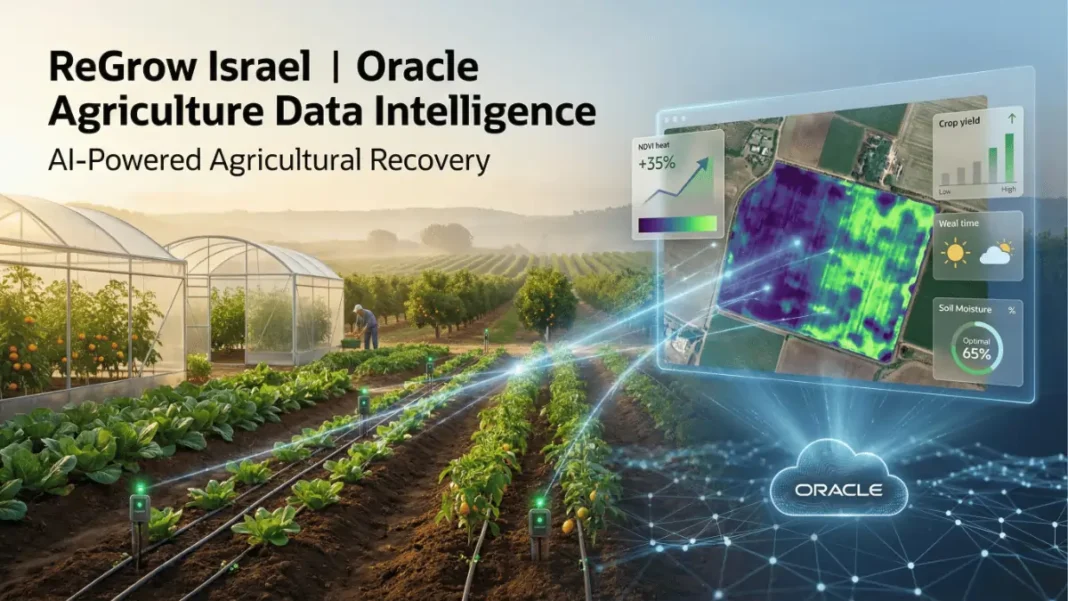
- Platform integrates satellite imagery, ground sensors, and AI models for real-time soil, crop, and water monitoring
- AI forecasts crop yields, detects threats, models interventions, and quantifies risks for strategic resource allocation
- Partnership supports recovery from Negev greenhouses to Galilee orchards using data-driven precision
ReGrow Israel has fundamentally changed how the nation approaches agricultural recovery and Oracle’s data intelligence platform proves it. The organization established by Volcani International Partnerships in collaboration with Mishkey HaNegev selected Oracle Agriculture Data Intelligence on February 13, 2026, to restore and strengthen farming across Israel. This partnership delivers real-time visibility into soil conditions, crop progress, and water use through integrated satellite imagery, ground data, and sensor feeds, enabling farmers to make predictive, strategic decisions rather than reactive ones.
Oracle Agriculture Data Intelligence: The Technology Foundation
Oracle’s platform operates as a unified environment that consolidates disparate data sources into actionable agricultural intelligence. The system integrates satellite imagery, weather patterns, soil data, historical crop performance records, and sensor feeds simultaneously. Built on Oracle Cloud Infrastructure (OCI), the platform processes vast datasets to generate forecasts and detect anomalies that would remain invisible through manual observation.
The AI models embedded in the system perform four critical functions: crop yield forecasting, threat detection, intervention program modeling, and risk quantification. These capabilities transform raw data into strategic insights that inform both immediate farming decisions and long-term agricultural planning.

Real-Time Monitoring Capabilities
The platform delivers real-time views into soil conditions, crop progress, and water use for agricultural decision-makers. Soil condition analysis tracks moisture levels, nutrient composition, and compaction status across different field zones. Crop progress monitoring uses satellite imagery to assess vegetation health and detect stress before visible symptoms appear. Water use tracking measures irrigation efficiency and identifies areas of over- or under-watering through sensor integration.
This continuous data flow replaces periodic manual field assessments with automated surveillance that operates across all farming regions.
What makes Oracle’s crop yield forecasting accurate?
Oracle Agriculture Data Intelligence combines historical yield data, satellite imagery, weather patterns, and AI-driven predictive models to forecast crop yields. The system identifies crop stress, disease risks, and growth irregularities through machine learning algorithms that refine predictions over time, achieving higher accuracy than traditional estimation methods.
The Israeli Agriculture Context
Yael Har-Even, General Manager of Oracle Israel, stated that “the past two years have had a devastating impact on the Israeli agriculture sector, highlighting both the challenges and the incredible resilience of our farmers and organizations like ReGrow Israel who are working tirelessly to help them recuperate, rebuild, and bring new innovation to market“. This period inflicted severe disruption across Israeli farming operations, creating an urgent need for recovery infrastructure.
Danielle Abraham, Executive Director of ReGrow Israel, emphasized their mission: “From the greenhouses of the Negev to the orchards of the Galilee, our mission is to help farmers rebuild with strength and purpose“. The organization recognized that recovery required leveraging cutting-edge data solutions and local expertise to create a more adaptable agricultural system.
Strategic Benefits of Data-Driven Agriculture
Predictive Production Planning
The platform enables farmers to forecast production volumes before harvest begins, allowing adjustment of supply chain logistics, labor allocation, and market strategies. Early yield predictions reduce waste from overproduction or lost revenue from underestimation.
Proactive Risk Management
AI-driven threat detection identifies pest outbreaks, disease patterns, and drought stress in early stages when intervention costs remain low. The system models different intervention scenarios to determine optimal response strategies before implementing costly measures.
Resource Optimization
Real-time water use monitoring and soil condition analysis guide precision irrigation and fertilization. This reduces input costs while improving sustainability critical factors for both economic viability and environmental stewardship in water-scarce regions.
Scalable Intelligence Infrastructure
Oracle’s cloud-based architecture allows ReGrow to expand coverage across diverse agricultural zones without proportional infrastructure investment. The platform accommodates data from new regions, crop types, and sensor networks through standardized integration protocols.
How does satellite imagery improve farm management?
Satellite imagery provides high-resolution visual data on crop health, soil moisture, and vegetation indices across entire fields simultaneously. This remote sensing enables farmers to identify problem areas, monitor growth patterns, and detect anomalies early without physical field inspections. AI processes these images to flag stress indicators and predict yields before harvest.
Technology Integration and Workflow
The platform operates through three integrated layers. The data ingestion layer collects information from satellites, weather stations, soil sensors, and historical databases. The AI processing layer applies machine learning models to identify patterns, generate forecasts, and flag anomalies. The visualization layer presents insights through interactive dashboards designed for agricultural decision-makers.
ReGrow Israel receives consolidated views of all monitored farms with drill-down capabilities to specific fields, crops, or time periods. Automated alerts notify stakeholders when conditions deviate from expected parameters or when predicted risks exceed threshold levels.
Implementation Across Israel’s Agricultural Regions
ReGrow Israel’s deployment strategy addresses the diversity of Israeli agriculture spanning from Negev greenhouses to Galilee orchards. Negev greenhouse operations require different monitoring parameters than Galilee orchards the platform accommodates both through customizable data models and alert configurations. This flexibility allows the same underlying technology to serve vegetable production, fruit cultivation, and field crops with region-specific calibration.
What risks can Oracle Agriculture Data Intelligence detect?
The platform identifies multiple agricultural risk factors including drought stress through soil moisture analysis, crop disease through vegetation health indices, pest outbreak patterns through anomaly detection, and yield shortfalls through production forecasting models. AI quantifies the severity and probability of each risk to prioritize intervention strategies.
Global Expansion and Government Applications
Oracle launched Government Data Intelligence for Agriculture on September 24, 2025, for national food security monitoring. Rwanda became an early adopter, with Hon. Paula Ingabire, Minister of ICT and Innovation, announcing the country’s adoption at the United Nations General Assembly sidelines in collaboration with the Tony Blair Institute for Global Change.
The ReGrow Israel implementation represents application at organizational scale for direct farmer support rather than government oversight. This dual deployment model demonstrates the technology’s versatility across different stakeholder needs from national policymakers tracking food security to agricultural organizations supporting individual farm recovery.
Abraham emphasized that Israel’s position as “a global leader in agricultural innovation” drives their commitment to pioneering data-driven recovery approaches. The partnership aims to establish replicable models that other agriculture-dependent regions can adapt when facing similar challenges.
Technical Considerations and Deployment
The platform’s effectiveness depends on data quality and coverage. Areas with inconsistent satellite visibility due to cloud cover or limited ground sensor deployment may experience reduced forecasting accuracy. Integration with existing farm management systems requires API compatibility and data standardization potential implementation barriers for operations using legacy technology.
The AI models require calibration periods to learn regional crop patterns and soil characteristics before achieving optimal prediction accuracy. Early deployment phases may show wider variance between forecasted and actual outcomes until sufficient historical data accumulates.
ReGrow Israel’s collaborative model with Volcani International Partnerships and Mishkey HaNegev provides agricultural expertise that informs platform customization for Israeli crop varieties, soil conditions, and climate patterns.

Frequently Asked Questions (FAQs)
What is Oracle Agriculture Data Intelligence?
Oracle Agriculture Data Intelligence is an AI-powered cloud platform that integrates satellite imagery, ground sensors, weather data, and historical records to provide real-time agricultural insights. It forecasts crop yields, detects threats, models interventions, and quantifies risks for strategic farm management and resource allocation.
Why did ReGrow Israel choose Oracle’s platform?
ReGrow Israel, established by Volcani International Partnerships in collaboration with Mishkey HaNegev, selected Oracle Agriculture Data Intelligence to support agricultural recovery after two years of devastating impact. The platform’s ability to integrate diverse data sources, generate real-time insights, and forecast production outcomes aligned with ReGrow’s mission to rebuild Israeli farming with data-driven precision.
How does the platform help farmers make better decisions?
The system provides real-time visibility into soil conditions, crop health, and water use through automated monitoring. AI-generated forecasts and threat alerts enable proactive intervention before problems escalate. Farmers receive actionable insights through interactive dashboards rather than relying on periodic manual assessments, reducing response time and input costs.
What AI capabilities does Oracle’s agriculture platform include?
Oracle Agriculture Data Intelligence employs machine learning models for crop yield forecasting, pest and disease threat detection, intervention program modeling, and risk quantification. These AI capabilities process satellite imagery, sensor data, and historical patterns to predict outcomes and identify anomalies invisible to human observation.
Can this technology be used outside Israel?
Yes. Oracle launched Government Data Intelligence for Agriculture on September 24, 2025, with Rwanda as an early adopter. Rwanda’s Minister of ICT and Innovation announced adoption at the UN General Assembly sidelines in collaboration with the Tony Blair Institute for Global Change. The underlying technology adapts to different crops, climates, and agricultural systems through customizable data models and regional calibration.
What data sources does the platform integrate?
The platform combines satellite imagery, ground-based sensor feeds, weather station data, soil analysis results, and historical crop performance records. This multi-source integration provides comprehensive visibility across environmental factors affecting agricultural production. The system operates on Oracle Cloud Infrastructure for scalability and processing power.
How does this partnership support Israel’s agricultural recovery?
ReGrow Israel uses Oracle’s platform to give farmers tools for predictive planning rather than reactive crisis management. Real-time monitoring and AI forecasts help optimize resource allocation, reduce input waste, and improve yield predictability. The partnership aims to establish resilient, data-driven agricultural practices from Negev greenhouses to Galilee orchards.

