

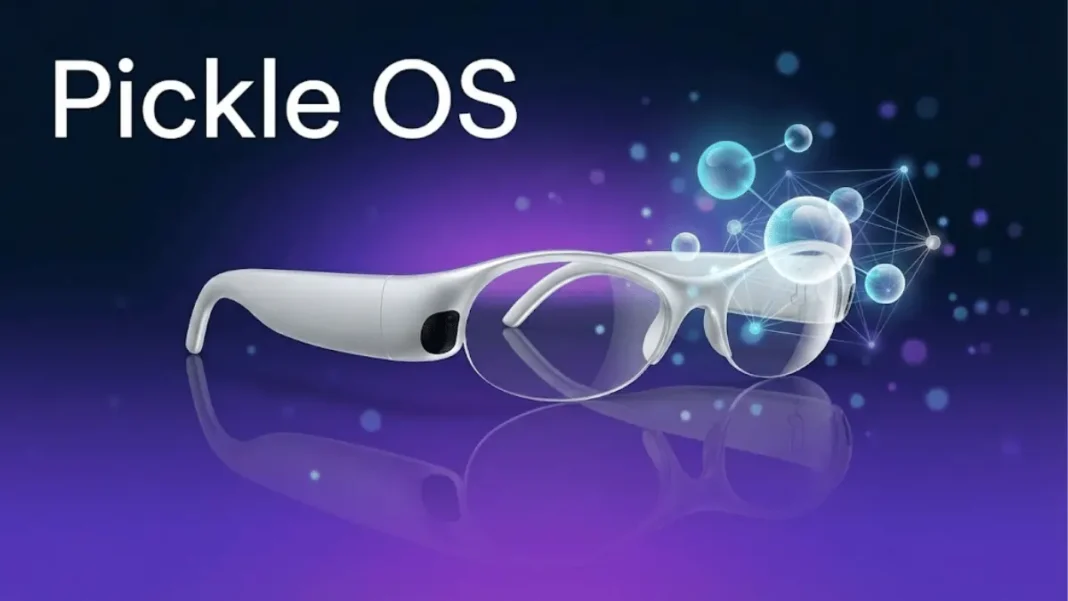
Pickle OS, a memory-based operating system designed to function like human memory, officially launched on January 1, 2026. Developed by Y Combinator-backed startup Pickle, the OS powers the company’s debut hardware product, Pickle 1 AR glasses, marketed as the world’s first “soul computer”. The system collects and organizes user context from every source into a unified memory architecture, enabling AI to recall information from years ago exactly when needed.
What’s New
Pickle OS represents a fundamental departure from traditional operating systems by prioritizing memory architecture over application management. The system continuously processes real-world context audio, video, conversations, notes, and behaviors into what the company calls “memory bubbles,” searchable clusters of connected information. CEO Daniel Park describes it as “the environment where the soul is raised,” emphasizing the OS evolves a distinct AI personality that learns user preferences and intent within days of usage.
The OS launched exclusively on Pickle 1 hardware, a 68-gram aluminum AR glasses device powered by Qualcomm Snapdragon processors. Pre-orders opened January 1, 2026, with the announcement video accumulating 2.8 million views in its first 16 hours. Pickle OS currently supports three core user types: learners who digest knowledge, creators seeking a creative partner, and “doers” organizing scattered contexts.
Why Privacy Architecture Matters
Pickle built its entire system around verifiable privacy, a response to widespread concerns about AI wearables recording personal data. All user data is processed inside hardware-isolated AWS Nitro Enclaves secure environments that cryptographically prove they’re running approved, open-source code. Data exists only in volatile memory during processing and is never written to disk in readable form.
The company published its Enclave and Extension code on GitHub for public audit, allowing users to verify that server-side code matches the open-source version through remote attestation. Pickle OS employs forward secrecy, permanently destroying encryption keys when sessions end, making retroactive decryption impossible even if servers were compromised. The system guarantees zero data retention for AI training and provides granular controls to toggle specific contexts or delete all memories instantly.
How Pickle OS Compares to Competitors
| Feature | Pickle OS | Meta Ray-Ban | Humane AI Pin |
|---|---|---|---|
| Memory Model | Infinite memory clusters | Session-based assistant | Cloud-dependent queries |
| Privacy Architecture | Verifiable open-source enclaves | Meta account required | Centralized processing |
| AI Autonomy | Proactive task execution | Voice-activated only | Limited automation |
| Form Factor | 68g AR glasses | Camera-equipped frames | Standalone pin |
| Launch Date | January 2026 | September 2023 | April 2024 |
Pickle OS distinguishes itself through persistent memory that retrieves context from up to six years ago, while competitors focus on real-time voice assistance. The system auto-syncs life updates daily in the background, maintaining a comprehensive personal knowledge base.
What’s Next
Pickle has not announced shipping dates for pre-ordered Pickle 1 devices or confirmed international availability beyond the initial U.S. launch. Critics noted the announcement video relied heavily on computer-generated imagery with minimal live demonstrations of input mechanisms like voice commands or gesture controls. The company has signaled plans to expand Pickle OS beyond glasses hardware, positioning it as a standalone platform for “learners, creators, and doers”.
The broader question remains whether consumers will embrace always-recording AI wearables despite robust privacy measures. Pickle’s success hinges on demonstrating real-world utility that justifies continuous life-logging a value proposition the tech industry has struggled to articulate since Google Glass failed in 2013. Early social media traction suggests strong interest from AI enthusiasts, but mainstream adoption will require shipping working hardware and proving the AI delivers on its memory promises.

Featured Snippet Boxes
What is Pickle OS?
Pickle OS is a memory-based operating system launched January 2026 that collects user context from all sources and organizes it into searchable memory clusters. It powers the Pickle 1 AR glasses and functions like human memory, retrieving information from years ago when needed.
Is Pickle OS open source?
Pickle OS uses verifiable privacy with open-source Enclave and Extension code published on GitHub. Users can cryptographically verify that server-side code matches the auditable open-source version before their device sends any encryption keys.
How does Pickle OS protect privacy?
Data is processed in hardware-isolated AWS Nitro Enclaves that exist only in volatile memory during tasks. Encryption keys are permanently destroyed after each session (forward secrecy), and the system guarantees zero data retention for AI model training.
Can Pickle OS run on other devices?
Currently, Pickle OS only runs on Pickle 1 AR glasses launched January 2026. The company has positioned the OS as a platform for learners, creators, and doers, suggesting potential future expansion beyond wearables.

