

Quick Brief
- The Launch: OpenAI integrated Ollama support into Codex CLI on January 15, 2026, enabling developers to run open-weight models (gpt-oss:20b, gpt-oss:120b) locally without cloud dependencies
- The Impact: Developers gain full local control over AI coding assistants, eliminating API costs and data privacy concerns in enterprise environments
- The Context: This move positions OpenAI to compete in the $1.37 trillion AI infrastructure market, addressing enterprise demand for on-premises AI deployment
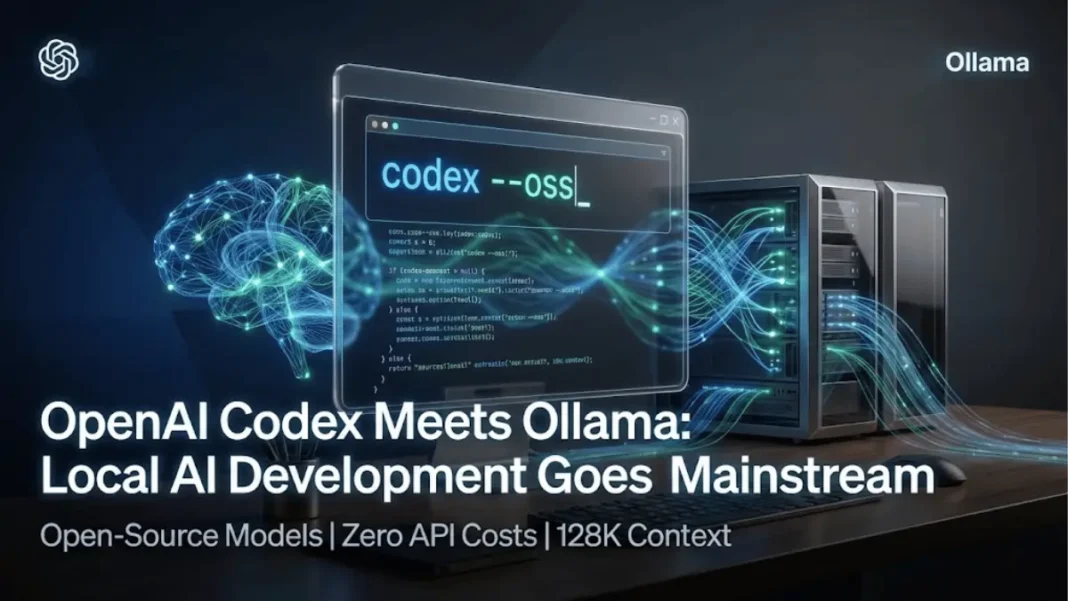
OpenAI announced native Ollama integration for its Codex CLI on January 15, 2026, allowing developers to execute AI-powered coding tasks using open-source models hosted locally or on private infrastructure. The integration supports OpenAI’s gpt-oss model family, including the 20-billion and 120-billion parameter variants released under Apache 2.0 licensing on August 5, 2025. Developers can now deploy Codex with the --oss flag to access models that read, modify, and execute code entirely within their working directories.
Technical Architecture: Local Inference with 128K Token Context
The Ollama integration operates through a modified Codex CLI that defaults to the gpt-oss:20b model when launched with the --oss flag. OpenAI engineered both gpt-oss variants with 128,000-token native context windows, supporting full codebase analysis alongside conversational history. The gpt-oss:20b model (21B total parameters, 3.6B active) runs on consumer hardware with 16GB of memory, while the gpt-oss:120b variant (117B total parameters, 5.1B active) requires a single 80GB GPU for production deployments.
Developers can switch models using command-line flags: codex --oss -m gpt-oss:120b for larger parameter counts, or configure remote Ollama instances through base URL settings. Configuration management occurs through ~/.codex/config.toml files, where users specify model providers and API authentication for distributed deployments.
| Feature | Specification | Hardware Requirement |
|---|---|---|
| Default Model | gpt-oss:20b (21B params, 3.6B active) | 16GB RAM minimum |
| Premium Model | gpt-oss:120b (117B params, 5.1B active) | Single 80GB GPU |
| Context Window | 128K tokens native | No configuration needed |
| Installation | npm install -g @openai/codex | Node.js environment |
| Launch Command | codex --oss | Ollama daemon running |
Market Positioning: Capturing Enterprise AI Infrastructure Demand
The Ollama integration directly addresses enterprise requirements in the $1.37 trillion AI infrastructure market, which grew 49% year-over-year in 2026. Infrastructure spending now dominates AI investments as organizations prioritize on-premises deployment over cloud-dependent solutions. OpenAI’s strategy to support open-weight models allows enterprises to avoid recurring API costs while maintaining data within corporate firewalls a critical requirement for organizations handling proprietary codebases.
AdwaitX Analysis: This integration signals OpenAI’s pivot toward infrastructure-agnostic deployment models. By enabling local execution, OpenAI competes across the AI coding assistant sector while capturing demand from enterprises requiring data sovereignty. The AI infrastructure market is projected to reach $1.75 trillion by 2028, with inference optimization and on-device deployment emerging as dominant investment themes.
The gpt-oss models’ Apache 2.0 licensing removes adoption barriers for commercial deployments. OpenAI trained these models using reinforcement learning techniques derived from frontier systems including o3, o3-mini, and o4-mini, positioning them as alternatives to closed-source coding agents while retaining architectural advantages from OpenAI’s internal research.
Enterprise Deployment: Cloud and Self-Hosted Configurations
Organizations can deploy Codex with Ollama across three infrastructure models. Self-hosted deployments run entirely on-premises using locally pulled models via ollama pull gpt-oss:20b. Hybrid architectures connect Codex to remote Ollama servers through base URL configuration, enabling centralized model serving across development teams. Cloud deployments leverage Ollama’s managed infrastructure, requiring API key authentication through the OLLAMA_API_KEY environment variable.
The Codex CLI’s architecture prioritizes efficiency for terminal-based workflows. Integration with the Model Context Protocol (MCP) allows Codex to access third-party tools and databases, expanding functionality beyond code generation to full-stack development automation. Approval modes let teams configure permission levels before Codex executes shell commands or modifies production files.
Development Roadmap: Inference Optimization and Ecosystem Expansion
OpenAI’s January 2026 updates indicate continued investment in Ollama compatibility, with recent commits improving error handling and response processing for open-source backends. The AI infrastructure sector is prioritizing inference performance in 2026, with enterprises re-architecting deployments for real-time workloads using model compression and distributed GPU scheduling.
Ollama’s native support for OpenAI’s quantization formats enables efficient serving of gpt-oss models without additional conversion steps. Future updates are expected to extend MCP integrations and support additional open-weight model families beyond the gpt-oss series. OpenAI benchmarked the gpt-oss models against o3-mini and o4-mini on coding benchmarks, achieving competitive performance while maintaining full transparency through open-weight distribution.
Frequently Asked Questions (FAQs)
What models work with OpenAI Codex and Ollama?
Codex supports gpt-oss:20b (21B/3.6B active parameters) and gpt-oss:120b (117B/5.1B active parameters) with 128K token context windows.
How much does Codex with Ollama cost?
Zero API fees for self-hosted deployments. Infrastructure costs depend on model size: 16GB RAM for 20b, 80GB GPU for 120b.
Can Codex run entirely offline?
Yes. After installing Codex CLI and pulling models with ollama pull gpt-oss:20b, all operations execute locally without internet connectivity.
What are hardware requirements for gpt-oss:120b?
A single 80GB GPU. The 120B model (117B total/5.1B active parameters) requires high-memory infrastructure unsuitable for consumer laptops.

