

Quick Brief
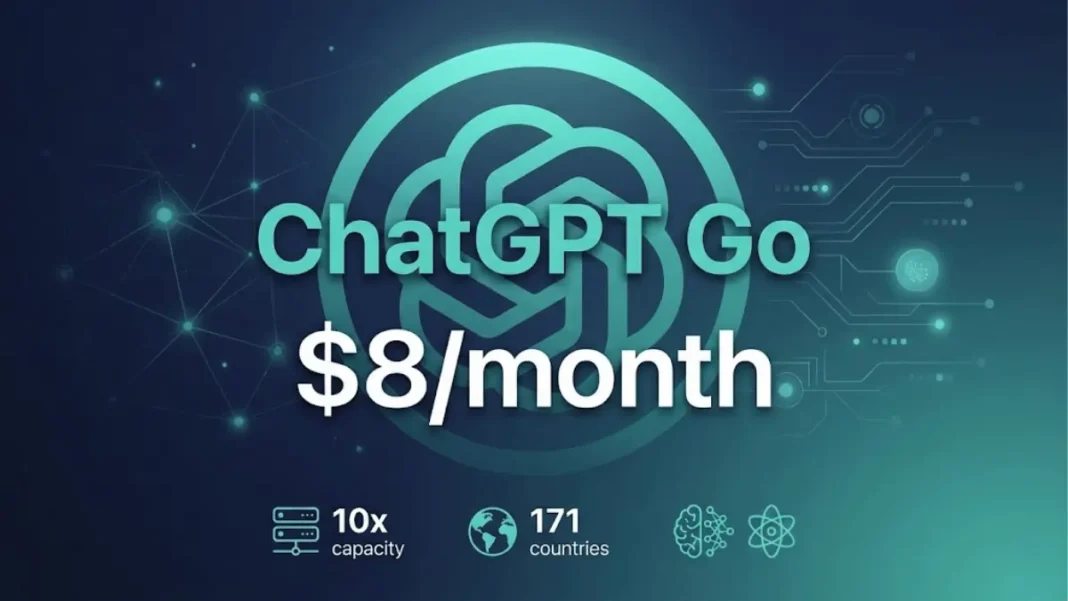
- The Launch: OpenAI rolled out ChatGPT Go globally at $8/month (US pricing), following successful deployment across 171 countries since August 2025.
- The Impact: Creates a three-tier subscription model ($8/$20/$200) targeting price-sensitive markets while introducing advertising to free and Go users in the US.
- The Context: Move positions OpenAI to diversify revenue streams beyond premium subscriptions as competition intensifies in the AI subscription market.
OpenAI announced the worldwide availability of ChatGPT Go on January 15, 2026, establishing an $8 monthly subscription tier designed to expand access to GPT-5.2 Instant across global markets. The plan, initially launched in India in August 2025, has become OpenAI’s fastest-growing subscription offering after deployment to 170 additional countries. Concurrent with the global rollout, OpenAI confirmed plans to test targeted advertising in ChatGPT’s free and Go tiers within the US market.
ChatGPT Go Features and Pricing Structure
ChatGPT Go delivers 10x more messages, file uploads, and image generation capacity compared to the free tier, with access to GPT-5.2 Instant OpenAI’s optimized model for everyday tasks including writing, learning, and problem-solving. The subscription includes extended memory and context windows, enabling the platform to retain user information across extended conversations.
Pricing varies by market, with localized rates including S$13 in Singapore, AUD$13 in Australia, ₫132,000 in Vietnam, and ฿259 in Thailand. OpenAI now operates three consumer subscription tiers globally: ChatGPT Go at $8, ChatGPT Plus at $20, and ChatGPT Pro at $200.
| Plan | Monthly Price (USD) | Primary Model | Key Differentiator |
|---|---|---|---|
| ChatGPT Go | $8 | GPT-5.2 Instant | 10x free tier limits, affordable access |
| ChatGPT Plus | $20 | GPT-5.2 Thinking | Advanced reasoning, Codex coding agent |
| ChatGPT Pro | $200 | GPT-5.2 Pro | Maximum compute, early feature access |

AdwaitX Analysis: Revenue Diversification Strategy
The ChatGPT Go launch represents a strategic shift toward market segmentation and revenue diversification as OpenAI faces pressure to monetize its 100+ million user base. By introducing advertising to lower-cost tiers while maintaining ad-free experiences for Plus ($20), Pro ($200), Business, and Enterprise users, OpenAI positions itself to capture revenue from price-sensitive demographics without alienating premium subscribers.
Vietnam and Thailand emerged as high-growth markets, with Vietnam registering a 3x increase in weekly active users and Thailand demonstrating 4x adoption growth over the past year. This momentum in emerging markets validates OpenAI’s India-first testing strategy, which preceded the global rollout by five months.
The $8 price point undercuts competitors in the mid-tier segment, positioning below Gemini Advanced ($19.99), Claude Pro ($20), and Perplexity Pro ($20), while targeting users unwilling to commit to the $20 Plus tier. OpenAI’s advertising announcement aligns with Bloomberg reporting that the company seeks to bolster revenue streams beyond subscription-only models.
GPT-5.2 Model Architecture
GPT-5.2 Instant serves as the foundation for ChatGPT Go, optimized for speed and efficiency in information retrieval, how-to guides, and routine problem-solving tasks. The model operates within an automatic routing system (GPT-5.2 Auto) that determines whether to deploy Instant for straightforward queries or escalate to GPT-5.2 Thinking for complex reasoning tasks requiring extended processing.
ChatGPT Plus subscribers access GPT-5.2 Thinking, which generates visible chain-of-thought reasoning traces before delivering answers, while Pro users receive unlimited access to GPT-5.2 Pro OpenAI’s most computationally intensive model designed for research-grade intelligence.
Advertising Roadmap and Market Implications
OpenAI plans to initiate advertising tests in the US for free and Go tier users in the coming weeks, with no immediate timeline for international expansion. The company stated that advertising revenue will support continued free and low-cost access to ChatGPT, ensuring sustainability without requiring all users to convert to premium subscriptions.
Business and Enterprise customers will remain exempt from advertising regardless of tier, maintaining OpenAI’s commitment to ad-free experiences for corporate deployments. The advertising model follows industry precedents set by Spotify, YouTube, and LinkedIn, which operate freemium models with ad-supported tiers alongside premium subscriptions.

Frequently Asked Questions (FAQs)
What does ChatGPT Go include for $8 per month?
ChatGPT Go provides 10x more messages, file uploads, and image creation than the free tier, plus access to GPT-5.2 Instant with extended memory.
Which ChatGPT plans will display advertisements?
OpenAI will test ads exclusively in the free tier and ChatGPT Go within the US. Plus, Pro, Business, and Enterprise remain ad-free.
How does ChatGPT Go pricing compare to competitors?
At $8/month, ChatGPT Go costs 60% less than Claude Pro, Gemini Advanced, and Perplexity Pro, which range from $19.99-$20 monthly.
When did ChatGPT Go first launch?
ChatGPT Go debuted in India in August 2025, expanded to 170 countries by late 2025, and achieved global availability on January 15, 2026.
What is the difference between GPT-5.2 Instant and GPT-5.2 Thinking?
GPT-5.2 Instant prioritizes speed for routine tasks, while GPT-5.2 Thinking applies extended reasoning with visible chain-of-thought processing for complex queries.

