

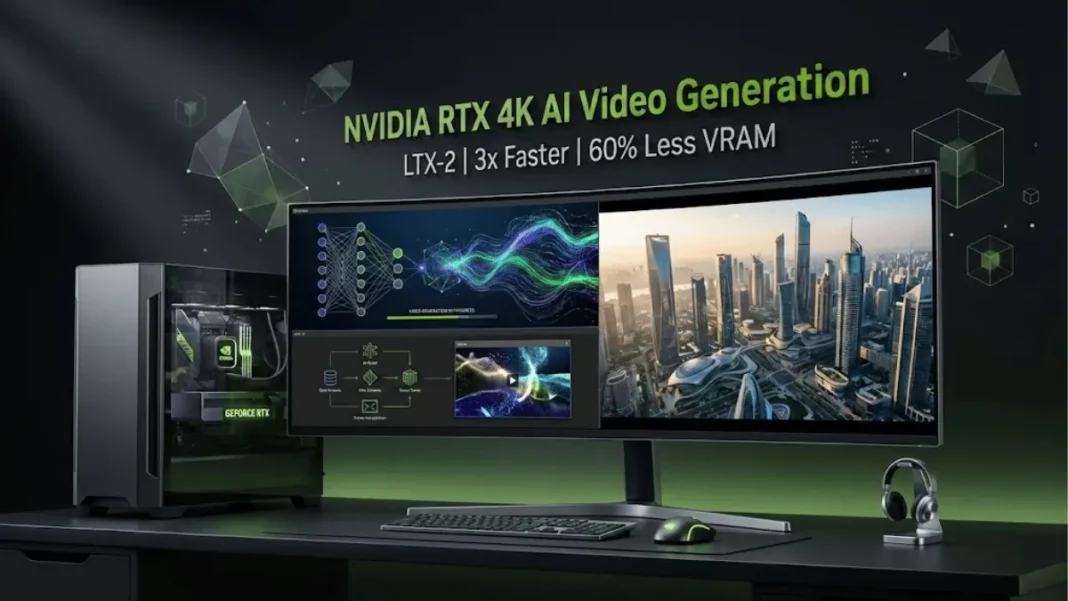
NVIDIA announced major AI performance upgrades at CES 2026 that enable GeForce RTX and NVIDIA RTX PRO users to generate 4K AI videos up to 3x faster while using 60% less VRAM. The updates center on optimized support for Lightricks’ open-source LTX-2 video model, native NVFP4 and FP8 precision formats in ComfyUI, and new RTX Video Super Resolution integration. These advancements allow creators to run advanced video generation workflows locally without relying on cloud services.
What’s New in NVIDIA’s AI Video Pipeline
NVIDIA introduced an RTX-powered video generation pipeline that combines 3D scene control in Blender with AI-driven keyframe generation and 4K upscaling. The workflow is built around three modular blueprints: a 3D object generator for scene assets, a 3D-guided image generator for photorealistic keyframes, and a video generator that animates between keyframes and upscales to 4K using RTX Video technology.
The pipeline is powered by ComfyUI, which NVIDIA optimized by 40% on NVIDIA GPUs over recent months. The latest ComfyUI update adds native support for NVFP4 and NVFP8 data formats. Combined with PyTorch-CUDA optimizations, performance improves 3x with 60% VRAM reduction on RTX 50 Series using NVFP4, and 2x faster with 40% VRAM reduction using NVFP8.
NVFP4 and NVFP8 checkpoints are now directly available in ComfyUI for top models including LTX-2, FLUX.1, FLUX.2, Qwen-Image, and Z-Image. RTX Video Super Resolution will be added as a ComfyUI node next month, enabling real-time 4K upscaling with edge sharpening and artifact cleanup.
LTX-2: Open-Source 4K Video Model With Audio
Lightricks released LTX-2 as the first complete open-source AI video foundation model that generates up to 20 seconds of 4K video with synchronized audio. The model delivers quality comparable to cloud-based alternatives while running on consumer RTX GPUs.
LTX-2 includes multi-keyframe support and advanced conditioning capabilities enhanced with controllability low-rank adaptations (LoRAs). It supports multimodal inputs including text, image, audio, depth maps, and reference video for precise creative control. The model achieves significant compute efficiency and runs on GPUs with 12GB+ VRAM.
NVIDIA applied NVFP8 optimizations specifically for LTX-2’s open weights release. The model weights and video generation workflow will be available for download next month, with LTX-2 and ComfyUI RTX updates accessible now.
Performance Gains Across AI Workflows
Video Generation Performance
| Format | Speed Increase | VRAM Reduction | GPU Compatibility |
|---|---|---|---|
| NVFP4 | 3x faster | 60% less | RTX 50 Series |
| NVFP8 | 2x faster | 40% less | RTX 40/50 Series |
Small Language Model Improvements
NVIDIA collaborated with open-source developers to boost SLM inference by 35% on llama.cpp and 30% on Ollama for RTX GPUs and DGX Spark over four months. The optimizations especially benefit mixture-of-experts models like NVIDIA Nemotron 3. These updates are live now, with llama.cpp also featuring faster LLM loading times.
Local Video Search With Hyperlink
Nexa.ai unveiled a beta version of Hyperlink that adds RTX-accelerated video search to its local knowledge base agent. The tool indexes documents, images, and now video content for natural language search with inline citations. On an RTX 5090, Hyperlink indexes at 30 seconds per gigabyte for text and images and responds in three seconds, versus an hour per gigabyte indexing and 90 seconds response time on CPUs.
What This Means for Creators and Developers
These updates make professional-grade AI video generation accessible on mid-range RTX hardware for the first time. The 60% VRAM reduction allows creators to run larger models and complex multi-stage workflows on GPUs that previously couldn’t handle them.
ComfyUI’s improved memory offload feature, known as weight streaming, enables the software to use system RAM when VRAM is exhausted. This allows mid-range RTX GPUs to handle models and node graphs that would normally require high-end hardware.
The local processing approach offers privacy, security, and low latency compared to cloud-based tools. Artists gain frame-level control over video outputs through Blender scene integration rather than relying solely on text prompts.
Availability and Rollout
LTX-2 model weights and NVFP8 optimizations are available for download now. ComfyUI with NVFP4/FP8 support is live, with checkpoints for LTX-2, FLUX, Qwen-Image, and Z-Image accessible directly in the interface.
The complete video generation workflow blueprint and RTX Video node for ComfyUI will launch next month. Hyperlink’s video search beta access begins rolling out this month via sign-up. llama.cpp and Ollama performance updates are available now and will appear in the next LM Studio update and upcoming MSI AI Robot app release.
NVIDIA Broadcast 2.1, which expands Virtual Key Light support to RTX 3060 desktop GPUs and higher, is available for download today. DGX Spark received new playbooks for speculative decoding and dual-module fine-tuning.
Featured Snippet Boxes
What is LTX-2 and why does it matter?
LTX-2 is Lightricks’ open-source AI video model that generates up to 20 seconds of 4K video with synchronized audio on consumer RTX GPUs. It delivers cloud-quality results locally with multi-keyframe control and LoRA fine-tuning support, making professional video generation accessible on standard hardware.
How much faster is NVFP4 compared to standard formats?
NVFP4 precision on RTX 50 Series GPUs delivers 3x faster video generation performance and reduces VRAM usage by 60% compared to standard FP16 formats. NVFP8 provides 2x speed and 40% VRAM savings on RTX 40/50 Series cards.
Can mid-range RTX GPUs generate 4K AI videos now?
Yes. ComfyUI’s weight streaming feature offloads models to system RAM when VRAM is full, enabling mid-range RTX GPUs to run larger models and complex workflows. The VRAM reductions from NVFP4/FP8 formats further expand compatibility across RTX 40 and 50 Series GPUs.
When will RTX Video upscaling be available in ComfyUI?
The RTX Video Super Resolution node for ComfyUI will be available next month. It will provide real-time 4K upscaling with edge sharpening and compression artifact cleanup for generated videos.

