

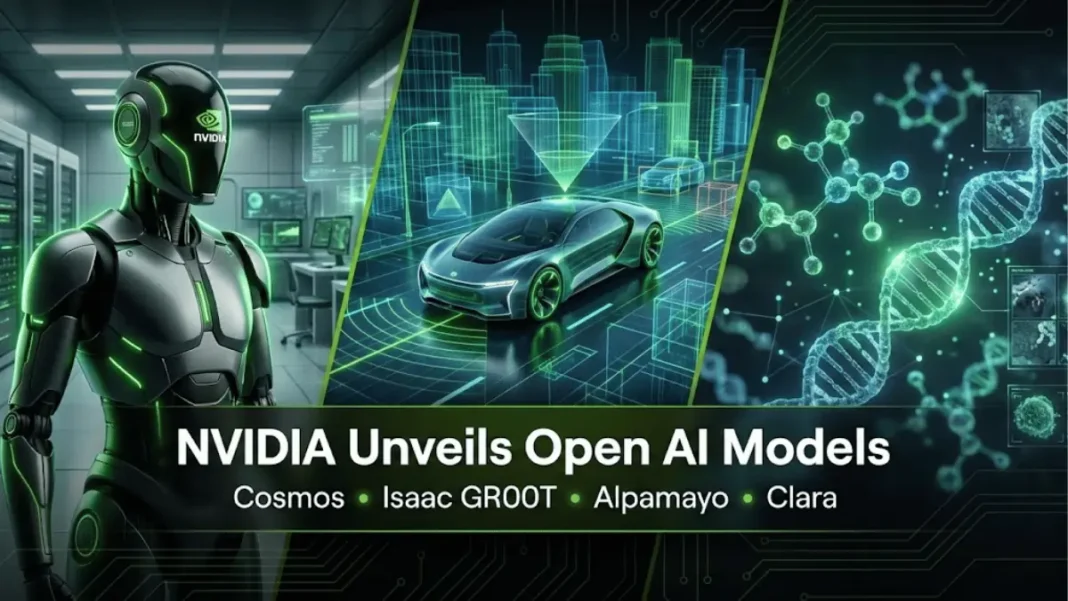
NVIDIA has released a comprehensive suite of open AI models, datasets, and development tools spanning robotics, autonomous vehicles, enterprise AI, and healthcare. The announcement, made at CES 2026, includes new models in the Nemotron, Cosmos, Isaac GR00T, Alpamayo, and Clara families, backed by unprecedented open data resources including 10 trillion language training tokens, 500,000 robotics trajectories, and 100 terabytes of vehicle sensor data.
What NVIDIA Released
NVIDIA’s latest open model portfolio targets five key domains with distinct AI capabilities. The release includes:
- NVIDIA Nemotron models for speech, multimodal retrieval-augmented generation (RAG), and AI safety to power enterprise agents
- NVIDIA Cosmos open world foundation models for physical AI development, including Cosmos Reason 2, Cosmos Transfer 2.5, and Cosmos Predict 2.5
- Isaac GR00T N1.6, a reasoning vision-language-action (VLA) model for humanoid robots with full-body control
- NVIDIA Alpamayo, the first open reasoning VLA model family for autonomous vehicles, with AlpaSim simulation framework
- NVIDIA Clara AI models for healthcare, including La-Proteina, ReaSyn v2, KERMT, and RNAPro for drug discovery and protein design
All models are available on GitHub, Hugging Face, and build.nvidia.com under NVIDIA’s open model license.
Why This Matters for AI Development
NVIDIA’s release represents the largest collection of open multimodal AI data ever contributed by a single company, lowering barriers to entry for physical AI development. Companies including Bosch, CrowdStrike, Salesforce, ServiceNow, Palantir, and Uber have already begun adopting these models.
The Cosmos platform addresses a critical challenge in robotics and autonomous systems: models that can perceive, reason, and act in complex real-world environments. Cosmos Reason 2 tops leaderboards for helping robots and AI agents understand and interact with the physical world more accurately. Leading robotics companies like 1X, Agile Robots, Agility, Figure AI, and Neura Robotics are among early adopters.

Alpamayo Brings Chain-of-Thought Reasoning to Autonomous Vehicles
NVIDIA Alpamayo 1 is the industry’s first open, large-scale reasoning VLA model specifically designed for autonomous vehicle development. The model uses video input to generate driving trajectories while explaining the logic behind each decision.
The platform includes AlpaSim, an open-source simulation framework for closed-loop training and evaluation across diverse driving scenarios and edge cases. NVIDIA is releasing over 1,700 hours of driving data covering rare and complex real-world conditions across multiple geographies. NVIDIA CEO Jensen Huang stated that Alpamayo enables vehicles to “think through rare scenarios, drive safely in complex environments and explain their driving decisions”.
Alpamayo does not run directly in vehicles but serves as a teacher model for developers to fine-tune and integrate into their autonomous driving technology stacks.
Enterprise and Healthcare Applications
ServiceNow is training its Apriel model family on Nemotron datasets for cost-efficient multimodal performance, while CodeRabbit uses Nemotron models to scale AI code reviews. Cadence and IBM are piloting Nemotron RAG models to improve search across complex technical documents.
In healthcare, NVIDIA Clara models target drug discovery bottlenecks. La-Proteina enables atom-level-precise protein design for diseases previously considered untreatable, while ReaSyn v2 incorporates manufacturing feasibility into AI drug design. KERMT provides computational safety testing early in development by predicting drug interactions with the human body.
What’s Next
NVIDIA’s Nemotron 3 Super and Ultra models are expected in the first half of 2026. Many of these models will become available as NVIDIA NIM microservices for secure, scalable deployment on NVIDIA-accelerated infrastructure from edge to cloud.
Developers can access models immediately through the NVIDIA API catalog, NGC catalog, and Hugging Face. NVIDIA DGX Cloud offers deployment options with enterprise support through NVIDIA AI Enterprise.

Featured Snippet Boxes
What AI models did NVIDIA release in January 2026?
NVIDIA released five open model families: Nemotron for enterprise AI agents and speech, Cosmos for physical AI and world simulation, Isaac GR00T N1.6 for humanoid robots, Alpamayo for autonomous vehicles, and Clara for healthcare and drug discovery.
How much data did NVIDIA make available with these models?
NVIDIA contributed 10 trillion language training tokens, 500,000 robotics trajectories, 455,000 protein structures, 100 terabytes of vehicle sensor data, and over 1,700 hours of driving footage across diverse geographies. This represents one of the largest open multimodal AI datasets ever released.
Where can developers access NVIDIA’s open AI models?
All models are available on GitHub, Hugging Face, NVIDIA NGC catalog, and build.nvidia.com under NVIDIA’s open model license. Many will also be available as NVIDIA NIM microservices for production deployment on NVIDIA-accelerated infrastructure.
What makes NVIDIA Alpamayo different from other autonomous driving models?
Alpamayo 1 is the first open, large-scale reasoning VLA model for autonomous vehicles that can explain its driving decisions using chain-of-thought reasoning. It analyzes rare scenarios and complex environments, serving as a teacher model for developers to fine-tune into smaller runtime models.

