

Quick Brief
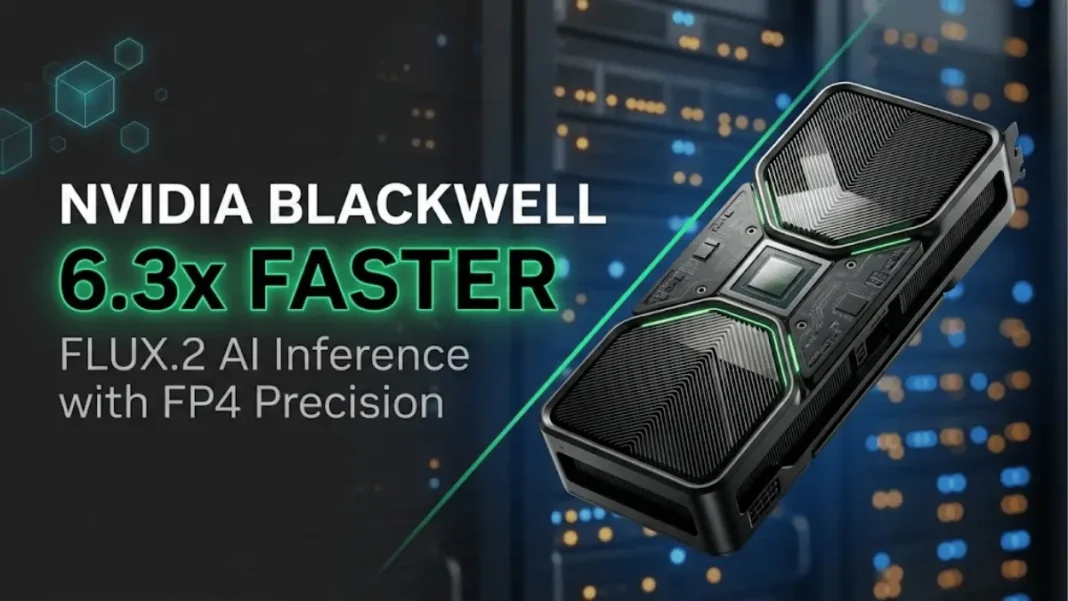
- The Breakthrough: NVIDIA achieved 6.3x inference speedup on FLUX.2 [dev] text-to-image model using NVFP4 quantization on DGX B200 systems, delivering 144 PFLOPS performance
- The Impact: Data center operators gain near real-time image generation capabilities with significantly reduced latency for AI workloads
- The Context: Following 2025 partnership with Black Forest Labs, NVIDIA extends FP4 optimization from consumer RTX 50 Series to enterprise Blackwell data center GPUs
NVIDIA announced on January 22, 2026, a major inference optimization breakthrough for the FLUX.2 [dev] text-to-image model, achieving a 6.3x speedup through NVFP4 precision on Blackwell-based DGX B200 systems. The optimization builds on NVIDIA’s 2025 collaboration with Black Forest Labs (BFL) to unlock low-precision image generation performance across its GPU portfolio. This advancement marks a significant leap in data center AI inference efficiency, enabling near real-time editing experiences for enterprise visual AI applications.
DGX B200 Delivers 1.7x Generational Performance Leap
The NVIDIA DGX B200 architecture demonstrates a 1.7x generational improvement over H200 systems when running FLUX.2 [dev] in default BF16 precision. The DGX B200 system features eight Blackwell GPUs with a combined 1,440GB of HBM3e memory and 64TB/s memory bandwidth. The platform delivers 144 PFLOPS for FP4 inference and 72 PFLOPS for FP8 tensor operations, powered by dual Intel Xeon Platinum 8570 processors with 112 cores.
The Blackwell architecture introduces native support for NVFP4 (4-bit floating point) precision, expanding NVIDIA’s data format flexibility beyond FP64, FP32/TF32, FP16/BF16, INT8/FP8, and FP6. Each DGX B200 system incorporates two NVSwitch units providing 14.4TB/s aggregate NVLink bandwidth for inter-GPU communication. System power consumption reaches approximately 14.3kW maximum, reflecting the substantial computational density.

Layered Optimization Stack Drives 6.3x Speedup
NVIDIA engineers applied four sequential optimization techniques to achieve the 6.3x speedup on single-B200 performance from the BF16 baseline. The optimization stack includes CUDA Graphs for kernel launch overhead reduction, torch.compile for Python execution acceleration, NVFP4 quantization for reduced precision computation, and TeaCache for temporal caching. TeaCache employs dynamic caching strategies that adaptively reuse cached outputs based on predicted differences between consecutive timesteps in the diffusion model’s denoising loop.
The combined effect of these optimizations delivers “remarkable reduction in latency, enabling efficient deployment on NVIDIA data center GPUs,” according to NVIDIA’s technical blog. The optimization code and end-to-end FLUX.2 example are available in the NVIDIA/TensorRT-LLM/visual_gen GitHub repository. Multi-GPU configurations achieve even greater performance, with two-B200 systems delivering 10.2x speedup.
FLUX.2 Architecture and Enterprise Deployment
FLUX.2 [dev] represents a natural extension of latent diffusion models, incorporating in-context learning capabilities previously limited to large language models. Black Forest Labs developed FLUX.1 Kontext [dev] to demonstrate visual-generation models’ feasibility for in-context learning, later extending these capabilities to FLUX.2. The FLUX model series has become “the world’s most popular text-to-image media models, serving millions of high-quality images everyday” via Azure AI services infrastructure.
Black Forest Labs utilizes NVIDIA GB200 NVL72 systems to train next-generation multimodal FLUX models as part of Microsoft’s Fairwater AI superfactory deployment. The partnership enables BFL to “build and deliver the best possible image and video models faster and at greater scale,” according to CEO Robin Rombach. Microsoft plans to launch Blackwell Ultra GPU-based VMs later in 2025 for agentic and generative AI workloads.
| Specification | DGX B200 | DGX H200 |
|---|---|---|
| GPU Architecture | Blackwell | Hopper |
| GPU Count | 8 GPUs | 8 GPUs |
| Total GPU Memory | 1,440GB HBM3e | 1,128GB HBM3e |
| Memory Bandwidth | 64TB/s | 4.8TB/s per GPU |
| FP4 Performance | 144 PFLOPS | Not supported |
| FP8 Performance | 72 PFLOPS | 31.7 PFLOPS (3,958 TFLOPS/GPU) |
| NVLink Bandwidth | 14.4TB/s aggregate | 7.2TB/s aggregate |
| Generational Speedup | Baseline | 1.7x slower (BF16) |
Market Implications for AI Infrastructure
The 6.3x inference speedup positions Blackwell-based systems to reduce total cost of ownership for data center operators running visual AI workloads. The performance improvement translates to higher throughput per watt, with Blackwell delivering 42% better energy efficiency in end-to-end transformer training compared to H200. Organizations deploying FLUX models can achieve near real-time image generation, enabling interactive editing workflows previously impractical at scale.
Microsoft’s adoption of GB300 Blackwell Ultra in Azure signals broader hyperscaler commitment to next-generation AI infrastructure. Black Forest Labs’ migration to ND GB200 v6 VMs demonstrates enterprise demand for specialized inference acceleration beyond general-purpose compute. The NVFP4 format’s 50x energy efficiency improvement over previous generation inference creates economic incentives for infrastructure modernization.
Technical Implementation Roadmap
NVIDIA provides developers with a complete inference pipeline incorporating state-of-the-art optimizations through the TensorRT-LLM visual generation repository. The implementation includes low-precision kernels optimized for FP4 computation, caching techniques for temporal coherence, and multi-GPU inference support. Developers can access code snippets and step-by-step deployment guides for replicating the 6.3x speedup results.
The optimization techniques extend beyond FLUX.2 to other diffusion-based models requiring inference acceleration. TeaCache’s adaptive caching strategy applies to any diffusion model exhibiting temporal correlation between consecutive denoising steps. Future Blackwell variants like B300 offer increased performance with 288GB HBM3e per GPU and 15 PFLOPS FP4 capability, targeting planetary-scale models.

Frequently Asked Questions (FAQs)
What is NVFP4 and how does it improve inference speed?
NVFP4 is a 4-bit floating point format in Blackwell GPUs that enables 144 PFLOPS inference performance on DGX B200 systems, delivering 6.3x speedup for FLUX.2 workloads.
How much faster is DGX B200 compared to H200?
DGX B200 achieves 1.7x faster performance than H200 in BF16 precision, with additional optimizations reaching 6.3x speedup for FLUX.2 inference.
What is TeaCache optimization?
TeaCache dynamically reuses cached outputs in diffusion models by predicting differences between consecutive timesteps, reducing redundant computation during inference.
Which companies use FLUX models in production?
Black Forest Labs deploys FLUX models via Azure AI infrastructure, serving millions of daily images for media production, advertising, and content creation.

