

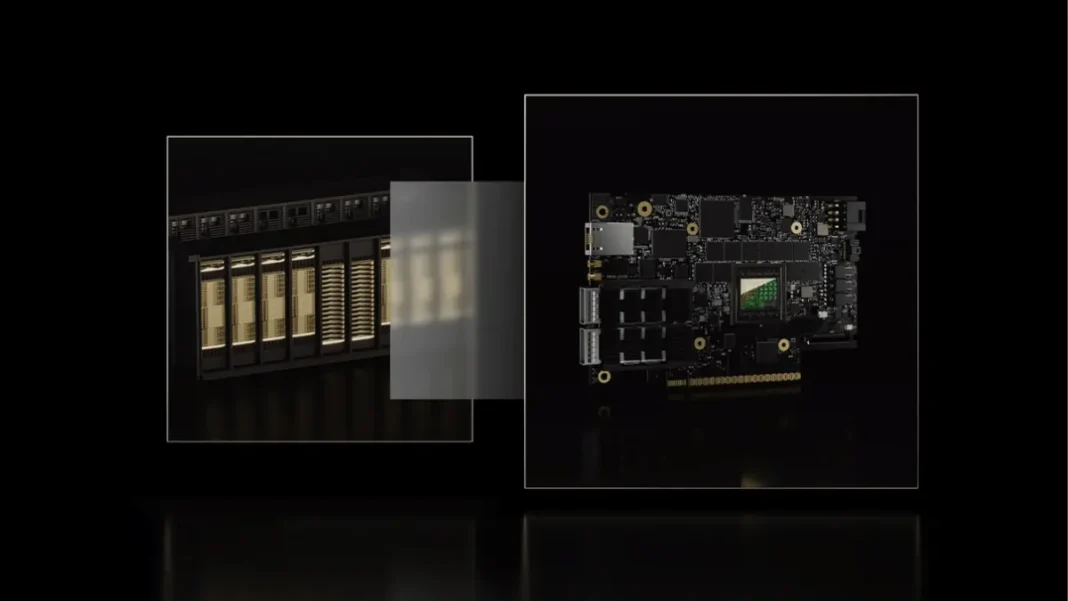
NVIDIA has expanded its Enterprise AI Factory validated design to include BlueField cybersecurity and infrastructure acceleration capabilities. The update, announced at CES 2026 in Las Vegas (January 6-9), integrates nine partner platforms to deliver hardware-accelerated security that operates at the same speed as AI workloads. BlueField offloads networking, storage, security, and orchestration tasks to a dedicated processor, freeing CPUs and GPUs to focus exclusively on AI operations.
What’s New in the AI Factory Design
NVIDIA BlueField now powers the operating system layer of AI factories by handling infrastructure services that previously consumed CPU and GPU resources. The processor delivers zero-trust, hardware-accelerated security through the DOCA Argus framework, which provides AI runtime visibility and threat detection across data ingestion, fine-tuning, and inference stages.
Nine leading software platforms are now validated for the Enterprise AI Factory design:
- Armis Centrix – continuous cyber exposure management
- Check Point Infinity AI Cloud Protect – real-time network and host security with DOCA Argus telemetry
- F5 BIG-IP Next for Kubernetes – AI workload isolation and policy enforcement
- Fortinet FortiGate VM – zero-trust segmentation and next-gen firewalling
- Palo Alto Networks Prisma AIRS – zero-trust AI runtime protection at infrastructure layer
- Rafay – multi-tenant isolation and production AI factory operations
- Red Hat OpenShift – production-grade application platform with enhanced networking
- Spectro Cloud PaletteAI – full-stack AI for regulated environments
- Trend Vision One – infrastructure-level monitoring with global threat intelligence
All partners leverage NVIDIA RTX PRO Servers and BlueField acceleration to maintain efficiency as traffic and scale increase.
Why Hardware-Accelerated Security Matters
Traditional security tools struggle to keep pace with AI workload speeds and can create performance bottlenecks. BlueField isolates security functions on dedicated silicon, enabling real-time threat detection without impacting host system performance.
DOCA Argus operates independently of the host CPU, using advanced memory forensics to deliver detection speeds up to 1,000x faster than existing agentless solutions. The framework remains invisible to attackers even during system compromise because it runs outside the host environment. For enterprises deploying containerized AI workloads like NVIDIA NIM microservices, this architecture provides consistent protection across multi-tenant infrastructures without agent installation or resource overhead.
How BlueField Differs From Traditional Infrastructure
| Aspect | Traditional Setup | BlueField Architecture |
|---|---|---|
| Security processing | Runs on host CPU/GPU | Isolated on dedicated DPU |
| Performance impact | Security tasks slow AI workloads | Zero overhead on AI compute |
| Threat detection | Agent-based, visible to attackers | Agentless, invisible operation |
| Workload focus | CPUs handle infrastructure + AI | CPUs/GPUs focus only on AI |
BlueField-4, the latest generation, combines an NVIDIA Grace CPU and ConnectX-9 networking to deliver 6x the compute power of BlueField-3, supporting AI factories up to 4x larger.
Rollout and Availability
The expanded Enterprise AI Factory validated design is available now for enterprises building on-premise AI infrastructure. NVIDIA showcased the BlueField integrations at CES 2026, running January 6-9 in Las Vegas.
The validation applies specifically to NVIDIA RTX PRO Servers running the partner platforms listed above. Enterprises can deploy BlueField as embedded SmartNICs in standard x86 servers, at the edge for latency-sensitive applications, or across bare-metal, virtualized, and containerized environments.
NVIDIA has not announced a timeline for additional partner validations or support for older BlueField generations in the AI Factory design.

Featured Snippet Boxes
What does NVIDIA BlueField do in an AI factory?
BlueField is a dedicated processor that handles networking, storage, security, and orchestration tasks, offloading these functions from CPUs and GPUs so they can focus entirely on AI workloads. It provides hardware-accelerated, zero-trust security that operates at AI speed.
How fast is DOCA Argus threat detection compared to traditional tools?
DOCA Argus delivers threat detection up to 1,000x faster than existing agentless solutions by using advanced memory forensics that run on BlueField DPUs. The framework operates without agents or host resources, maintaining zero performance impact.
Which companies are validated for NVIDIA Enterprise AI Factory with BlueField?
Nine partners are now validated: Armis, Check Point, F5, Fortinet, Palo Alto Networks, Rafay, Red Hat, Spectro Cloud, and Trend Micro. All platforms run on NVIDIA RTX PRO Servers with BlueField acceleration.
Can BlueField work with existing data center infrastructure?
Yes. BlueField DPUs can be embedded in standard x86 servers, deployed at the edge, or integrated across bare-metal, virtualized, and containerized environments. They support major orchestration platforms including Kubernetes, OpenStack, and VMware.

