

Quick Brief
- The Launch: NVIDIA released two open-source AI blueprints Multi-Agent Intelligent Warehouse (MAIW) and Retail Catalog Enrichment targeting retail supply chain inefficiencies
- The Impact: Retailers gain AI-powered coordination between IT and operational technology layers, reducing catalog enrichment costs and warehouse response times
- The Context: Showcased at NRF 2026: Retail’s Big Show (January 11-13) as retailers face pressure from aging systems, siloed data, and rising customer expectations
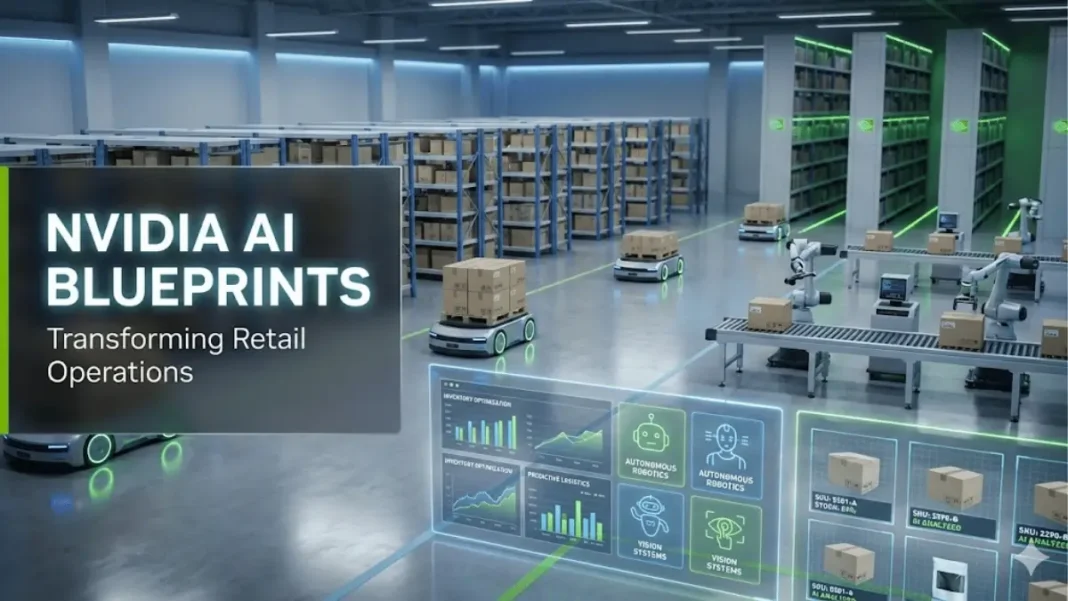
NVIDIA announced the release of two AI blueprints on January 8, 2026, designed to address critical inefficiencies in retail operations. The Multi-Agent Intelligent Warehouse (MAIW) and Retail Catalog Enrichment blueprints provide open-source developer references that enable customization of AI-powered solutions across the retail value chain. The blueprints will debut at the National Retail Federation’s Retail’s Big Show in New York City from January 11-13, 2026.
What’s New: Dual-Blueprint Architecture
The MAIW blueprint introduces an agentic AI coordination layer that sits between IT infrastructure and operational technology systems. This architecture comprises five specialized agents equipment asset operations, operations coordination, safety compliance, forecasting, and document processing orchestrated by a central warehouse operational assistant.
The system enables supervisors to query in natural language, such as “Why is packing slow?” and receive real-time analysis of equipment status, task queues, and staffing data with supporting evidence and actionable recommendations. Production-grade capabilities include role-based access control and policy guardrails for safety-critical decisions.
The Retail Catalog Enrichment blueprint leverages NVIDIA Nemotron vision language models to generate structured, localized product content at scale. The system processes product images to extract metadata including color, material, capacity, and style, then generates localized titles, descriptions, and culturally relevant lifestyle imagery. An integrated AI “judge” validates outputs for quality and consistency.
Why It Matters: Closing the IT-OT Gap
The retail industry faces a persistent disconnect between information technology and operational technology layers that prevents accurate inventory measurement, technology issue resolution, and dynamic workforce allocation. Tarik Hammadou, director of developer relations for AI for retail and consumer packaged goods at NVIDIA, stated that “having agents in between IT and OT allows the AI agents to act as the coordinators”.
Grid Dynamics has already deployed a catalog enrichment system using the Retail Catalog Enrichment blueprint for large retailers. Ilya Katsov, chief technology officer of Grid Dynamics, emphasized that “the quality of the search and the quality of the browsing experience for customers directly depends on the quality of the catalog data”. The company will demonstrate production implementations at NRF 2026 Booth #5921 alongside NVIDIA and Dell.
Kinetic Vision, a product development firm, identified the blueprints as solutions to decades-long supply chain issues. CEO Jeremy Jarrett noted that “charts and graphs are yesterday, we need predictions and prescribed actions”.
Technical Specifications
| Component | MAIW Blueprint | Retail Catalog Enrichment Blueprint |
|---|---|---|
| Architecture | Multi-agent coordination layer | Vision language model pipeline |
| Core Technology | Specialized agents for operations, safety, forecasting | NVIDIA Nemotron VLM |
| Integration Points | Warehouse management systems, ERP, robotics, IoT data | Product images, brand guidelines, taxonomy |
| Key Capabilities | Natural language queries, role-based access control, policy guardrails | Multi-image processing, localization, attribute extraction, quality validation |
| Output Format | Real-time operational intelligence with evidence | Product titles, descriptions, SEO/GEO tags, 2D/3D assets |
What’s Next: Physical AI Integration
NVIDIA outlined plans to embed a physical AI layer into warehouse and store operations. Hammadou stated that “by training physical agents with capabilities like computer vision, we’re moving toward more adaptive and autonomous operations”.
The blueprints complement NVIDIA’s previously released agentic Retail Shopping Assistant Blueprint, forming an end-to-end AI infrastructure from warehouse to consumer. The company also released the Nemotron-Personas-USA open-source dataset to improve diversity in synthetically generated shopper demographic data.
Retailers can access detailed implementation documentation on the NVIDIA Technical Blog. The company projects reduced integration costs and faster deployment timelines for developers customizing solutions to specific retail environments.
What are NVIDIA AI blueprints for retail?
Open-source developer references for building AI-powered warehouse coordination systems and automated product catalog enrichment solutions at enterprise scale.
How does multi-agent AI improve warehouse operations?
It coordinates between IT and operational technology layers, providing real-time analysis of equipment, staffing, and tasks through natural language queries with policy-compliant recommendations.
Which companies use NVIDIA retail blueprints?
Grid Dynamics deployed a catalog enrichment system for large retailers, while Kinetic Vision plans implementations for supply chain optimization.
When will NVIDIA showcase these blueprints?
NVIDIA demonstrates the blueprints at NRF 2026: Retail’s Big Show, January 11-13, 2026, at Jacob K. Javits Convention Center in New York City.

