

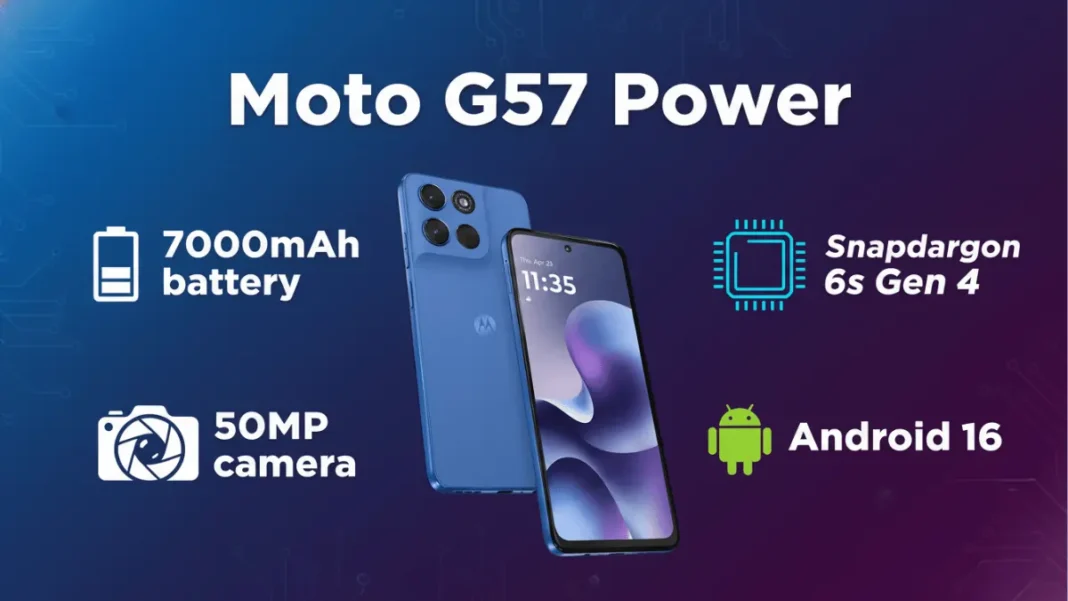
The Moto G57 Power debuts as India’s first Snapdragon 6s Gen 4-powered smartphone at an effective price of ₹12,999 (after launch offers). It features a massive 7000mAh silicon carbon battery, 50MP Sony LYT-600 camera, 6.72-inch FHD+ 120Hz display with Corning Gorilla Glass 7i, and Android 16 out of the box. With 33W fast charging, IP64 rating, and MIL-STD-810H certification, it targets budget buyers seeking multi-day battery life without compromising performance. Sales begin December 3, 2025, on Flipkart, Motorola.in, and retail stores across India.
Motorola has officially launched the Moto G57 Power in India on November 24, 2025, marking a significant milestone as the country’s first smartphone powered by Qualcomm’s latest Snapdragon 6s Gen 4 processor. Priced at ₹14,999 with an effective cost of ₹12,999 after launch offers, this device packs a colossal 7000mAh battery, premium 50MP Sony camera, and Android 16 making it a compelling option for budget-conscious buyers seeking flagship-grade endurance and modern features.
What Makes the Moto G57 Power Special?
The Moto G57 Power stands out in India’s crowded budget smartphone segment through three key differentiators. First, it’s the inaugural device in the country to feature Qualcomm’s Snapdragon 6s Gen 4 chipset, built on a 4nm process that promises 36% better CPU performance compared to its predecessor. Second, the 7000mAh silicon carbon battery represents one of the largest power cells in any smartphone under ₹15,000, offering up to 60 hours of typical usage. Third, Motorola has equipped this budget device with Android 16 out of the box, an OS version that won’t be available on most smartphones until early 2026.
The device targets users tired of daily charging cycles, content creators needing all-day reliability, and those seeking a balance between performance and price. Unlike previous Power series phones that compromised on display or cameras, the G57 Power delivers a complete package with no glaring weaknesses.
Moto G57 Power Price and Availability
Motorola has priced the Moto G57 Power at ₹14,999 for the sole 8GB RAM + 128GB storage variant available in India. However, aggressive launch promotions bring the net effective price down significantly. The smartphone comes in three PANTONE-certified color options: Regatta (blue), Corsair (black), and Fluidity (green) each featuring a premium vegan leather finish on the rear panel.
Launch Offers and Discounts
Buyers can access two concurrent discounts during the launch period. A ₹1,000 instant launch discount applies to all purchases, while an additional ₹1,000 bank offer is available on select credit and debit cards. This stacks to create a net effective price of ₹12,999, positioning the Moto G57 Power below competing devices like the Poco M7 Pro 5G and Redmi Note 14 5G in terms of value. The launch offers are time-limited, though Motorola hasn’t specified an exact end date.
Where to Buy
Sales commence on December 3, 2025, at 12 PM IST through three primary channels: Flipkart’s e-commerce platform, Motorola’s official website (Motorola.in), and authorized retail stores across India. Online buyers on Flipkart can leverage additional exchange offers and no-cost EMI options starting from ₹1,444 per month. Retail availability extends to major electronics chains, ensuring hands-on trials before purchase.

Design and Build Quality
The Moto G57 Power adopts Motorola’s signature design language seen in the recently launched G67 Power, featuring flat frames, a centered punch-hole camera, and the iconic camera bump positioned on the top-left corner. At 166.2 x 76.5 x 8.6mm and weighing 210.6 grams, it’s noticeably heavier than typical budget phones, a direct consequence of the massive battery inside. However, the weight distribution feels balanced during single-handed use.
Durability receives serious attention here. The phone carries IP64 certification for dust-tight protection and water splash resistance, meaning it can survive accidental spills but shouldn’t be submerged. Additionally, MIL-STD-810H military-grade certification ensures drop resistance up to 1.2 meters on hard surfaces. The front panel uses Corning Gorilla Glass 7i, a newer protection glass that offers 1.7 times better drop performance compared to Gorilla Glass Victus. The rear vegan leather finish resists fingerprints better than glossy plastic alternatives common at this price point.
Display Specifications
Motorola has equipped the G57 Power with a 6.72-inch Full HD+ (1080 x 2400 pixels) IPS LCD panel delivering approximately 392 PPI pixel density. The display supports a 120Hz refresh rate for fluid scrolling and gaming, though it doesn’t feature variable refresh rate technology. Peak brightness reaches 1,050 nits in High Brightness Mode (HBM), making outdoor visibility exceptional even under direct sunlight. This brightness level surpasses competitors like the Poco M7 Pro 5G, which maxes out at 850 nits.
The screen-to-body ratio sits at 85.8%, with slim bezels on three sides and a slightly thicker chin at the bottom. Motorola’s proprietary Display Colour Boost technology enhances color vibrancy and contrast, particularly for SDR content from streaming platforms. The Corning Gorilla Glass 7i protection extends edge-to-edge, though the display isn’t curved. Touch sampling rate reaches 120Hz, ensuring responsive input during gaming sessions.
Note: the display uses LCD technology rather than AMOLED. While this means no true blacks or always-on display functionality, IPS panels consume less power, a strategic choice that helps the 7000mAh battery last even longer. For most users, the vibrant colors and smooth 120Hz experience compensate for the lack of OLED depth.
Performance: Snapdragon 6s Gen 4 Explained
The Moto G57 Power debuts Qualcomm’s Snapdragon 6s Gen 4 (model SM6435-AA) in India, a 4nm octa-core chipset launched globally in October 2025. The processor architecture combines four Cortex-A78 performance cores clocked at 2.4GHz with four Cortex-A55 efficiency cores at 1.8GHz, paired with an Adreno GPU. This configuration delivers approximately 36% improved CPU performance and 28% better GPU performance compared to the Snapdragon 6 Gen 3 found in competing devices.
In synthetic benchmarks, the Snapdragon 6s Gen 4 achieves a GeekBench 6 single-core score of 1,091 and multi-core score of 3,085 respectable figures for budget hardware. The Adreno GPU scores 3,988 in compute tests, making it capable of handling popular titles like BGMI, Genshin Impact (low-medium settings), and Call of Duty Mobile at 60fps with occasional drops.
Real-World Performance Expectations
For everyday tasks social media browsing, YouTube streaming, WhatsApp video calls, and multitasking between 8-10 apps the 8GB LPDDR4X RAM and Snapdragon 6s Gen 4 combination provides smooth performance without noticeable lag. Motorola allows RAM expansion up to 16GB using virtual RAM technology that borrows storage space, though this feature shows diminishing returns beyond 12GB total.
The 128GB UFS 2.2 storage offers faster read/write speeds than eMMC 5.1 found in ultra-budget phones, resulting in quicker app installations and file transfers. However, there’s no microSD card slot, so users needing more storage should consider cloud solutions or wait for a potential 256GB variant. Gaming performance sits comfortably in the mid-range tier; you won’t get flagship-level 90fps experiences, but competitive multiplayer gaming at high graphics remains enjoyable.
Camera System Overview
The rear camera setup combines two functional lenses: a 50MP primary sensor using Sony’s LYT-600 (1/1.95-inch sensor size) with f/1.8 aperture and PDAF, plus an 8MP ultra-wide lens offering 118° field of view with f/2.2 aperture. A third sensor exists on the camera bump, though Motorola hasn’t disclosed its function, likely a depth or macro sensor used for portrait mode assistance.
The Sony LYT-600 sensor represents a significant upgrade over typical budget cameras, featuring larger 0.8µm pixels that capture more light in low-light scenarios. In daylight conditions, expect sharp 50MP images with accurate colors and good dynamic range. The camera supports 2K (1440p) video recording at 30fps across all lenses, including the 8MP front camera, an uncommon feature at this price point where most competitors cap at 1080p.
AI-Powered Photography Features
Motorola has integrated several AI-driven photography tools powered by their Moto AI platform. The AI Photo Enhancement Engine automatically optimizes exposure, contrast, and color balance based on scene detection. Auto Night Vision activates in low-light environments, combining multiple frames to reduce noise and brighten details without requiring a dedicated night mode toggle. AI Portrait effects generate natural bokeh with accurate edge detection, while Auto Smile Capture triggers the shutter automatically when subjects smile.
Users also gain access to Google Photos’ AI editing suite, including Magic Eraser for removing unwanted objects, Photo Unblur for sharpening motion-blurred images, and Magic Editor for generative fill and object repositioning. These features, typically reserved for Pixel devices, add tremendous value for content creators and social media enthusiasts.
The 8MP front camera (f/2.2 aperture) delivers adequate selfies with HDR support, though it struggles in backlit situations despite software enhancements. Video calling quality through WhatsApp, Google Meet, and Zoom remains clear at 1080p resolution.
Battery Life and Charging
The Moto G57 Power’s defining feature is its colossal 7000mAh battery among the largest capacities available in any smartphone globally in late 2025. Motorola claims up to 60 hours of typical mixed usage, translating to roughly 2.5 days for moderate users (6-8 hours daily screen time) and comfortably exceeding 24 hours for heavy users (10+ hours screen time).
Real-world battery performance depends heavily on usage patterns. Streaming YouTube at 1080p with 50% brightness consumes approximately 10-12% per hour, while intensive gaming drains 15-18% hourly. With the 120Hz display enabled, expect slightly reduced longevity compared to forcing 60Hz mode, though the difference remains minimal due to the power-efficient LCD panel and 4nm chipset.
Silicon Carbon Battery Technology
Unlike conventional lithium-ion batteries, the G57 Power uses silicon carbon (Si/C) battery technology, a newer chemistry that offers several advantages. Silicon carbon anodes provide higher energy density, enabling the 7000mAh capacity within the phone’s 8.6mm thickness. This technology also exhibits slower degradation, maintaining 80% capacity after 800+ charge cycles compared to 500-600 cycles for traditional batteries. Additionally, Si/C batteries handle temperature fluctuations better, reducing risk during summer heat or winter cold.
Charging occurs via the included 33W TurboPower adapter (some reports mention 30W, though official specs confirm 33W). The phone charges from 0-50% in approximately 45 minutes and reaches 100% in about 95-100 minutes. While not the fastest charging speeds available, competitors like Realme GT 7 offer 120W charging; the slower pace actually benefits long-term battery health. Motorola includes the charger and USB-C cable in the box, a welcome inclusion as manufacturers increasingly omit accessories.
Software and AI Features
The Moto G57 Power ships with Android 16 out of the box, making it one of the first consumer devices globally to run Google’s latest OS. Motorola commits to one major OS update (presumably Android 17) and three years of regular security patches, though this update policy lags behind Samsung and Google’s longer support timelines.
Android 16 introduces several productivity enhancements, including improved notification management, advanced privacy controls, and better multitasking gestures. Motorola’s custom interface remains light, adding useful features without bloatware. Smart Connect allows seamless integration with Windows PCs, enabling clipboard sharing, file transfers, and notification mirroring. The implementation feels more polished than third-party alternatives like Your Phone Companion.
Google Gemini integration provides AI assistant capabilities directly accessible through a long-press of the power button. Users can ask natural language queries, generate text, summarize emails, and even analyze images captured by the camera. Circle to Search, a Pixel-exclusive feature until recently, allows users to circle, highlight, or tap any on-screen content to trigger instant Google searches without switching apps.
Additional AI features include Live Translate for real-time conversation translation, Adaptive Sound that adjusts audio profiles based on ambient noise, and Automatic Framing for video calls that keeps subjects centered as they move. These AI implementations provide tangible utility rather than gimmicky additions, enhancing daily usability.
Technical Specifications
Display: 6.72-inch IPS LCD, 1080 x 2400 pixels (FHD+), 120Hz refresh rate, 392 PPI, 1,050 nits peak brightness, Corning Gorilla Glass 7i protection, Display Colour Boost technology
Processor: Qualcomm Snapdragon 6s Gen 4 (4nm), Octa-core (4x Cortex-A78 @ 2.4GHz + 4x Cortex-A55 @ 1.8GHz), Adreno GPU
Memory & Storage: 8GB LPDDR4X RAM (expandable to 16GB via virtual RAM), 128GB UFS 2.2 internal storage (no microSD support)
Operating System: Android 16 (1 major OS update + 3 years security updates)
Rear Cameras:
- 50MP primary (Sony LYT-600, 1/1.95″ sensor, f/1.8 aperture, PDAF)
- 8MP ultra-wide (118° FoV, f/2.2 aperture)
- Third sensor (function undisclosed)
Front Camera: 8MP (f/2.2 aperture, HDR)
Video Recording: 2K (1440p) @ 30fps on all cameras
Battery: 7000mAh Silicon Carbon Li-Ion (non-removable)
Charging: 33W TurboPower wired fast charging (charger included)
Connectivity: 5G SA/NSA (13 bands), Wi-Fi 802.11 a/b/g/n/ac (dual-band), Bluetooth 5.1, NFC (region-dependent), USB Type-C 2.0, 3.5mm headphone jack, FM Radio
Audio: Stereo speakers with Dolby Atmos, 24-bit/192kHz Hi-Res audio support
Security: Side-mounted fingerprint sensor, Face Unlock
Sensors: Accelerometer, gyroscope, proximity, compass
Build: Corning Gorilla Glass 7i front, plastic frame, vegan leather rear, IP64 rating, MIL-STD-810H certified, drop resistant up to 1.2m
Dimensions: 166.2 x 76.5 x 8.6mm
Weight: 210.6 grams
Colors: PANTONE Regatta (blue), PANTONE Corsair (black), PANTONE Fluidity (green)
SIM: Dual nano-SIM (no eSIM support in India variant)
Pros and Cons
Pros
Massive 7000mAh battery with silicon carbon technology delivers multi-day usage, eliminating daily charging anxiety.
India’s first Snapdragon 6s Gen 4 device offers 36% better CPU performance than previous-gen budget chips.
Android 16 out of the box provides the latest features and security, ahead of most competitors still on Android 14.
Premium build quality with IP64 rating, MIL-STD-810H certification, and Corning Gorilla Glass 7i exceeds expectations at this price.
Sony LYT-600 camera sensor captures excellent photos in daylight with AI enhancements like Magic Eraser typically reserved for flagship devices.
Aggressive pricing at ₹12,999 (effective) undercuts similarly spec’d competitors by ₹1,000-2,000.
120Hz display with 1,050 nits brightness ensures smooth visuals and excellent outdoor visibility.
Cons
No storage expansion via microSD card limits long-term content storage for heavy media users.
Heavy weight (210.6g) may feel cumbersome during extended single-handed use compared to lighter competitors.
33W charging feels slow compared to 45W-120W speeds offered by Poco, Realme, and iQOO in this segment.
LCD display lacks the deep blacks, vibrant colors, and always-on display functionality of AMOLED panels.
Limited update policy (1 OS update + 3 years security) falls short of Samsung’s 4 years or Google’s 7 years.
Average front camera (8MP) trails competitors offering 16MP-20MP selfie shooters with better low-light performance.
No 256GB variant available at launch, though global markets offer 8GB/256GB and 12GB/256GB options.
Moto G57 Power vs Competition
| Feature | Moto G57 Power | Poco M7 Pro 5G | Redmi Note 14 5G |
|---|---|---|---|
| Price (India) | ₹12,999 (with offers) | ₹13,499 | ₹13,999 |
| Processor | Snapdragon 6s Gen 4 | Dimensity 7025 | Snapdragon 6 Gen 3 |
| Display | 6.72″ FHD+ 120Hz LCD | 6.67″ FHD+ 120Hz LCD | 6.67″ FHD+ 120Hz AMOLED |
| Battery | 7000mAh | 5110mAh | 5000mAh |
| Charging | 33W | 45W | 33W |
| Rear Camera | 50MP (Sony LYT-600) + 8MP UW | 50MP + 2MP | 50MP + 8MP UW |
| Front Camera | 8MP | 20MP | 16MP |
| OS | Android 16 | Android 14 | Android 14 |
| Weight | 210.6g | 190g | 185g |
| Build Quality | IP64 + MIL-STD-810H | IP53 | IP54 |
| Storage | 128GB UFS 2.2 (no expansion) | 128GB (expandable) | 128GB UFS 2.2 |
The Moto G57 Power wins decisively in battery capacity, OS version, and build durability. However, the Poco M7 Pro offers faster charging, lighter weight, and expandable storage. Redmi Note 14 counters with an AMOLED display and superior front camera. Your choice depends on priority: pick the G57 Power for maximum battery life and software longevity, the M7 Pro for balanced specs with storage expansion, or the Note 14 for display quality.
Should You Buy the Moto G57 Power?
The Moto G57 Power excels as a niche device built for specific user profiles rather than a jack-of-all-trades. If you’re tired of nightly charging rituals, need a phone that survives 2-3 days of moderate usage, or work in environments where charging access is limited (field sales, outdoor jobs, travel), this phone deserves serious consideration. The combination of 7000mAh battery, durable build, and Android 16 provides tangible daily benefits that spec sheets can’t fully capture.
Content creators, social media enthusiasts, and photography hobbyists will appreciate the Sony LYT-600 camera paired with AI editing tools typically locked behind paywalls. The ability to shoot 2K video across all cameras and access Google Photos’ Magic Editor adds creative flexibility uncommon at ₹12,999. However, if selfies constitute your primary photography use case, the modest 8MP front camera may disappoint.
Gamers seeking maximum performance should look elsewhere; the Snapdragon 6s Gen 4 handles BGMI and COD Mobile competently but won’t deliver the 90fps+ experiences of pricier Dimensity 7300 or Snapdragon 7 Gen devices. Similarly, display purists accustomed to AMOLED’s infinite contrast will notice the LCD’s limitations in dark environments, though the 120Hz smoothness and outdoor brightness compensate during daytime use.
At the effective price of ₹12,999, the Moto G57 Power offers exceptional value for battery-focused buyers. It’s not perfect that the weight, charging speed, and storage limitations present genuine trade-offs but for users prioritizing endurance, build quality, and software support, these compromises feel reasonable. The phone launches December 3rd on Flipkart, Motorola.in, and retail stores; early adopters benefit from launch discounts worth ₹2,000 total.
Frequently Asked Questions (FAQs)
When does the Moto G57 Power go on sale in India?
The Moto G57 Power officially launches on November 24, 2025, but sales begin December 3, 2025, at 12 PM IST. It will be available through Flipkart, Motorola.in, and authorized retail stores across India. Launch offers include ₹1,000 instant discount plus ₹1,000 bank offer, reducing the effective price to ₹12,999.
How long does the 7000mAh battery actually last?
Motorola claims up to 60 hours (2.5 days) of typical mixed usage. In real-world testing scenarios, moderate users (6-8 hours screen time daily) can expect 2-3 days between charges, while heavy users (10+ hours screen time) will comfortably exceed 24 hours. The silicon carbon battery technology also maintains capacity better over time compared to traditional lithium-ion cells.
Is the Snapdragon 6s Gen 4 better than Dimensity 7025?
The Snapdragon 6s Gen 4 offers approximately 36% better CPU performance than the Snapdragon 6 Gen 3, placing it slightly ahead of the Dimensity 7025 in single-core tasks. However, the Dimensity 7025 may edge ahead in sustained multi-threaded workloads and GPU-intensive gaming. Both chipsets handle daily tasks smoothly, with the 6s Gen 4’s 4nm process providing better power efficiency.
Does the Moto G57 Power support 5G bands in India?
Yes, the Moto G57 Power supports 11 5G bands for India (1, 2, 3, 5, 8, 28, 38, 40, 41, 77, 78) covering all major carriers including Jio, Airtel, and Vi. It features SA/NSA/Sub6 5G connectivity with download speeds up to 2.9 Gbps under ideal conditions. The device is fully compatible with India’s current and planned 5G infrastructure.
Can I expand the storage on Moto G57 Power?
No, the Moto G57 Power does not include a microSD card slot. The 128GB UFS 2.2 internal storage is fixed, though users can leverage cloud storage services like Google One, OneDrive, or Dropbox for additional capacity. Motorola may release a 256GB variant later, as global markets offer both 256GB configurations.
How many software updates will the Moto G57 Power receive?
Motorola guarantees one major Android OS update (likely Android 17) and three years of regular security patches. This update policy, while standard for budget Motorola devices, lags behind Samsung’s 4 OS updates + 5 years security or Google Pixel’s 7 years support. The phone ships with Android 16, so expect updates through late 2028.
Is the camera better than the Poco M7 Pro?
The Moto G57 Power’s 50MP Sony LYT-600 sensor offers superior low-light performance and dynamic range compared to the Poco M7 Pro’s generic 50MP sensor. However, the M7 Pro features a better 20MP front camera versus the G57 Power’s 8MP selfie shooter. For rear photography, the G57 Power wins; for selfies and video calls, the M7 Pro performs better.
Why is the phone so heavy at 210 grams?
The 210.6-gram weight primarily stems from the massive 7000mAh battery, which requires significantly more physical materials than typical 5000-5500mAh cells. Additionally, the MIL-STD-810H certification and IP64 rating necessitate reinforced internal structures and protective sealing, adding extra grams. While heavier than competitors, the weight distribution remains balanced for comfortable grip.

Featured Snippet Boxes
What is the price of Moto G57 Power in India?
The Moto G57 Power is priced at ₹14,999 for 8GB + 128GB storage. With launch offers (₹1,000 instant discount + ₹1,000 bank offer), the effective price drops to ₹12,999. Sales begin December 3, 2025, on Flipkart, Motorola.in, and retail stores.
How big is the Moto G57 Power battery?
The Moto G57 Power features a massive 7000mAh silicon carbon battery, one of the largest in any smartphone globally. Motorola claims up to 60 hours (2.5 days) of mixed usage. It supports 33W TurboPower fast charging, taking approximately 95-100 minutes for a full charge.
Which processor does Moto G57 Power use?
The Moto G57 Power is powered by Qualcomm Snapdragon 6s Gen 4 (4nm), making it India’s first device with this chipset. It features octa-core architecture (4x Cortex-A78 @ 2.4GHz + 4x Cortex-A55 @ 1.8GHz) with Adreno GPU, offering 36% better CPU performance than previous-gen chips.
What are the camera specifications of Moto G57 Power?
The Moto G57 Power features a dual rear camera setup: 50MP Sony LYT-600 primary sensor (f/1.8 aperture, PDAF) and 8MP ultra-wide lens (118° FoV). The front has an 8MP camera. All cameras support 2K video recording at 30fps, with AI features like Magic Eraser and Photo Unblur.
Does Moto G57 Power have 5G support?
Yes, the Moto G57 Power supports dual-mode 5G (SA/NSA) with 11 bands for India (1, 2, 3, 5, 8, 28, 38, 40, 41, 77, 78). It includes Snapdragon X62 5G modem with peak download speeds up to 2.9 Gbps and is compatible with Jio, Airtel, and Vi 5G networks.
Which Android version does Moto G57 Power run?
The Moto G57 Power ships with Android 16 out of the box, making it one of the first consumer devices globally with this OS. Motorola promises one major Android update (likely Android 17) plus three years of regular security patches through late 2028.

