

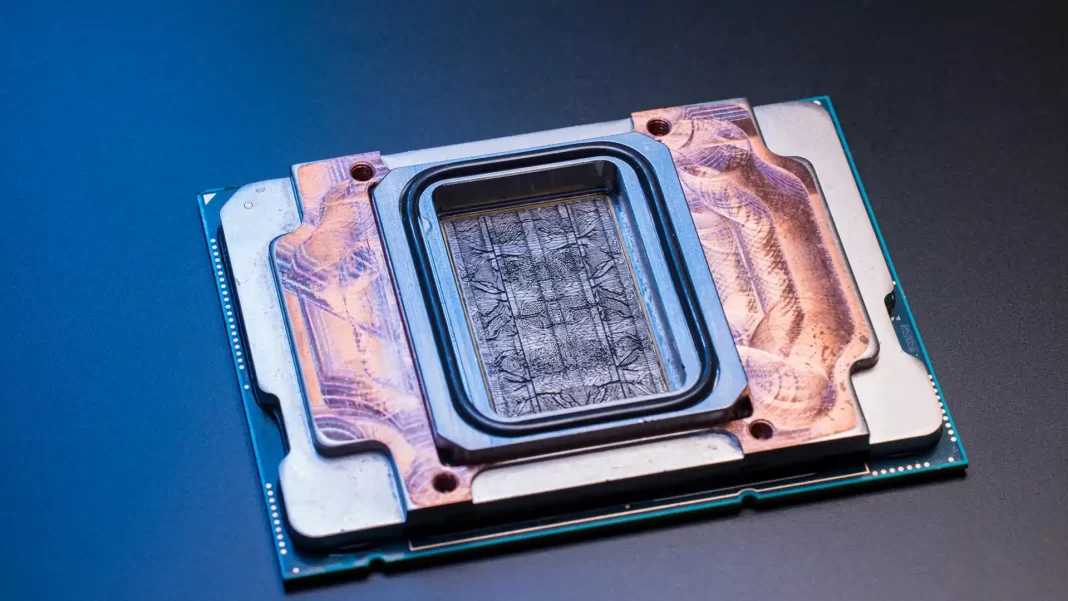
Short Answer: Microsoft says its microfluidics cooling brings liquid inside the silicon through etched micro-channels, removing heat up to 3× better than cold plates and cutting the maximum temperature rise by 65% in lab tests. It already cooled a server running core services for a simulated Teams call. Production-grade rollout will depend on manufacturing and reliability work.
Table of Contents
What Microsoft actually announced
On September 23, 2025, Microsoft detailed an in-chip microfluidics system that routes coolant through channels etched into the back of the die. In lab-scale testing, it removed heat up to three times better than today’s cold plates and reduced a GPU’s max temperature rise by 65%. The team also used AI to map per-chip hotspots and route coolant to where it’s needed most.
Judy Priest, CTO for Cloud Operations & Innovation, said the approach enables more power-dense designs in the same space. Sashi Majety cautioned that in about five years, sticking with traditional cold plates could leave operators “stuck,” signaling that thermal headroom will cap AI performance without new cooling. Microsoft also ran the tech on a server supporting a simulated Microsoft Teams meeting to prove real-world behavior.
Microsoft says it’s investigating how to incorporate microfluidics into future generations of its first-party chips. In parallel, it continues to build out its custom Cobalt CPU and Maia AI accelerator families, where cooling headroom is central. Expect early integration paths to emerge as packaging partners and fabs validate yield and reliability.

How microfluidics cooling works inside a chip
At a high level, microfluidics brings coolant closer to the heat source than any plate ever could. Microsoft and partner Corintis used bio-inspired designs that resemble leaf veins or butterfly wings to split and recombine flow, keeping pressure drop manageable while bathing hotspots. The channels are about the width of a human hair, so depth, spacing, and smoothness matter. Over the last year, the team iterated four designs to balance flow against die strength.
Independent literature shows why this path is attractive: integrated microchannel coolers can handle extreme local heat flux and have long been studied for 3D-stacked chips. Microsoft’s update is that the patterns are AI-optimized to specific workloads, not just generic grids.
Why it matters for power and cost
Cooling is a huge slice of data-center energy. Estimates vary by design, but reputable analyses put cooling at up to ~40% of total electricity in less efficient sites, while efficient hyperscalers run much lower shares. Either way, reducing the need to chill fluid as hard can improve PUE and opex.
Microsoft says microfluidics lets the coolant touch hotter silicon directly, so supply temperatures can be warmer while doing a better job than cold plates. That translates into less chiller work and higher server density per rack, which means more compute in the same building footprint.
Mini case study (illustrative): If a high-density AI rack draws 60 kW IT and your current setup runs PUE 1.35, total rack draw is ~81 kW. If microfluidics plus warmer water loops trim cooling power by even 10–15%, that could save 2–3 kW per rack continuously. At $0.10/kWh, that’s roughly $1.8K–$2.6K saved per rack per year, before density gains.
Microfluidics vs today’s options
| Cooling method | How it works | Strengths | Trade-offs | Best fit |
|---|---|---|---|---|
| Cold plates | Liquid in a metal plate on the package | Mature, serviceable | Heat has to cross package layers; hotspots persist | Moderate-density AI, retrofit |
| Immersion | Boards immersed in dielectric fluid | Uniform heat removal | Requires tank form factor; service model changes | New builds, non-GPU spiky loads |
| Microfluidics (in-chip) | Etched microchannels in silicon | Up to 3× heat removal vs cold plates; targets hotspots; warmer loops possible | New packaging, fab steps, leak-proofing, reliability studies | Highest-density AI, future 3D stacks |
Risks to manage:
- Reliability: sealing, corrosion, clogging, particulate control, fluid compatibility.
- Manufacturing: added etch steps, yield hit on expensive dies, RMA decision flows.
- Serviceability: new diagnostic tools for flow and pressure inside the package.
- Vendor alignment: fabs, OSATs, pump vendors, and coolant suppliers must coordinate.
Roadmap and market signals
This isn’t a science project. Microsoft already ran a simulated Teams workload on microfluidics and says it’s exploring production incorporation with silicon partners. Expect pilot systems to come first in internal Azure fleets, then selective workloads that stress hotspots.
Investors took notice: Vertiv (VRT) a major thermal gear supplier traded lower on the news as markets weighed the impact on traditional cooling stacks.
FAQ
How is this different from direct-to-chip cold plates?
Cold plates sit on top of the package. Microfluidics routes fluid inside the die, attacking hotspots directly and reducing thermal resistance across package layers.
What about immersion cooling why not just dunk servers?
Immersion works well but changes service models and floor layouts. Microfluidics keeps standard server shapes while targeting hotspots more precisely. Some sites may mix methods.
How big are the channels?
About the width of a human hair, which makes them tricky to etch and keep structurally sound.
Is it safe to run liquid through chips?
The package is sealed and designed to prevent leaks. The challenge is long-term reliability and particulate control, which Microsoft is testing now.
Will this help with 3D-stacked chips?
Yes. In-chip cooling is a stepping stone to 3D architectures, where vertical stacks trap heat. Microfluidics can bring coolant to inter-die regions.
How much of a DC’s power goes to cooling?
Depends on design and climate. Studies show ~7% at efficient hyperscalers up to ~30-40% at less efficient or legacy sites.
Featured Answer Boxes
What is Microsoft’s microfluidics cooling?
A liquid-cooling method that etches micro-channels into the silicon so coolant flows over hotspots inside the chip. Microsoft reports up to 3× better heat removal than cold plates and a 65% reduction in max temperature rise in lab tests.
How soon could this reach production?
Microsoft says it’s investigating incorporation into future first-party chips and working with fabrication partners. Early pilots will likely appear in internal Azure fleets before broader rollout. Timing depends on manufacturing yield and reliability data.
Does it cut data-center power use?
Potentially. Because coolant can be warmer and still effective, chiller loads may drop, improving PUE and opex especially in dense AI racks where cold plates struggle with hotspots. Exact savings will vary by design.
Source: Microsoft News

