

Quick Brief
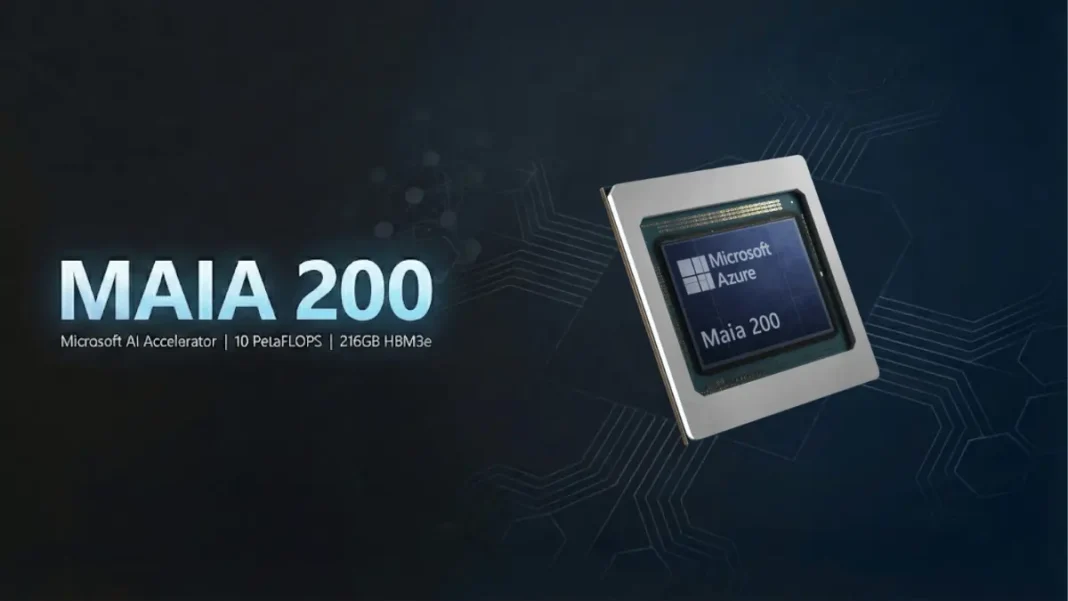
- The Launch: Microsoft deployed Maia 200, a 3nm AI inference accelerator delivering 10 petaFLOPS FP4 performance with 216GB HBM3e memory 30% better performance per dollar than current Azure hardware
- The Competition: Maia 200 achieves 3x the FP4 performance of AWS Trainium 3 and surpasses Google TPU v7 in FP8 operations, according to Microsoft’s benchmarks
- The Impact: Now serving OpenAI’s GPT-5.2 models across Microsoft 365 Copilot and Azure Foundry, with initial deployment in US Central (Iowa) and US West 3 (Arizona) regions
- The Strategy: SDK preview opens to developers today, positioning Microsoft to reduce dependency on third-party GPU suppliers while controlling AI infrastructure economics
Microsoft officially deployed its Maia 200 AI accelerator on January 26, 2026, positioning the 140-billion-transistor chip as the most performant first-party silicon from any hyperscaler, according to the company’s official announcement. Fabricated on TSMC’s 3nm process node, Maia 200 delivers over 10 petaFLOPS in 4-bit precision (FP4) and exceeds 5 petaFLOPS in 8-bit precision (FP8) within a 750-watt thermal design power envelope. The accelerator now powers inference workloads for OpenAI’s latest GPT-5.2 models across Azure’s commercial services, including Microsoft 365 Copilot and Microsoft Foundry.
Technical Architecture: 216GB Memory and 7 TB/s Bandwidth
Maia 200 integrates 216GB of HBM3e high-bandwidth memory operating at 7 TB/s, coupled with 272MB of on-chip SRAM to address the data-feeding bottleneck endemic to large language model inference. This memory configuration exceeds Nvidia’s B200 GPU, which offers 192GB HBM3e at 8 TB/s bandwidth. Each chip supports native FP8 and FP4 tensor cores optimized for low-precision compute, reflecting the industry’s shift toward quantized neural network operations.
The accelerator’s two-tier scale-up network architecture, built on standard Ethernet rather than proprietary fabrics, exposes 2.8 TB/s of bidirectional bandwidth per chip. Microsoft engineered clusters scalable to 6,144 accelerators yielding 61 exaFLOPS of aggregate FP4 compute and 1.3 petabytes of pooled HBM3e memory using a custom Maia AI transport protocol.
Within each server tray, four Maia 200 chips connect via direct, non-switched links, maintaining high-bandwidth communication locality for distributed inference tasks. The unified fabric simplifies programming models and reduces network hops across intra-rack and inter-rack topologies, according to Microsoft’s technical documentation.
Competitive Positioning: 3x AWS Trainium Performance Claim
Microsoft explicitly benchmarked Maia 200 against Amazon Web Services’ third-generation Trainium and Google’s seventh-generation Tensor Processing Unit, claiming three times the FP4 performance of Trainium 3 and FP8 throughput exceeding TPU v7. The company reports Maia 200 delivers 30% better performance per dollar compared to current Azure AI infrastructure.
Amazon’s Indiana datacenter deploys 500,000 Trainium2 chips for Anthropic’s model training, while Microsoft’s Maia 200 targets the inference market serving real-time applications like Copilot. Google’s TPU architecture has historically matched or exceeded Nvidia GPUs in certain AI workloads, particularly for large-batch training operations integrated with TensorFlow.
Maia 200’s focus on inference rather than training represents Microsoft’s strategic bet that token-generation economics will dominate cloud AI profitability as models mature beyond the frontier training phase.
| Specification | Microsoft Maia 200 | AWS Trainium 2/3 | Nvidia B200 |
|---|---|---|---|
| Process Node | TSMC 3nm | N/A | TSMC 4N |
| Transistors | 140 billion | N/A | 208 billion |
| FP4 Performance | 10+ petaFLOPS | 3x lower (per Microsoft) | 20 petaFLOPS (with sparsity) |
| FP8 Performance | 5+ petaFLOPS | N/A | N/A |
| Memory | 216GB HBM3e @ 7 TB/s | 96GB HBM3 | 192GB HBM3e @ 8 TB/s |
| TDP | 750W | N/A | 1000W |
| Scale-up Bandwidth | 2.8 TB/s bidirectional | N/A | 1.8 TB/s (NVLink) |
Deployment Strategy and OpenAI Integration
Microsoft activated Maia 200 clusters in its US Central datacenter region near Des Moines, Iowa, with US West 3 near Phoenix, Arizona, scheduled next. The phased rollout prioritizes geographies serving Microsoft’s highest-revenue AI products: Microsoft 365 Copilot and Azure OpenAI Service. Scott Guthrie, Microsoft’s executive vice president for Cloud + AI, confirmed Maia 200 will serve OpenAI’s GPT-5.2 models.
Microsoft’s Superintelligence team will deploy Maia 200 for synthetic data generation and reinforcement learning workflows, accelerating the production of domain-specific training data for next-generation in-house models. This application addresses a critical bottleneck in AI development: generating high-quality synthetic data at sufficient scale and speed to improve model capabilities.
The company validated Maia 200 silicon within days of receiving packaged parts, reducing datacenter deployment time through pre-silicon emulation and co-design of networking, cooling, and Azure control plane integration. Second-generation closed-loop liquid cooling Heat Exchanger Units manage the 750W thermal output across dense rack configurations.
Economics of Custom Silicon Infrastructure
Maia 200’s 30% performance-per-dollar improvement translates directly to margin expansion for Azure’s AI services. Microsoft’s $17.5 billion India infrastructure investment announced December 2025 signals the company will deploy custom silicon globally, not solely in US regions.
The two-tier Ethernet-based interconnect architecture represents significant technical differentiation from competitors. By avoiding proprietary fabrics like Nvidia’s NVLink, Microsoft reduces both capital expenditure and vendor lock-in.
Amazon’s Trainium and Google’s TPU have established multi-generation product roadmaps, with Trainium2 already deployed at hyperscale. Microsoft’s statement that Maia is designed as a “multi-generational” program indicates commitment beyond a single silicon generation.
Developer Access: Maia SDK Preview and PyTorch Integration
Microsoft opened preview access to the Maia 200 Software Development Kit (SDK) on January 26, 2026, targeting AI startups, academic researchers, and enterprise developers. The SDK includes PyTorch integration, a Triton compiler for kernel optimization, access to Maia’s low-level NPL (Neural Programming Language), and a simulator with cost calculator for pre-deployment workload modeling.
The toolchain architecture mirrors AWS’s Neuron SDK and Google’s TPU compiler ecosystem, providing abstraction layers that simplify model porting while exposing low-level hardware primitives for performance-critical applications. Triton compiler support enables developers to write custom CUDA-like kernels optimized for Maia’s tensor cores.
Azure Foundry customers enterprises building custom AI applications on Azure’s model catalog will gain Maia 200 access through managed inference endpoints. The simulator and cost calculator tools suggest Microsoft will offer transparent pricing models to encourage migration from Nvidia-based infrastructure.
Multi-Generation Roadmap Through 2030
Microsoft stated it is “already designing for future generations” beyond Maia 200, with expectations that each iteration will deliver improved performance and efficiency for production AI workloads. Industry precedent from AWS (Trainium 1-3 over four years) and Google (TPU v1-v7 over eight years) suggests 18-24 month refresh cycles for custom AI accelerators.
The company has not disclosed total Maia program investment or specific timelines for future generations. Microsoft’s India datacenter investment alone totals $17.5 billion through 2028, with AI infrastructure deployment explicitly mentioned.
Frequently Asked Questions (FAQs)
What is Microsoft Maia 200’s performance compared to Nvidia GPUs?
Maia 200 delivers 10 petaFLOPS FP4 and 5 petaFLOPS FP8, optimized for inference rather than training. Microsoft claims 30% better cost efficiency per dollar for AI applications compared to current Azure hardware.
When will Azure customers access Maia 200 instances?
Maia 200 deployed in Azure’s US Central region (Iowa) January 2026, with US West 3 (Arizona) next. Developer SDK preview opened January 26; general Azure Foundry availability timeline unannounced.
How does Maia 200 compare to AWS Trainium 3?
Microsoft claims Maia 200 achieves 3x the FP4 performance of AWS Trainium 3 and exceeds Google TPU v7 in FP8 operations, with 216GB HBM3e versus Trainium’s 96GB memory.
What AI models run on Microsoft Maia 200?
OpenAI’s GPT-5.2, Microsoft 365 Copilot, Azure Foundry models, and Microsoft’s internal Superintelligence team synthetic data pipelines currently use Maia 200 for inference and reinforcement learning tasks.
Can developers optimize models for Maia 200 hardware?
Yes. The Maia SDK includes PyTorch integration, Triton compiler, NPL low-level programming, and a simulator with cost calculator. Preview access available through Microsoft’s developer portal.

